
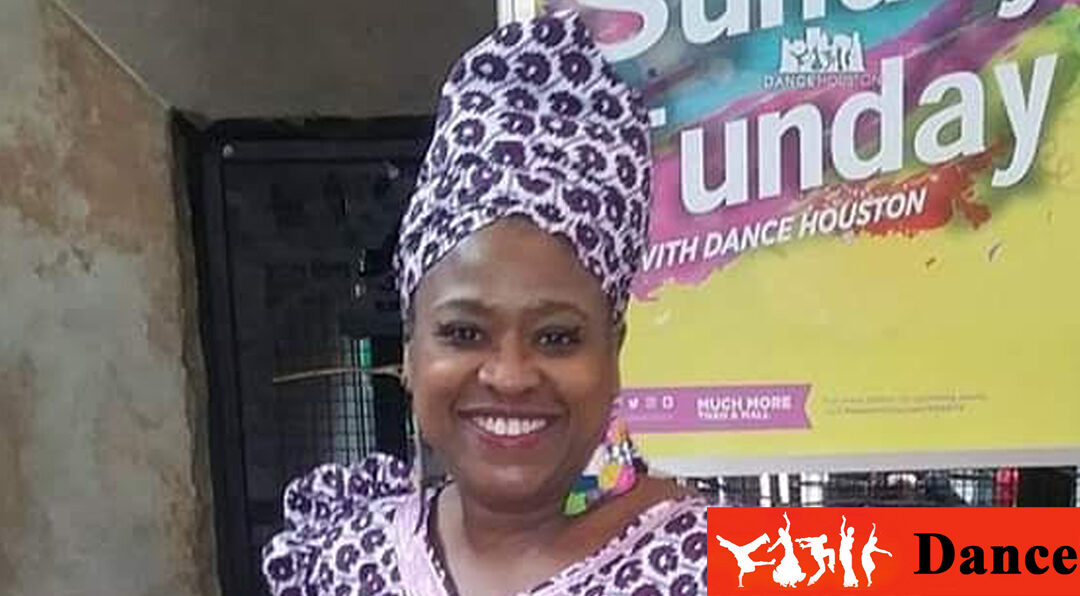
Tracie Jackson talks about West African dances as reflections of every day village life that adapted and transitioned through slavery to provide powerful experiences of release and healing. Follow Tracie at https://www.facebook.com/tracie.jackson.336 and her company Intuitive African Dance and Drum Culture at https://www.facebook.com/Intuitiveafricandance and https://www.instagram.com/intuitiveafricandance/
DanceTalks with Tracie Jackson: Full Transcript
Hosted by Andrea Cody, Director of Dance Houston. Originally released June 29, 2020. This transcript was generated automatically and may contain small errors.
Episode summary (SEO)
On this episode of DanceTalks from Dance Houston, host Andrea Cody talks with Tracie Jackson, director and co-founder of Intuitive African Dance and Drum Culture in Houston and an adjunct professor teaching West African dance at the University of Houston. An attorney originally from Cincinnati, Tracie took her first dance class in New Orleans in 1995 with Ausettua AmorAmenkum and fell in love with traditional West African dance and drumming. She explains how rhythms from Guinea, Mali, Senegal and Ghana were created to mark everyday village life, from planting and harvest to marriage and rites of passage; how the djembe player’s break signals dancers to change steps; and how the ballet style of national companies like Les Ballets Africains brought village dances to the stage. She also talks about performing Yankadi and Macru with the Houston Symphony, taking online classes during the quarantine, leading a healing class in Emancipation Park, and how African rhythms traveled through the transatlantic slave trade into tap, gospel, jazz, capoeira and New Orleans’ Congo Square. Recorded June 20, 2020.
Key takeaways
- Remember why you’re dancing. Traditional West African dances are rooted in specific meanings, and Tracie tells her dancers their movement should express that meaning.
- Listen for the break. Dancers don’t count to eight; the lead djembe player’s break signals when to change to the next phrase.
- Get grounded. West African technique starts with bent knees and real core, glute and quad strength, which takes work for people who didn’t grow up moving that way.
- The rhythms traveled. Carried through the slave trade, African polyrhythms live on in tap, gospel, jazz, Caribbean and Latin music, and capoeira.
- Flow through the moment. Tracie’s mantra is to relax and float with the waves rather than fight them, so your creative process stays broad and flexible.
Transcript
This transcript has been lightly edited for readability: filler words and repeats were removed, and several passages that could not be heard clearly in the recording were left out.
[0:00] Introduction
Andrea: Hello and welcome to DanceTalks. I’m your host, Andrea Cody, and today is June 20, 2020. My guest is Tracie Jackson. Tracie is the director of Intuitive African Dance and Drum Culture. She’s also an adjunct professor in the University of Houston dance department, teaching West African dance. Tracie, welcome to DanceTalks.
Tracie Jackson: Well, hello, Andrea, thank you for having me. I hope all is well.
Andrea: It is. Thanks for being here. Tell us about yourself.
Tracie Jackson: Okay. I am the director and co-founder of Intuitive African Dance and Drum Culture. We’ve been here in Houston for 13 years. I’ve been teaching traditional African dance and performing in the city for about 12 years, and I just finished my first semester as an adjunct professor in the University of Houston’s dance department. That was exciting and fun.
[1:00] Learning to dance in New Orleans
Andrea: Great. How did you learn the dances?
Tracie Jackson: I started learning back in 1995, after I finished law school, got married and moved with my then-husband to New Orleans. I befriended Ausettua AmorAmenkum, who at that time was, and still is, a teacher of dance at Tulane University. She teaches traditional West African dance and hip-hop, and she would invite me to her classes. I had never taken a dance class. I think I may have seen one performance when I still lived in Cincinnati, where I’m originally from, but that was it. I went to get a great workout. I just said, okay, let me go move, and I absolutely fell in love with it, and I’ve been going ever since.
[2:02] Classes, workshops and performances
Andrea: Very cool. Tell us about the different things your company does.
Tracie Jackson: Up until the pandemic started, we had been teaching a weekly community class, which started in 2008. So we teach classes, we do performances, and we do workshops for various groups: schools from preschool through elementary, middle and high school, colleges, as well as corporate classes and events.
Andrea: What are the educational programs like?
Tracie Jackson: Basically, they come in two forms. We can do a drum and dance interactive workshop. We usually do those for schools and colleges, because that way the participants have an opportunity to get up and participate. They learn basic techniques on the drums. We take a bunch of drums, shakers and the cowbell, and we give the participants an opportunity to learn some basic techniques, and we do the same with the dancing. People can get up, and we teach them a few moves to the rhythms. We also teach them the history of the rhythms, and everybody seems to enjoy that.
Andrea: Cool. What’s your typical performance like?
Tracie Jackson: Let me back up. We perform traditional African dances from West Africa, a region which I believe has 16 independent countries. Our genres of dance come mainly from Guinea, Mali and Senegal, and a few from Ghana. People contact us for performances for different events: birthday parties, baby showers, weddings, you name it. Depending on the event, we try to tailor our performance to provide specific meaning for that occasion. Our performances last anywhere from 15 or 20 minutes to an hour. It all depends on what the person or the school wants; we cater to the needs of the event planner.
Andrea: Wonderful. What would you do at a wedding?
Tracie Jackson: At a wedding, two particular rhythms come to mind. They are always performed together: Yankadi and Macru. The rhythms are specific to choosing and solidifying a relationship with the person you have chosen. They are danced by both men and women. In Yankadi, you choose your mate and that choice is reciprocated, often with a scarf tied around each person, and then Macru celebrates that union. So that’s an example of a rhythm we would do for a wedding.
[5:07] Personal style
Andrea: Cool. How would you describe your personal style?
Tracie Jackson: My personal performance style? Dancing is athletic, so you have to keep your body conditioned. And being a director and a teacher, you’re multitasking, so my performance style has definitely been a work in progress over the years. During this quarantine, I’ve had more time to focus on my own performance, because there are no regular classes going on. I’ve had the opportunity to take a lot of classes online from different teachers and really pay attention to myself. I took one of my mirrored closet doors off, brought it downstairs and set it up against the wall in my living room, so I can really look at myself and see what to work on.
Traditional West African dances are what I would call spirit-filled, because they are rooted in specific meaning. I think it’s very important that your movement resonates with the meaning you’re trying to express. I always tell my dancers, remember why you’re dancing. Remember the meaning of the dance. Some people you look at and think, oh my God, how can they move so fluidly? And some people may have the technique down, but they haven’t released. You can get lost in the sound of those drums and just let go. These dances are centuries old, and they were designed to symbolize everyday living situations in the villages and communities, some of which are rooted in spiritual or religious beliefs. That’s where it comes from, and you kind of surrender to that. You get lost, and your body is on autopilot.
[8:26] Quarantine and online classes
Tracie Jackson: Before the quarantine, most of my work as an attorney was done at home anyway, even though I do have an office I can work out of. My practice doesn’t require me to be in court often; I do a lot of brief writing, and you can do that anywhere. So I was accustomed to being at home. It’s different now, because before, I was still running around with my boys when they were in school, and now I don’t have that, so I’m filling the void by taking additional classes.
Andrea: Awesome. Who have you been taking classes from?
Tracie Jackson: Oh, man. I call it the quarantine blessing, because with Zoom and Google Meet, you can take classes with anybody, anywhere. Youssouf Koumbassa is a big teacher from Guinea. Another teacher, also from Guinea, has played and danced on Broadway. Djeneba Sako is from Mali; she’s great. Within the West African region there are different genres of traditional West African dance, and each country has its own style. We deal with the djembe and the dundun drums, but in other countries, like Senegal, they also have the sabar drums. So it gives me an opportunity to take classes from people I don’t get to travel to. Even if I get to travel to New York and take classes, that’s one time out of the year. Now I’m taking three classes a week.
Andrea: Cool. And when we were talking before, you mentioned you’d taken a class with Debbie Allen’s program.
Tracie Jackson: Yes. During this time, Debbie Allen has been showcasing the classes she offers online, and I’ve been able to take Katherine Dunham technique classes. I think she also has someone who teaches West African dance, in addition to other genres. So it’s just been a blessing. All of a sudden, we have access to all of these people.
[11:58] Katherine Dunham technique
Andrea: Right. Will you please tell us about Katherine Dunham technique?
Tracie Jackson: Katherine Dunham, as we know, is one of the foremothers. Pearl Primus would be the other foremother who started bringing traditional African dance to the forefront in performance. Katherine Dunham was actually an anthropologist and studied extensively in different countries. Haiti, I know, was one, and I believe she spent time in Africa as well. Her technique is basically a conditioning technique that helps strengthen the body to move in that spirit-filled way. For example, in Haiti you have a lot of Orisha dances that were carried over through the transatlantic slave trade, which definitely deal with spirit entities; it’s a religious art form. So your body moves in a snake-like way, and her conditioning exercises basically loosen up your muscles, your spine and your hips to allow you to move in that manner.
Andrea: Undulation.
Tracie Jackson: Yes, undulation. Yes, yes, yes.
[13:10] Why the dances were created and how they traveled
Andrea: Great, thank you. Will you please tell us about the history of the different dances from Africa that you’ve learned about: where they’re from, why they were created, and why they’ve traveled and stayed with us?
Tracie Jackson: Okay. Again, these rhythms are centuries old. Traditionally, they are always accompanied by percussion, by drumming. The dances and rhythms were created to symbolize everyday living situations. You have dances that symbolize planting and harvesting food. You have dances, as we discussed, for choosing and marrying. You have dances for preparing a woman to give birth. You have rites of passage dances for children. As children aged into young adulthood, in traditional times they would be taken from their families and basically have classes: now you are about to become a young woman or a young man, and these are the things that are expected of you now. You are no longer expected to do these other things. They were taught what their responsibilities would be. So there were dances to protect the children spiritually while they went through that process, dances that encouraged them during the process, and dances performed after the process was over. And of course there are spiritual and religious dances.
One of the beauties of this art form is that it traveled. As the slave trade traveled, the enslaved Africans took their music and their movements with them. I have a map that I use in some of my workshops that shows the enslaved Africans went to Europe, the North American continent, the South American continent, basically everywhere in the world.
What happened was that their traditional music and movements either transitioned, as I would say happened here in the United States, or fused. In the United States, the drum was forbidden, with the exception of one city. But in other countries, the drum joined the other musical instruments being played by the people who lived there, so the genres fused. The polycentric movements and the polyrhythmic sounds fused with what already existed. In this country, because the drum was forbidden, the enslaved West Africans transferred the drum rhythms they couldn’t play to their feet: tap dancing, the fast syncopation of tap. If you think of gospel music, those rhythms were transferred to voices or instruments. Think of Louis Armstrong, who of course wasn’t enslaved, playing his horn and taking one note and creating a thousand from it. That’s how it came out in this country. In other countries, whole new genres were born, like steel drumming in the Caribbean, and rumba and salsa in Latin American countries.
That is why I think everybody can benefit from learning something about this art form, because no matter what music genre you like, there’s something that connects back to these rhythms.
[18:06] Dancing with the Houston Symphony
Andrea: Do you hear African rhythms in classical European music?
Tracie Jackson: You do: again, the polyrhythms, the way the music is arranged. It’s so interesting that you say that, because I guess about six years ago we were invited by the Houston Symphony to do a performance with them. They have an educational series every year, and that year had an African theme, and they wanted dancers and traditional African drums to accompany the symphony. I said, oh my God, how is this going to work? And then they said, we only have one rehearsal. But we actually did Yankadi and Macru, because those rhythms are also played on the balafon, and the balafon is basically a precursor to the xylophone. They wanted rhythms that could be played by the orchestra, and it turned out that we were dancing to a symphony with traditional African drums.
Andrea: Was that music a fusion of African and European genres, or were they playing European music with those instruments?
Tracie Jackson: They basically patterned their musical arrangement around the drum.
Andrea: So it was a new song, taking the drums and adding all the other instrumentation.
Tracie Jackson: Yes, yes, yes. It worked out really well.
Andrea: That’s beautiful. And then you got to dance to it too. What was that like?
Tracie Jackson: It was amazing. It was well received. I was extremely nervous, because first of all, the timing: the symphony plays a little slower, and we only had one rehearsal, and we actually had to do two shows. But it turned out very nicely.
Andrea: Did it change your dance style?
Tracie Jackson: No, we performed the traditional movements.
[20:55] The djembe and the break
Andrea: What were those rhythms again?
Tracie Jackson: We did Yankadi and Macru.
Andrea: How do they go?
Tracie Jackson: Okay, so with the drumming, you have your djembe player. The djembe is an hourglass-shaped drum played with the hands, and the djembe player is the lead drummer. He leads the drum ensemble, and he also signals the dancers when to start and change by playing what’s known as the break, or the call. The dundun drums are played as a set of three, sometimes all by one person, and sometimes broken down so that one person is playing each of the three. Macru is the follow-up rhythm for Yankadi, and it has its own break.
Andrea: Oh, cool. So do those rhythms repeat for the whole song?
Tracie Jackson: Yes. You have the basic rhythm, but there’s room for the drummers to put their own creative style into it, as long as they stay within the timing. Think of the lead djembe player as the lead vocalist of a choir. The lead vocalist will go everywhere, and the choir is the background. It’s the same with the drums: the dundun player is the foundation, and the lead djembe player has license to go wherever he wants. You’ll also have djembe players who accompany the lead and play a steadier rhythm, and the lead djembe player goes everywhere but comes right back when it’s time to change your step.
Andrea: So when they play the break, is that when you’re supposed to tune back in and listen for what’s next?
Tracie Jackson: Your ear is trained. In performances, we don’t perform to counts. It’s not five, six, seven, eight; you’re listening for the break. Within the phrase between breaks you may have several different movements, and when you hear the break, it’s time to change to the next phrase in the choreography.
Andrea: Oh, okay. So in the middle, is it somewhat trance-like, like you’re just in that moment?
Tracie Jackson: You’re dancing, you’re moving to the rhythm, and you have your choreography. When you hear the break, you change to the next movement.
[24:36] Signature steps and ballet style
Andrea: So that tells us a little bit about your creative process too. You have a plan, an order.
Tracie Jackson: Yes. There are specific movements to each rhythm. If you see somebody dancing and you see a particular movement, you’ll be able to identify the rhythm: oh, that’s Dundunba. Each rhythm has specific movements that are unique to that rhythm. Now, when you go to the villages and see the village people dancing, they may only have two or three or four movements, but you’re going to see the signature steps.
The teachers I’ve learned from, whom I refer to as master artists, come from different countries in the West African region and performed with the professional national dance companies. For example, Les Ballets Africains was the national touring company. What they did, since they came from different countries in that region, was go around to all of those countries, learn the traditional dances, and make them presentable for stage performance. They embellished them and called it ballet style. But there are traditional movements within that style that help you identify, oh, that’s Lamban, or oh, that’s Soli. Each rhythm has its own movements, if that makes sense.
Andrea: Yeah, it does. So going from a village onto the stage in ballet style, how does it change the dance?
Tracie Jackson: Basically, the ballet style incorporates all the traditional movements but adds to them to make it dramatic. When you see things with the hands, and twirls and turns, that’s ballet style. Choreography, basically.
Andrea: Do you do that when you perform?
Tracie Jackson: Oh, absolutely, because that’s who we’re learning from. We’re learning from those choreographers.
[27:42] Master drummers and learning by ear
Andrea: Who are some of the master drummers you recommend?
Tracie Jackson: Wow. Well, one was here in Houston up until 2008. He’s from Guinea, and I believe he’s in Rochester, New York, now: Mohamed Diaby, a wonderful djembe player. Mangue Sylla teaches djembe and dundun classes. He’s from Guinea, and I think he lives in New York also. M’Bemba Bangoura is a wonderful djembe player. All of these guys are having online classes now, so you can find out their schedules. It’s a wonderful opportunity, because there’s no formal notation for this art form. There are no notes you can study and play like when you’re studying piano. It’s by ear.
And like anything you’re learning, I tell dancers who’ve never taken a dance class before: you didn’t always know how to walk. When you first started walking, you fell a lot of times. So don’t get discouraged; keep practicing. My sons, who are now 18 and 20, have basically been drumming for 15 years, because I started them when they were five or six. When I went to classes, I would make them sit with the drummers. I bought them a drum, and ten years later they’re in class, and I’m listening to my youngest son play the breaks for all these rhythms. I’m like, oh wow, he just soaked it in. The same with the dancing; that’s how I learned when I was in New Orleans, taking classes with Ausettua. Now I travel to different conferences, or I bring master artists to town and we have classes.
Andrea: Awesome. Do most drummers specialize?
Tracie Jackson: Most drummers do specialize, but they usually know how to play both. My sons can play both. My oldest prefers the dundun, and my youngest is the djembe player.
[29:53] A healing class in Emancipation Park
Andrea: Awesome. What have you been doing, aside from taking classes?
Tracie Jackson: I taught a class in the park a couple of weeks ago, in Emancipation Park here in Houston. With all the tension going on, on top of being in this forced isolation, or forced state of stillness, as I’ll call it, I think people were uneasy and anxious, experiencing all kinds of emotions. I know I was. I’ve been doing this art form for 25 years as a student and a professional, and it’s my go-to self-care. It’s like, oh, I need to dance, I need to hear the drum. So I put on this class simply for healing and releasing, for people to come together and hear the drums. We danced two rhythms, Kakilambe and Dundunba.
Again, the beauty of this art form is the meaning of the rhythms. Kakilambe is a spiritual rhythm; I hesitate to say religious. If you see this rhythm performed, you’ll see a mask dancer who represents a spiritual energy that comes at a consistent time, I believe once a year, and when it comes, people go to the forest with their offerings, asking for blessings. We do the same thing in church. I don’t know what religion you may be, but it’s like when the pastor asks you what you want. So I chose that rhythm because I wanted people to set their intentions. There’s a lot going on in this world that needs to be corrected. For yourself as an individual, for your family, for your community, what do you want to see change? What do you want to see happen? Be clear, and ask for those blessings.
Then we followed up with Dundunba, a rhythm performed as the men go off and prepare for war. We have challenges in our lives every day; it feels like war. So I used Dundunba to help people get their strategy and their tactics down: how are you going to tackle this? You have your intentions, and now we’re putting them into action. That tells you how astonishing these rhythms are. They’re centuries old, born in a time when we didn’t have computers, cars or electricity, when everybody had to plant and harvest their own food and go kill the goat or the cow or the chicken. But the meaning behind the rhythms can still be applied today, and that’s profound to me: that you can use dance and drumming to help propel you through situations. That’s what I try to use the art form for.
Andrea: Powerful. When you were at Emancipation Park doing this, what were you asking for?
Tracie Jackson: I was asking for clarity. I was asking for resolution. I think this forced stillness gives us an opportunity to go within. My prayer for the world, and it has been for a long time, is that each person just looks in the mirror, like the Michael Jackson song “Man in the Mirror,” and goes inside and deals with their unhealed traumas. If everybody did that, what kind of ripple effect would that have on the world? Everybody has some type of trauma from childhood. Maybe you were the younger child and thought you weren’t treated as fairly as the older child, or your parents didn’t take as many pictures of you as a baby, and you internalized that. Something that small can affect your behavior as an adult. So if we just look inside and reevaluate the conditions we grew up in that shaped how we see things, we might say, oh, maybe I have engaged in this behavior. It wasn’t intentional, but now I can see how it may have been perceived. Those are some of the things I was thinking while we were in Emancipation Park. It was two o’clock on a Sunday afternoon, and everyone thought it was going to be blazing hot, but we were under shaded trees and there was a constant breeze the entire time. I took that as confirmation that this is something good.
Andrea: It sounds like it was really wonderful, and right on time.
Tracie Jackson: Yes, absolutely.
Andrea: Are you going to do it again?
Tracie Jackson: We might. One of my drummers is out of town for the summer, and my oldest is on an internship, so that’s always the issue: you’ve got to find drummers. We’ll see if I can find some.
[37:03] African dance in today’s culture
Andrea: How have you seen African dance take shape in our culture since you came to it, in how people understand it, get involved with it or react to it?
Tracie Jackson: From our experience performing in front of very broad audiences of every ethnic group and race, it is very well received by adults and children alike. People really, really love the drumming. And over the years I’ve seen more and more of the traditional rhythms and drumming styles incorporated into entertainment: artists, movies, television shows where there may be an African dance class going on in the background. So it’s definitely coming to the forefront. I’ve had educators at every level, and in the dance community the students and teachers are looking to broaden their dance training into different genres. Ballet and modern are important as well, but people want a broader foundation.
The class at U of H was very well received. The students told me they had never had a class like this. They couldn’t have their annual spring show, where the seniors produce choreography, so one of the professors came up with the idea of having them video a choreographed piece, and we had a Zoom meeting where the pieces were shown. It was beautiful and so creative, and several of the students choreographed an African dance piece. I was very proud and pleased that they received it and liked it enough to choreograph a piece to some of the things they had learned.
Andrea: Cool. I can see what you’re talking about, with it coming to the forefront. Dancers want that versatility. They see it, so they want it, and it’s within reach because you and people like you are giving it to them, and there’s a pathway. So You Think You Can Dance might not be around when you grow up, but The Lion King Broadway tour is probably going to be around for a long time.
Tracie Jackson: Right. Like we’ve already discussed, the polyrhythms are universal. It’s there, it’s comprehensive, and people can use it as a foundation or explore more of the traditional styles.
[41:36] Technique: rooted and grounded
Andrea: I question my own idea that African dance is very improvisational, free-spirited and spontaneous, and yet there’s this choreographic element. I don’t know if that’s just for stage productions or if it’s in the root. Can you tell me more about that in the traditional way, and how you personally go between the two?
Tracie Jackson: Okay, so there’s definitely a performance style, and then there’s learning, of course. I would start with the basic technique of African dance. An analogy would be ballet, where your body is up and moves as one unit. If you’re up, your whole body is going one way; you’re leaping one way. In contrast, in traditional African dance, as I’ve already described, you’re rooted. Your initial stance, going back to the Katherine Dunham technique, has a bend in the knees, which allows your back and your shoulders to move in all of these ways. You’re grounded.
And yes, there is definitely technique, because remember, each rhythm has specific movements unique to that rhythm. For example, when I was in Guinea, we went to what is called a Dundunba circle. A drum and dance circle is what I refer to as the original Soul Train line, except you’re in a circle, with a bunch of drummers at the top of the circle and everybody else around it, and people jump out there and start dancing. They were dancing, and I couldn’t recognize the rhythm from how the drummers were playing. Then a dancer hit a movement, and I said, oh, I could tell by what she was doing what the rhythm was. So there are very specific movements, and to execute them and make them look spirit-filled, you have to get that grounded feeling. If you haven’t been doing West African dance, like me when I started, that’s hard, because we don’t walk like that. We don’t walk with a bend in our knees; we walk with our legs straight. Getting accustomed to that position and having the core strength, with your glutes and quads strong enough to hold your body while you do all this, is some work.
So there’s a choreographic piece, but there’s also very much a technique. Take Dundunba, which we danced in the park: look at your arms. The dance is for men preparing for war, and these dances mimic what you’re doing. If you’re harvesting food, what are you doing? You might have a pick or some tool, so your dance movements will mimic that. Same with the animals that are around; your body imitates their movements. That’s where the technique piece comes in.
[46:20] Dancing at home
Andrea: Cool. So how have you been dancing at home, and how has it helped you?
Tracie Jackson: Like I said, I’ve been taking classes, and I put my mirror up so I can look at myself. Teaching dance online is different from teaching in a studio, because you have to keep your students’ attention. So basically we’re doing movements over and over and over again, and that has improved my memory for the movements. After doing this for 25 years, I can hear a rhythm and recall the movements to it. But not everybody can; if you’re just starting, you won’t be able to do that yet. So when you’re trying to learn these rhythms, this is a wonderful opportunity, if you have the time, to take classes. I’ve been taking about three a week.
Andrea: I’m pretty sure we have time. So tell us why we should do it.
Tracie Jackson: Well, first of all, you’re moving your body. Let’s start with that. In my opinion, there’s no better detox than a bunch of sweat. And then it depends on your level of interest in dance, period. Some people just want to come and move. When I first started, I was not interested in being on stage or having a dance company. I just wanted a fun workout. And this was different, because what dance workout do you do to live music? But as I learned more, it started going in different directions for me. Not everybody wants that. Some people just want to move, and some people want to do something different when they move. And of course, if you’re a performer or want to teach, this is an opportunity to study.
[49:06] Personal motto
Andrea: Great. What’s your personal motto?
Tracie Jackson: My personal motto right now, my mantra, is “I’m flowing through the moment,” because there are a lot of things going on that we can’t control. I think about being in the ocean, floating on my back, with the waves kind of beating you up. But if you relax and don’t fight it, you stay above water. You’re still breathing air and you’re moving. It might be a little choppy and a little uncomfortable, but if you just relax and go with it, you’re going to be all right. So that’s my mantra: flow with it. Don’t tense up and don’t get aggravated, because that constricts your creative process. It makes you narrow instead of broad, and we have to be thinking broadly right now, because things are so dynamic and change every day depending on what’s going on. You have to stay flexible.
Andrea: The world is so different now, in the blink of an eye.
Tracie Jackson: In the blink of an eye. And we’re not going back.
Andrea: No, I don’t think so.
Tracie Jackson: It’s a challenge. I think there’s a way to have performances; it’s just going to be different. Who doesn’t enjoy going to a concert to hear their favorite vocalist? You might be doing that from your living room now. You have to stay flexible, because there are challenges. Even hooking up this call today, we had some challenges with the sound. If you’re uptight, you won’t be able to overcome these unknown challenges that come up.
[51:30] Performing in the near future
Andrea: Do you have any ideas of what you can do as a performer in the near future?
Tracie Jackson: The example I gave of what U of H did was flawless. They invited their families, because these were the senior dancers, and people were commenting while we were watching. I think this is a viable way to do it. It was seamless, a beautiful presentation. You got to know a little more about the students, and you got to see their artistic, creative process in their productions.
Andrea: I love that it generated all that communication among the audience and with the artists.
Tracie Jackson: And they were watching too, right along with everyone, and they invited people to come. So that’s one way.
Andrea: The drum seems pretty ideal right now, because it’s loud and it doesn’t need electricity. You can space out pretty much anywhere and get it going.
Tracie Jackson: Yes. My son went to the park last night, actually, for Juneteenth. Some of the boys are going to go and just drum for the Juneteenth celebration. We do that sometimes; they just go out and drum, and people come and sit and listen, and sometimes people ask, can I get on and try?
[54:34] Congo Square and New Orleans
Andrea: Cool. Would you please tell us about the history of how you think African dance came through the transatlantic slave trade and slavery?
Tracie Jackson: Well, it’s really fascinating. The map I have shows everywhere the enslaved Africans went: Europe, the North American continent, the Caribbean, South America. And in New Orleans, you have to remember that Louisiana was not always owned by the United States. At different times during the slave trade, it was owned by the French, the Spanish or the United States. Under Spanish and French rule during slavery times in New Orleans, on Sundays the enslaved Africans had the day off, and they could congregate in what’s now known as Congo Square, in Louis Armstrong Park. It’s still there. They could play their drums, dance their dances and sell their wares. That was their free day.
I lived in New Orleans for 10 years, which is where I was introduced to this art form on a dance level, and you can feel it in that city. You can walk the streets of New Orleans and it speaks to you. African dance in that city is very much alive and well today, because it was allowed during slavery times and it continued, unencumbered, even after the slave trade ended. Traditional dances from Haiti and from the different places people migrated to New Orleans from continued. In New Orleans you’ll find children who not only drum, but walk on stilts and do cultural masking dances for different celebrations and ceremonies. It continued there with the children, and that’s very important. It shows you how something can continue if it’s nurtured. In the rest of the country, the drum was forbidden, so you didn’t see African dances in other cities. That’s why New Orleans had this mystique about it, and everybody who visited would say, ooh, it’s so different, because those cultural dances and practices were allowed to stay in place and manifest.
[57:52] Dance as release under oppression
Andrea: Wow. How do you think repression affected the power and meaning of the dance?
Tracie Jackson: Oh, it intensified it. I don’t know if you’re familiar with capoeira, the martial art. I don’t know if you know it originated out of African dance. The enslaved Africans started engaging in the movements to release themselves from bondage, literally, and they created the movements you see in capoeira, which evolved into movements that became very fluid and dance-like, with their own music. Dance and drumming were a way to relieve that, and you might not find this in textbooks, because this art form isn’t discussed like that. Let’s be real about it. As I mentioned, the balafon is the precursor of the xylophone; it looks just like a xylophone, except it’s wooden. And the enslaved Africans mastered the fiddle and other instruments, and they kept dancing and singing, as we know, on the plantations, usually as entertainment for the slave owners and their families. But it was a way to escape the oppression in a demonstrative way. You can move your body, and they don’t know what it means unless you explain it to them. I really believe that’s why I’m here today, because in that system, while millions and millions of people died, millions more survived and kept reproducing, even under those conditions. So I think this art form is very, very powerful. I have even seen animals react to the sound of a drum, at a birthday party for a toddler at a residence. That’s how I know it resonates with anyone.
Andrea: It’s a hard-earned treasure.
Tracie Jackson: It is definitely a blessing. I believe in everything there’s a blessing. We may not understand it at the time, because some things can seem so horrific, just like what we’re in now. May he rest in power: George Floyd’s death has ignited conversation, protest and people speaking out. But more importantly, I think people are actually starting to talk with each other about some difficult subjects, and that needs to happen. If we’re going to seek a resolution, those conversations have to be had, so at least there can be an understanding.
[63:12] A family reunion
Andrea: That power of dance is still so present, and it’s so wonderful that you’re sharing it.
Tracie Jackson: I knew that even before I started a company. When I was still living in New Orleans, I hosted a family reunion for my dad’s side of the family, and I had my teacher’s dance company perform. An elder relative came to me crying, and she said, I want to thank you. Pretty much no one in my family had ever seen African dance. As African Americans, we’ve been cut off from that history, that African culture. She thanked me and said, my adult daughter has been going through such a hard time, and I have not seen her smile in months, and my daughter smiled tonight. I just want to thank you for that. So even before I knew I would be performing or teaching dance at a college, none of which ever came into my head, I knew at that moment how powerful this art form was.
[65:14] The pep talk
Andrea: Awesome. When you prepare your sons or your students to get out there and perform the way you want, what do you tell them? What’s their pep talk? Let’s close with that.
Tracie Jackson: I tell the dancers that we are here to put a smile on someone’s face or to make them feel something. Artists tend to be hams sometimes; I call them dancing divas, and that’s fine. But I always urge them to remember that we’re here for a higher purpose, and if you concentrate on that, all of your needs will be taken care of. They will flow to you under that umbrella.
Andrea: My guest today is Tracie Jackson. Tracie, thank you for being a part of DanceTalks.
Tracie Jackson: Thank you, Andrea. It was fun.