
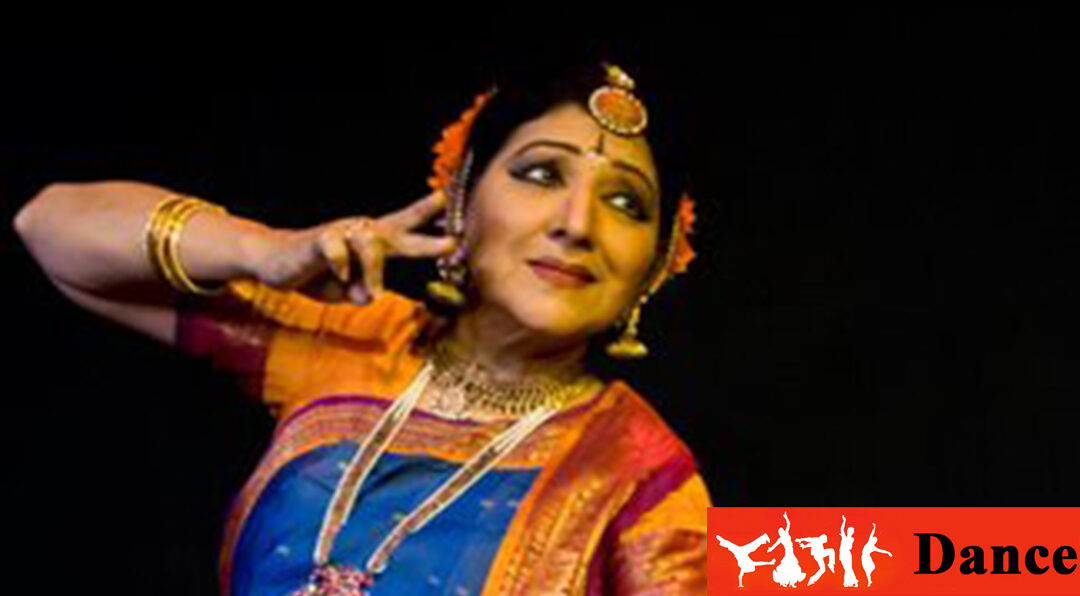
Rathna talks about Indian dance history and how it’s significance has changed throughout time. Follow her at https://www.instagram.com/rathnapapa and https://www.facebook.com/rathna.kumar.313.
DanceTalks with Rathna Kumar: Full Transcript
Hosted by Andrea Cody, Director of Dance Houston. Originally released April 22, 2020. This transcript was generated automatically and may contain small errors.
Episode summary (SEO)
On this episode of DanceTalks from Dance Houston, host Andrea Cody talks with Rathna Kumar, the Bharatanatyam and Kuchipudi dancer, choreographer and teacher who founded the Anjali Center for Performing Arts in 1975, the first Indian dance school in Texas. Rathna describes arriving in Houston as a young touring performer and English professor, when fewer than 500 Indians lived in the city, dancing at the Houston International Festival (then the Main Street Festival) and with the Cultural Arts Council of Houston, and turning down a PhD in English when Indian families begged her to teach. She shares the advice of her teachers, K.J. Sarasa in Bharatanatyam and her Kuchipudi guru, that art and knowledge are meant to be given away; her decades as a Young Audiences of Houston teaching artist; chairing Mayor Bob Lanier’s arts task force on cultural diversity; serving on the Miller Outdoor Theatre advisory board; and her nomination to the Texas Women’s Hall of Fame. Rathna also tells the history of the Devadasi temple dancers, learning abhinaya at 12 from an elderly Devadasi, Rukmini Devi’s revival of the form, the arangetram as a rite of passage, and the story of Bharata and the Natya Shastra. She closes with her favorite quote, “Everything passes; art alone, enduring, stays to us.” Recorded April 19, 2020.
Key takeaways
- Art is meant to be given. Rathna’s teachers told her that knowledge and art can’t be taken to the grave, and that sharing them only makes you more knowledgeable.
- Teaching makes you a better dancer. When you teach, you can’t afford to get slack, because your students are copying exactly what you show them.
- Light the fire early. Rathna believes every child should be educated in the arts, at least enough to gain tolerance, appreciation and love for them.
- Dance with your mind, not just your feet. Her teacher pushed her to choreograph and think for herself, because correct technique without understanding has no soul.
- Pass the torch. Every teacher has a responsibility to create others with the same passion, so the art keeps lighting new lives long after we’re gone.
Transcript
This transcript has been lightly edited for readability: filler words and repeats were removed, and several passages that could not be heard clearly in the recording were left out.
[0:00] Introduction and coming to Houston
Andrea: Five, six, seven, eight. Hello and welcome to DanceTalks. Today is April 19, 2020, and my guest is Rathna Kumar. She is the founder of the Anjali Center for Performing Arts, started in 1975. Rathna, thank you for being a part of DanceTalks.
Rathna Kumar: It’s an honor and a pleasure to be on this. Thank you so much.
Andrea: Thanks for being here. I’m so excited to get to know you even better. Would you tell me about your journey from India, when it happened and how you did it?
Rathna Kumar: Well, I was very reluctant. I came as a visitor to the U.S. at that time, and I kept thinking that I was going to be a visitor, that I would be returning, because I was in my 20s and at the peak of my career. I was traveling the world performing. I was very well known; I had danced for presidents and prime ministers, and I was living it up. I was part of a very well-known theater group. My world was dance, and I was an English professor in college, so my world was teaching, dancing, traveling and performing, and very carefree. But I realized soon enough that I would have to settle down sometime. Luckily, I got married to someone I knew very well, who was into theater himself, loved music and dance, and was so encouraging. If I am where I am today, it’s because of Anil, my husband, who went out of his way to make sure that I did not lose anything by moving to what was, at that time, an unknown land for me. There were less than 500 Indians in Houston when I arrived.
I had very long hair, and people used to keep touching it, saying, “Is this real?” And they would be surprised that I spoke good English. They would ask me, “Where did you learn this language?” and I would tell them, “In India.” People thought that maybe people who came from India didn’t speak English. Some didn’t, of course. But it was a lot of fun. My husband’s friends owned the first Indian restaurant in all of Texas, called Maharaja, and I used to walk around there. In those days you could walk anywhere, and I made friends with all the businesses around. It was a wonderful place to be. I felt so welcomed that pretty soon I was not missing home anymore, though the first week I cried so much that he wanted to send me back. But I did not go. I’m not somebody who regrets actions. I knew I was going to get married and move, and so I made the best of whatever life gave me.
[3:28] Finding a place to dance
Rathna Kumar: I didn’t ask for much. I just wanted to continue dancing; that was the only thing for me. The Houston International Festival was the Main Street Festival then, in ’75, and I called and said, “I want to dance.” I was dying to dance. I used to go to class every single day and practice for hours, and I couldn’t sit at home not dancing. So I called anything possible. They were starting what is now the Houston Arts Alliance; it was called the Cultural Arts Council of Houston and Harris County. I called them and said, “I want to come and join.” I read somewhere that there was an Asian festival going on, so I called Glenda Joe: “I want to be a part of this. Can I come and dance?” I was not really trying to become famous or anything. I just wanted to physically dance, so I was so happy that there were some opportunities.
And of course, the Indian community suddenly realized they had a dancer in their midst, and the mothers were calling me every single day: “Please, can you teach? Can you teach?” I really had not thought of teaching. I wanted to perform, I wanted to travel, and I wanted to do my PhD. I had even applied and been accepted at Rice University to do my PhD in English. And I had to turn it down, because when I started thinking about what was important to me, what I wanted to do with my life, I realized: what was I going to do with English? Speaking proper English I had learned already by doing a master’s. I didn’t really need the PhD to continue my dance, which was more important. So I was very aware of what steps I was taking, and I’ve never regretted that, because teaching has brought me the greatest joy and the greatest rewards.
[5:29] Becoming a teacher
Rathna Kumar: So in 1975, my journey as a teacher began, in addition to being a performer. Until then I was a performer and a choreographer, and now I became a teacher, a performer and a choreographer. And in a way an arts educator too, because many of the children who came to me were not at all connected with their Indian culture or heritage and knew very little. Their parents were working full-time jobs and didn’t have time. In India, the families are all joint families, and our grandparents or somebody would tell us the mythological stories and history, so we knew so much by the time we were out of school. These children were lacking that. So I became a storyteller, a teacher and a mentor, and I expanded their horizons by not just teaching the dance but spending a lot more time with them.
I’m so happy I did that, because in the process I learned a lot. I learned what it is to teach. Teaching English is very different: you stand and teach 100 kids. But actually getting up and teaching dance, I found out it was more difficult, because I was working with children, pre-K, K and above, not young adults like the ones I taught in college in India. It required a lot more patience, understanding and empathy, and I felt that it made me a better person. And I think my dancing improved, because while teaching you cannot afford to make mistakes. You have to do the correct thing to show them. You cannot get slack; you have to do it properly so that they have a role model and can look up and do it properly. The onus was upon me to do well myself so that I could inspire my students to do well, so I used to practice a lot to be good enough to teach. It was a wonderful experience to be given that opportunity and that honor, to have brought the first Indian dance institute to Texas and the Southwest of the United States. I will die with pride in my heart that I was able to use my own Indian artistic background to enhance the art scene of Texas and beyond, and make some small difference in the growth of the arts in this country. I’m very proud of that.
Andrea: I’m so glad you’ve done it. You opened your school five years before I was born, and I grew up celebrating diversity. That was the motto in this town; “celebrating diversity” was all over our middle school walls. So thank you for preserving and spreading this amazing, beautiful thing that you do.
[9:36] “Art is meant to be given”
Rathna Kumar: Thank you. I was raised in an extremely liberal family, where my parents and grandparents believed that art should be shared, that you cannot possess art or be possessive about it, and that it is meant to be given. Before I started my school, I was so scared. I said, “Oh my God, do I have the knowledge? Am I capable of teaching dance? Is this something I should even be thinking of?” So I called both my teachers, because I wanted their approval and their permission. In India, teachers are next to God. I would never question my teacher; if they told me to jump in the well, I would have jumped into the well. And in different words, both of them said the same thing.
I had only one teacher for Bharatanatyam, since I was four years old, my entire life. I never went from teacher to teacher, because she was so good. When I called her and said, “Please, teacher, tell me. I’m getting so scared. I’m only in my twenties. I always thought of teachers as older. What knowledge do I have to teach?” she said, “What is the point in your having studied since the age of four, so many years, if you do not want to share it with anybody else? Do you just want to keep it to yourself and dance, and that’s it, over? That’s not right. You need to think of sharing it with others.”
Then when I called my Kuchipudi teacher, he said, “Our scriptures specifically say this: when you die, you cannot take your money or your knowledge with you to the grave. Knowledge and money you should dispense with during your lifetime, because when you are gone, you don’t take any of that with you.” He said, “I think you should teach, because that way your knowledge will improve. You’re not giving anything away. In fact, you will become more knowledgeable as you give it to other people.” And with their blessings, I started. I realize it’s true. When we were kids, we used to read a lot, and we’d say, “You need to read this book,” and give it to our friends, because we wanted to share it. I feel that art is the same thing: “This is beautiful. Why don’t you look at it?” That’s how I feel when I go watch other art forms too. I’m so completely enveloped by this cocoon of beauty, love and warmth, and I think, “Oh my God, who created these beautiful things?” I feel that others should feel the same thing about Indian dance. So if I have been able to contribute, I’m glad.
[12:41] Young Audiences and arts education
Rathna Kumar: It’s strange, you were talking about sharing. Maybe I came to your middle school and performed at that time. I don’t know, because I have performed the length and breadth of Houston and beyond: The Woodlands, Kingwood and even Beaumont.
Andrea: I can guarantee you did not come to my school. I would never have forgotten it. I would have been blown away, and I would have fallen in love with Indian dance far sooner. What came to our school was a flamenco dance company, and it was just that one presentation. There wasn’t any other. We didn’t have Young Audiences back then.
Rathna Kumar: Young Audiences started in the ’80s. I was getting rid of old papers, and I found a Young Audiences catalog from 1988 with my picture, Indian dance. So from 1988, maybe around that time, I have been a member of Young Audiences. That’s when I really began believing very seriously in arts education. It’s not about getting a degree in the arts; you need to educate every child in the arts, at least to give them a tolerance, an appreciation and a love for the arts. You need to light that fire early in life. So I particularly chose elementary schools, and I don’t even remember how many hundreds and hundreds of schools I have been to. It plays a very significant role in my life: arts as a tool for educating, for informing, and not just for bettering people’s lives but for making them more sensitive.
Andrea: My K-through-12 education had that one performance, and the principal introduced them as “flamingo dancers.” The first time I saw Indian dance and world dance was in a world dance course in college, at the University of Chicago. I still have a book from that class on my shelf right next to me. She gave us books and showed us videos.
Rathna Kumar: Wonderful. That’s what I do at Rice University. I show videos. I tell them, “I teach one kind of dance, but if you think that this is all there is in India, there’s a world out there that nobody knows about, and you need to see all this.” I show them videos of different forms of Indian dance, including folk dances, just to tell them these are only glimpses of the diversity.
[15:47] The mayor’s arts task force and the Hall of Fame
Rathna Kumar: We were talking about diversity. I was on the Mayor’s Arts Task Force, and in fact I chaired the committee on diversity. Houston was becoming very, very diverse, and the communities were changing, and I think it was integral for the mayor at that time to understand that and introduce it into the arts. The forms and the requirements changed; they put in new criteria about cultural diversity, diversity on boards and diversity in programming. Cultural diversity became the buzz. I’m so glad they did that, because it gave a fillip to lots of artists like me to be emboldened, to seek more opportunities and to look for more avenues to participate in mainstream events.
Andrea: When did you serve on the task force?
Rathna Kumar: This was in the late ’80s, early ’90s. Mr. Bob Lanier was the mayor during that time. I was also on the Miller Outdoor Theatre advisory board; I was a mayoral appointee.
Andrea: Wow. What a pioneer.
Rathna Kumar: I was the first Indian woman to have been nominated to the Texas Women’s Hall of Fame. I have no idea to this day who nominated me. I got a letter in the mail, and of course I didn’t win it, because this was too early and I guess many people didn’t know me. And then decades later, Renu Khator became a Hall of Famer, and I felt so proud. I told her, “You know what? I kind of beat you to it, to the nomination, except I didn’t get it.” I felt so proud that she got it. I also got a congressional recognition, and certificates for volunteerism from President George W. Bush, Governor Rick Perry and the mayor.
[19:06] Dancing in hospitals
Rathna Kumar: I used to volunteer. I went and performed in hospitals, Shriners and Texas Children’s; I would go and dance for the children, and also at geriatric centers. I felt so bad; I said, “These people can’t get out anywhere.” So I just called up the hospitals and said I would like to come and share my dance with the patients if they were up to it, and they said, “Oh my God, how wonderful.” So I went to a bunch of hospitals and geriatric centers, the VA hospital and all these places. I didn’t tell anybody about it; I just did it. I think maybe word went around, because I got all these certificates. I felt very happy, and I forgot all about them until I found them lying inside. So I said, “Oh yeah, I forgot about this.” It’s a good time to reconnect with good memories.
A couple of kids wanted me to hug them, and I wasn’t sure. I had to ask the nurses, “Are we allowed to do that with the patients?” because I didn’t want to compromise anyone. They said, “Oh no, they’re okay. You can do that.” They were so warm, so loving and affectionate, and so willing to try. Those who were able would get up and move around and jump and kick, and the others would sit in their chairs and do the hand movements and clap. It was a very beautiful thing, and they seemed to like it, because I told them stories using hand gestures. All children love stories. Even as an adult, I still love stories. So I think that’s what they liked: the storytelling, and being able to enact the story with movements and expressions.
[21:28] The Devadasis
Andrea: Awesome.
Rathna Kumar: The solo dancers of Bharatanatyam became very famous in the 18th and 19th centuries. They mostly performed in the temples, and the moment the name of the dancer was announced, there would be a huge turnout. They were called servants of God, Devadasis. The saddest thing that happened is that they were not bad women at all. They were dancers. But during the performances, not everybody looked at them with good eyes. There were rich men who solicited their favors outside of the performance, because they couldn’t do anything in the temple; they had to behave well there. So the women became their mistresses or concubines. They were never married, so their children were illegitimate. They couldn’t have the father’s name and could not give a father’s name when they went to school; they had only the mother’s name. It was very sad. And the women never proved to be unfaithful; they were loyal to the one man who had solicited their favor. Yet the man was not ostracized for taking a mistress. The woman was. After a while they started losing favor because they got a bad name. Great artists of the highest caliber, extraordinary dancers and singers, were ostracized by society as women of ill repute.
And one of the children, the daughter of one of these women, became the first female doctor in India.
Andrea: Did you say she was the first doctor?
Rathna Kumar: First female Indian doctor, sorry. She came from this community, and she was so ashamed, because when somebody asked, “What’s your father’s name?” she couldn’t say. So she joined with the British, and all dancing was banned from the temples. These dancers were not allowed to dance anymore. They had been so famous, and the temples used to be filled with activity and beautiful dance. There was nothing wrong with it; they did worshipful dances, because it was the temple. It was a very elevated experience for the dancer and the audience. But when they lost that, they lost all their privileges and all their money. Many died in complete penury, and many starved to death.
[25:48] Learning from a Devadasi
Rathna Kumar: When I was about 12, my mother one day brought home an old lady whose one eye had been destroyed by cataract. It was white, and she could only see with one eye. My mother was very solicitous: she asked her to sit down and had the cook give her food and coffee. Then she called me and said, “Touch her feet,” in typical Indian fashion, so I touched her feet and bowed down with a namaste. She said, “You’re going to learn some dances from her.” I said, “But I already have a teacher.” She said, “No, you’re going to learn some special dances from her. Pay attention.” And then my mother told me, “You’d better show respect. Just because she’s old and wearing tattered clothes, you cannot disrespect her. She is one of the greatest dancers.” She was a Devadasi, an original Devadasi, one of the most famous, and she taught so many dancers during my time. I’m so honored. I wish I had been older so I could have understood what I was learning. I was only 12, too young, but I still remember what she taught me, because I learned six dances from her. Her specialty was facial expression and communication, and she was an outstanding, extraordinary woman. I still remember how, even with that one eye, she taught me to show nuances of expression. I think with gratitude of my mother, who had the vision at that time, when I was 12, that it would stand me in good stead later in life.
So these were the great dancers in the villages. The teachers were all male, and the performing artists were all young women, beautiful and very talented, blessed with God’s gift of dance and music. And then everything just went away for a while.
[28:38] Rukmini Devi and the revival
Rathna Kumar: Thank God there were some very bold women who decided they could not be kept down by this, though they were ostracized again. These were women from very good, well-placed families from the upper classes who decided to break the rules and learn dance. If not for them, we would not be dancing today. Thank God for those bold women who risked it. This happened in the 1930s. One of them had married a man 20 years older than her, and that itself was shocking to the Indian community. She married a white man, and then she traveled abroad. “Oh my God, she’s gone off to other countries!” She saw Anna Pavlova perform and walked up to her and said, “This is beautiful. I want to learn this kind of dance. Where can I learn?” Anna Pavlova looked at her and said, “I believe you’re from India, right? Why would you want to learn my kind of dancing when you have such beautiful dancing in your own country? Go back and learn your dancing. It’s way more beautiful.” So when she came back, she was 30 when she started learning, and she became one of the most famous dancers in the world.
Andrea: What’s her name?
Rathna Kumar: Rukmini Devi. She established Kalakshetra, one of the world’s most famous dance institutes.
Andrea: Are there videos of her?
Rathna Kumar: Oh yes, several. If you google Rukmini Devi, R-U-K-M-I-N-I D-E-V-I, you will see. My sister interviewed her and did a documentary on her.
Andrea: Cool. So how old were you when you worked with her?
Rathna Kumar: I didn’t work with her. She was the lady from the upper class who started dancing after people said you cannot dance, when it had gone down. I never learned from her; I learned from somebody else. But I knew her.
[31:20] Her teacher, K.J. Sarasa
Andrea: Who is your teacher?
Rathna Kumar: My teacher was a wonderful lady called Sarasa. She was one of the earliest female teachers, and of course it was a man’s world, so she had it very hard. Her father died when she was a very young girl, and she was raised by an uncle who told her that she was too dark to perform dance, that all the dancers were fair and beautiful, and because she was dark she should just stick to singing. She was a beautiful singer and a very beautiful-looking person, dark and beautiful. And she taught me with all the love of a mother, not just a teacher. She was strict but very loving, and she taught me a lot of good life lessons too, not just dancing.
Andrea: What was a life lesson that she taught you?
Rathna Kumar: She was a very upright person. The former chief minister of Tamil Nadu who died, the female chief minister whose name was Jayalalithaa, one of the most popular, was a film star and then became chief minister, like Ronald Reagan types. She was a gold medalist from her school, brilliant, an excellent orator; she spoke impeccable English and Tamil, and she was a natural leader. She was one of my teacher’s students. I was my teacher’s very first student, so she put everything into me.
On the day of my first performance, this young lady’s mother had brought her to see it, and the next day she wanted to join the class too. She was two years younger than me, and later on we became very good friends; we used to dance together and spent a lot of time together. I remember one instance. I had a lot of performances; every single weekend I was out of town, and I missed a lot of school and a lot of college. One time, when I was in the first year of my bachelor’s, the principal called my parents and told them I was not going to be promoted to the next year unless I could give a good reason for missing college. My parents had to go and show all the pamphlets from different performances: “This is where she was. We are her parents, and we travel with her. She never misses college when she’s in town.” The principal said, “Okay, but I don’t want her going anymore on weekdays.”
So my teacher had accepted to go to my performance and conduct it, because the teachers are the conductors, and I cannot dance without her; she is the one who conducts, and I follow her cues. After she had agreed, my friend’s mother, who was also an actress and very well-to-do, called my teacher and said, “My daughter has a performance that day, so I want you to come.” My teacher said, “No, I can’t. I’ve already accepted.” I learned from that that you need to show loyalty to the person who has asked you first. You cannot say, “Oh, sorry, the other person is giving me more money, so I’ll go there.”
[36:01] Learning to think for yourself
Rathna Kumar: I also learned to give respect to a student and give them space to evolve. Though she was completely uneducated (I don’t think she even went to school), she educated herself in a lot of things. On Sundays, when there were no other classes, she would ask me and one other senior student to come. She would give us a song and say, “I want you to choreograph this and show me.” We were teenagers, and we said, “Teacher, we can’t choreograph. We don’t know anything.” She said, “How long are you going to say you don’t know anything? Shouldn’t you think, read the words, understand, ask me questions and try doing something?” And then she would say, “This looks nice, but this doesn’t go with that, so the combination of steps is not good.” She encouraged us to think for ourselves, to become cerebral dancers and not just dance mechanically. If we just danced correctly, our technique would be fine, but there would be no soul in the dance. She made sure we felt what we did, understood it and were able to translate that into movement properly. That’s something I use with my students. I tell them you need to go beyond me; you need to do that extra. So I give them a piece of music and say, “Okay, you’re going to choreograph this one and show me,” and they love doing that.
Andrea: At what age do you give them that assignment?
Rathna Kumar: When they’re in high school, 17 or 18. By then they’ve been learning from me since the age of four or five, so they have learned enough to be able to do that.
[38:15] The arangetram
Andrea: I understand today it’s a rite of passage. Indian girls just do this: they grow up with a teacher, they are loyal, and then they do their… what is it called when they graduate?
Rathna Kumar: The arangetram. It’s interesting: one of my students had an interview with Duke University when she graduated from high school, and of course the people were non-Indian, and they asked, “Have you done your arangetram?” She said, “How do you know about this?” They said they have a lot of Indian students coming in for interviews who all talk about it. They wanted to know how much commitment a student has shown to one activity, sustaining it through so many years and going beyond. And these are all girls who still come to class with me. They’re working now, and they continue to dance in online classes. For them it is a commitment for life.
It’s so physically demanding. I’ve hurt my right knee three times and my left knee once, and I’ve hurt my back. Cuts, bruises. But we all dance because someone inspired us. Someone put this love and passion in our hearts. And I see a lot of students, even those born and raised here, who still have that. It’s such a wonderful feeling to see that coming out, the joy. And I keep thinking, “Thank God for giving me this opportunity to connect with these beautiful young people through dance.” The best thing in the world.
Andrea: It’s like we’ve discovered the fountain of youth. We found the holy grail. We can’t take that to the grave; we have to give it to these beautiful young children and people.
[40:44] “Like you hit the lottery”
Rathna Kumar: What a great joy. It’s like you hit the lottery, because ultimately nothing else matters but seeing the joy in a child’s face. Suddenly… oh my God, I went to, where was it? Lanier Middle School, to pick up my granddaughter, who was in the eighth grade, and this child runs up to me and says, “Ms. Kumar, Ms. Kumar!” An American child. “Do you remember me?” I looked at her and said, “Sorry, sweetie, I’m sorry.” She said, “You came to our school and danced for us when I was in elementary school. And I remember you doing the flower and the bee.” I said, “Oh my God, you remember me?” She said, “Oh, I remember you.” I almost cried. And I thought, okay, now this is definitely the lottery. That’s it. I’m ready to move on from this life. I really have no regrets, other than that I could not go before my son. But I’m glad that I’ve been able to give something. How long can you take from the world? It has given me so much. I’m glad I was able to give back something, and gave it from my heart, not in order to make money. With most of my students in all these online classes, I’m not even taking money from them. I told them, “I’m happy you’re making me do this.” This is purely out of love, love for the dance. Carrying it from one generation to the next is a two-way street, because it gives our lives meaning. Just think of the reward.
I keep hoping that my teachers felt the same when I was dancing, because I was crazy about dance from the time I began. It was the most important activity in my life. Even in elementary school, if I did not listen to my parents, they would say, “If you don’t do what I told you, I’m going to tell your teacher,” and I’d say, “No, Mommy, no, please don’t tell her! I’ll do it.” Or, “I’ll stop your dance class if you don’t.” Even then, I knew that was one thing I did not ever want to lose. It gave me the greatest joy, and I hope that it was rewarding for my teachers.
[44:57] Dancing at Memorial City Mall
Rathna Kumar: I was watching your face when we danced together; you were smiling the entire time. You had this beatific smile. You were watching those kids doing the hip-hop dancing, and you had this happy smile on your face that only someone can have when they’re really enjoying what they’re watching. That made me feel very good when I saw you that day.
Andrea: Oh man, those little kids sitting in that circle with you were just eating out of the palm of your hand. Just to catch our listeners up, this was a program we did at Memorial City Mall every Sunday, for two hours, free and open to mall-goers. Memorial City Mall is the mall; everybody’s there. We were bringing what we do straight into the heart of a cross-section of Houston that really includes everybody. Each week we would bring together a different mash-up, so here Rathna was with Jesse Germ from the RAD Academy. It was incredible to see parents bringing their kids to the mall, going to American Girl and picking things up, and then, “Hey, what’s this Indian dance thing?” And the girls just sat down, and they were glued. It was so cool. When we were leaving, a lady walked up and asked, “Are you going to be doing this again sometime?”
Rathna Kumar: I said I’d check with Andrea and let her know, and she said, “Oh good, because my daughter loved it.” Maybe you should take it to all the malls, where there are lots of people who don’t know anything about it. Total strangers are captivated by this hitherto unseen, unknown dance form from some distant part of the world they may not have a chance to go to. It’s such a revelation to a lot of people. I think they should introduce dance in all the malls.
Andrea: Yes, for sure. I loved how interactive it was, that you could really perform and engage.
Rathna Kumar: Well, hats off to you for that initiative. I think maybe more than 20 years ago, JCPenney had something called Journey to India. In all the JCPenney stores it was a month-long celebration, with Indian fabrics, Indian music and Indian dance, and we performed at lots of them. They even paid us quite well. My students danced at different stores every single weekend for a whole month, from Saturday morning till evening. They had a program listed outside, and hundreds of people came and watched. It was the same as here: a lot of people said, “Oh my God, we’ve never seen this before.” That’s the reason I’m saying, Andrea, you need to take this to all the malls and do what you did.
Andrea: Yes, we should. And I loved, as a mom, bringing my kids every Sunday, because I only had that one “flamingo” show I ever saw as a kid, and here they are in the midst of it, seeing everything, doing it, being infused with the music and vibing with the joy of the crowd. It’s fun. And I think for your dancers, bringing them out into the public is a little different from a recital, when you take them to festivals and places where people are just there for their own reasons.
[50:07] From folk tradition to rite of passage
Andrea: You’ve made the journey and shepherded along a new type of ritual. This dance went from being a tradition, to being banned, to being an act of rebellion, and now it’s a rite of passage.
Rathna Kumar: Absolutely. The folk dances are separate; it was always a classical dance form. But unfortunately it almost got wiped out, and I’m glad it was resurrected and is accepted today as one of the most beautiful art forms in the entire world. In India itself, when I was learning, every single child in every household studied dance or music. It was a rite of passage. But here the graduation has become a more significant thing. Like when you graduate from high school and get your diploma, graduating from a dance institute has also become a big event for the Indian community. The students don’t just learn for eight or nine years and stop. The fact that they have sustained an interest and commitment to this art for eight or nine years, through their PSATs, SATs and everything, is wonderful in itself, so they want some kind of reward for what they’ve done. So the graduation is like a graduation party; it’s a celebration of the number of years they’ve put into the dance. It’s become very important in the lives of many young kids here, not just those from South India, whose parents knew about Bharatanatyam very early, but children from other parts of India who have no idea what this is and still feel a draw. They learn for many years, do their arangetram and continue after that. Those are the ones who obviously have dance inside them.
[52:07] How dance began: Bharata and the Natya Shastra
Andrea: Can you tell us a little bit about the hand movements?
Rathna Kumar: I’m going to tell you a little story about how dance began. It’s a little bit like the Sodom and Gomorrah story. In India, they believe there was a time when the people had become extremely wicked, and a few holy men, the wise men, were concerned that the whole world would be tainted and there would be no good people left. So they went to the creator, Brahma, and said, “Brahma, you’re the creator. You’re always creating good and beautiful things. Can you create something that can help put these people back on the right track?” because they had wandered away from the path of righteousness.
So Brahma went into meditation. The Hindu scriptures are the Vedas, the four books that contain everything. He took an element from each one of them: music from one, philosophy from another, literature from another, emotional content from another. He combined them all and created a fifth Veda, the Natya Veda. He called one of the very wise men, whose name was Bharata (that’s why it’s called Bharatanatyam), and said, “I’m going to dictate to you. Write down all the notes I give you.” So Bharata started writing as Brahma was dictating. It was theory: not just dance, but the science of dramaturgy. It had theater craft, stagecraft, music and dance, with very detailed chapters on how people enter the stage, where they stand and how they hold their arms. And that’s when the sign language was created, because the dancers couldn’t be talking to the people. How do they communicate what the musicians are singing? By using hand gestures.
So the gestures were created, a kind of stylized sign language, and each gesture had many meanings. Pataka, the first one, can mean “stop,” “oh my God,” “everywhere,” “up above,” “down here,” “no, no, go away,” water, many different things. Bharata analyzed and explained them and wrote thousands of pages of notes, and it became the Natya Shastra, the science of dramatic art, dramaturgy, and everything that we have. Later on, another man called Nandikeshvara wrote another great book called the Abhinaya Darpana. My Kuchipudi is based on the Abhinaya Darpana, and my Bharatanatyam is based on the Natya Shastra. There are a few differences here and there, but our bodies are so used to the differences that it doesn’t matter. We follow strictly one for this and one for that. And that’s how Bharatanatyam got its name, because of Bharata, who wrote down the Natya Shastra and passed it on.
He got some of his disciples to learn it, converted all the theory into practical usage, and when he had trained these people, he said, “Go out into the world and do this.” So when they started dancing, all the people who were drunk and gambling suddenly said, “Hey, come here, there’s something strange going on. Do you want to come and see?” “What is it?” “I don’t know. They’re wearing costumes and doing something. Come on, let’s go listen. What is he saying?” So people started getting distracted from their bad ways, because they saw something very new and novel, and they were excited by this visual entertainment they had never seen before. Slowly it started having good effects on the people, because every story was about how the good were rewarded and the bad were punished. It went into their heads: “Oh my God, if we lead wicked lives, we too will be punished. We’d better get back to our good ways. We’ll ask God for forgiveness and become good people, so that we also get our rewards on earth and later. No more bad ways.” So little by little, the people became good again, because of dance, music and theater. These three arts are supposed to have changed the face of India. That’s what they say about the beginning of dance.
Andrea: Awesome. That’s why it was in the temple. That’s why the temple was a temple.
Rathna Kumar: Absolutely, absolutely.
Andrea: I see. So it’s a language and a sermon.
Rathna Kumar: Yes, yes. Even then, they realized that one of the most powerful tools is storytelling. The story is told through action, facial expressions, music and instruments, and gesture, movement and body language speak volumes. That’s the reason they put all these together.
[58:24] “Art alone, enduring, stays to us”
Andrea: Let’s finish up with your motto. Does that sound good?
Rathna Kumar: Everything that I write ends with Agnes de Mille’s words: “Everything passes; art alone, enduring, stays to us.” I believe in that. I believe that long after I’m gone, my art will be there, and long after the next person is gone, that art will still continue through somebody else. That is the greatness of art: it is eternal. And it couldn’t be eternal if it were not beautiful; only beautiful things remain forever. For that reason, I want to continue to do good work in this beautiful art form as much as I can, and leave a really worthy legacy behind that will be of value to the next generation, something good enough that they will be able to use these dances, perform them and teach them.
I give my music freely. I do not charge anybody who learns my dances. Take the music. When somebody asks me, “Oh my God, you’re giving your music away? Don’t you charge?” I say, “What am I going to do with it? No, I don’t charge for my music.” I feel that they are learning with sincerity and they deserve to have the music, so they can dance to it and perform it. I feel so happy to see them dancing to good music. So that’s what I feel: this art will continue for a very, very long time. But we need to create those souls, those evolved souls who can take this and continue the legacy and not just drop it by the wayside. As teachers, each one of us has the responsibility to create others with the same kind of passion that we have, so that they will continue this and pass it on. It’s like the Olympic torch: it has to keep lighting another torch, lighting another life, for a very, very long time.
Andrea: My guest today is Rathna Kumar. Rathna, thank you for being a part of DanceTalks.
Rathna Kumar: Oh, and always a part of your dance world, Andrea. Thank you for coming into my life.