
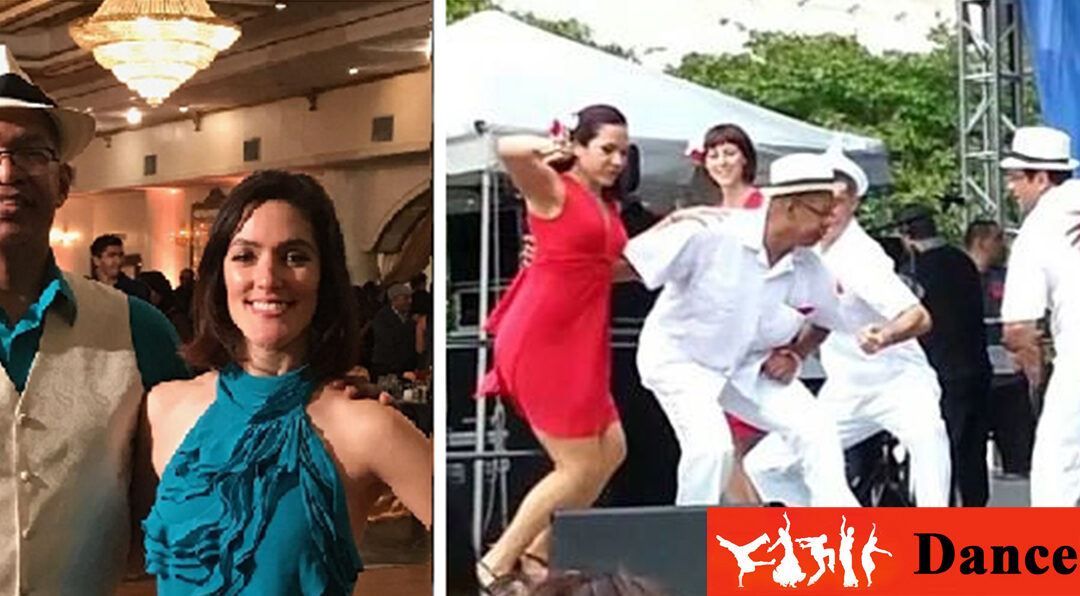
Michael Whitmire talks about sharing culture as a way to make friendships and memories. Follow him at https://www.facebook.com/mwhitmire and SALSA GRANDE at https://www.facebook.com/BiggerBetterSalsa. Micheal references this video during the discussion: https://youtu.be/r15MeG9P2g4
DanceTalks with Michael Whitmire: Full Transcript
Hosted by Andrea Cody, Director of Dance Houston. Originally released May 5, 2020. This transcript was generated automatically and may contain small errors.
Episode summary (SEO)
On this episode of DanceTalks from Dance Houston, host Andrea Cody talks with Michael Whitmire, a Houston attorney and the founder and director of Salsa Grande, which teaches salsa and Rueda de Casino. Michael’s first dance memories are copying Michael Jackson on Soul Train and square dancing in grade school; after law school, Houston friends from Puerto Rico, Cuba, Colombia and Venezuela brought him into salsa, and around 2000 he started taking classes seriously, moving from swing lessons at the downtown YMCA and the Melody Club to salsa. He explains how Rueda, born in 1950s Cuba, works as a circle dance with a caller inside the circle and calls like dame, sombrero and Kentucky, why connection and musicality matter more than fancy moves, and what it meant to win a salsa contest in Miami in 2002 with a stranger from the crowd. He also talks about respecting the Afro-Cuban roots of salsa as an African American dancer, the friendships dance has given him, and why a group touch dance like Rueda may be one of the last to return after COVID-19. Recorded May 2, 2020.
Key takeaways
- Rueda is square dancing’s Cuban cousin. It’s danced in a circle of any size, and the caller is one of the dancers, using spoken calls and hand signals so it works even in a loud club.
- Dance with your partner, not at them. Leaders should give followers room to express the music, and followers’ styling should still connect with their partner.
- Connection beats complexity. A couple doing simple moves in tune with each other and the music is more enjoyable to watch than a flashy couple who isn’t connected.
- Respect the culture you dance. Michael isn’t Latino, but he honors salsa’s Afro-Cuban roots and wants to be a bridge for newcomers.
- There’s always another dance. You don’t have to use every move in one song, and he’s optimistic that we’ll dance together again in person.
Transcript
This transcript has been lightly edited for readability: filler words and repeats were removed, and several passages that could not be heard clearly in the recording were left out.
[0:00] Introduction and first memories
Andrea: Five, six, seven, eight. Hello and welcome to DanceTalks. Today is May 2, 2020, and my guest is Michael Whitmire. Michael is the founder and director of Salsa Grande. Michael, thank you for being a part of DanceTalks.
Michael Whitmire: It’s a pleasure to be here, Andrea. Thank you very much for including me in your series of podcasts.
Andrea: For sure. We want to know all about you. When did you start dancing?
Michael Whitmire: Do you mean dancing in general, or the type of dancing I teach and do now?
Andrea: Just dancing. Your earliest memory.
Michael Whitmire: My earliest memory is as a child, trying to mimic what I saw from Michael Jackson on Soul Train. I could be Michael Jackson, my sister could be Janet Jackson, and we’d just enjoy the music and dance along to things I saw on TV, trying to imitate them. It made me feel good to watch it and to do those dances. Those are the earliest memories.
Andrea: What year?
Michael Whitmire: Let’s see, we’re talking the late ’70s, something like that, when I was a little child. I remember my first cousin chiming in too. So, the late ’70s.
Andrea: Cool. And when did you first take a dance class? What was the next big step for you?
Michael Whitmire: I think even in grade school, I remember taking a little square dance class in PE, probably in fourth or fifth grade. As we get into this discussion, square dancing really relates a lot to what I do now. Those are some of my first formal memories. In high school, we had maybe a semester of PE that included dance. After that, it probably wasn’t until after law school; I’m a lawyer, and that’s also how some people know me. After graduating from law school, I was in Austin for a while, then moved back to Houston, and I tried a few dance classes and danced with friends off and on for a while. Then I decided I wanted to get better, and around 2000 is when I really started taking dance classes seriously, especially salsa, and a variation of it called Rueda. A little before I got heavily into salsa lessons, I took swing dance lessons for about a year, and that was really my first serious dive into partner dancing: what it takes to lead a partner, follow along with the music and improvise on the spot. I did that off and on for a while, but then I got more and more into salsa. There were more opportunities for me to dance salsa, so that’s where I decided to put my focus. That’s where the serious learning started, around 2000.
[3:18] Square dancing in grade school
Andrea: Cool. Let’s go back to grade school. When you were square dancing, what was the scene like? Was it in the cafeteria? Did you do a show?
Michael Whitmire: I remember it being more than a day. I don’t remember doing an actual stage show, but I recall doing a little square dancing, probably in a cafeteria, going back on a regular basis to the point where we learned some moves, do-si-do and whatever, and having fun dancing with the other little girls in the class as a group activity. The main thing I recall is that it was fun, and that it was a structured dance activity.
Andrea: Where did you grow up?
Michael Whitmire: Mostly in Houston. I was born elsewhere, but I’ve been in Houston since I was six years old. Both of my parents are from Houston, so even though I’m not truly a native, I’ve been here long enough that Houston is my home.
Andrea: I feel you. I moved here when I was five.
Michael Whitmire: Okay, so not the same year, but the same age range.
Andrea: Right. And we did square dancing in kindergarten. One day we got dressed up and all the kindergarten classes came together in the cafeteria, all in our little groups of eight, and we did a show. I know my parents were there, because I’ve seen a video of it, and it was so fun. For our listeners, square dancing is done to old-timey western music, and there’s a caller who tells you what moves to do, like “swing your partner” and “your lady left,” and these moves just get called out, and we know what to do because we know each little piece.
Michael Whitmire: Right. And to get into the discussion, that’s what I still do now as an adult. It relates a lot to that square dancing we learned back then.
[5:36] Swing, salsa and the downtown YMCA
Andrea: When you started classes in swing and salsa, where did you go?
Michael Whitmire: In the mid to late ’90s, I took a class for maybe a month or so at a prominent dance studio that had been around for many years. It’s not really around now, because of what happened with Hurricane Harvey in Houston a few years ago. A friend of mine had taken the first month or so with her boyfriend, and they broke up, and she wanted to keep going, so I said, okay, I’ll tag along for the next session. I did, and I think I gained some things from it, but we both stopped after that. There was also a place called Rodriguez Dance Studio where I took a class or so. Then I got away from it, and around 2000 I got back into it.
For swing, there was a group called the Houston Swing Dance Society. I think they’re still around. One of their instructors was teaching at the downtown YMCA, and at the time my office was catty-corner from the downtown YMCA, so I’d go over there and take lessons. Eventually I think they moved to the Melody Club. For people who’ve been around Houston for a while, the Melody Club was a place where they did lessons and held socials. And as it turned out, the salsa instructor was also teaching at the downtown YMCA. So around the time I was thinking about switching from swing to salsa, I was taking classes there, and I realized the little rock step in swing was a little different from the rock step in salsa, and I was getting confused sometimes. That’s when I decided I should really focus on one or the other, and it wound up being salsa. I had more friends who knew how to dance salsa, and there were more opportunities to dance salsa at the time, so that’s where I veered.
Andrea: What kind of opportunities do you mean?
Michael Whitmire: How I got into salsa in the beginning was shortly after I graduated from law school. I worked for another year in Austin, then came back to Houston. One of my college roommates had also gone to law school, and we got back together in Houston. He had developed a wide circle of Hispanic friends, and when I hung out with him, I hung out with them. One night after dinner, a couple of ladies said they wanted to go to a salsa club, and I said, I’ll tag along. A couple of cute ladies want to do something, I’ll go do it too. And they taught me the very basic steps. From there, I developed friends within that network who had Hispanic backgrounds, from Puerto Rico, Cuba, Colombia, Venezuela, different countries like that. A big feature of a lot of their gatherings was music and dance. It could be a birthday party, a wedding or a house party, and at some point some Latin music would get turned on. My close network of friends was largely Hispanic, and their common practice of going out dancing or socializing would include salsa music, merengue and other Latin music. Taking them swing dancing would be taking them out of where they’d normally go. I had to make different friends from the swing classes I was taking, which was good; I met some nice people through that. But my wider circle included more Hispanic people and more events where there might be salsa music. There were also more restaurants and clubs in Houston that played it on a semi-regular basis. So there were more places and more opportunities, and I didn’t have to make much extra effort to dance salsa, whereas it took a little extra effort to go swing dancing. That’s how it went in that direction.
[10:09] Club Tropicana
Andrea: What are your favorite hot spots?
Michael Whitmire: When everything opens up again, hopefully: one of my favorite places is Club Tropicana. Tropicana is a great venue. From the outside, you wouldn’t necessarily recognize all the great stuff inside. It’s in a little strip center on a street corner, but once you go inside, it’s very nicely decorated. The owner is a dancer; I met him when we were both just dancers on the same dance team many years ago. I think he knows how to cater to the people who go there to grab a drink and relax, and also to the people who go primarily to dance, so it’s a good environment for a good mix of people. Tropicana is my go-to on a regular basis.
Andrea: They have a great band.
Michael Whitmire: Oh, yes. There are a couple of different bands. Before, there would be one band on Fridays and a different band on Saturdays, and they’d switch back and forth. At different points over the years, they’ve had a band on Tuesdays and Thursdays, but now it’s pretty much a Friday-Saturday thing. I know it’s going to be a good time if I go there on a Friday or Saturday.
Andrea: For sure. I’ve been a couple of times; it’s really fun. Actually, I think I’ve danced with you there one time.
Michael Whitmire: Hey! Yes, many years ago, I think we overlapped there.
Andrea: I remember how everybody I danced with there really knew how to dance.
Michael Whitmire: Okay, well, I like to think I know how to dance.
[11:48] First performances
Andrea: Well, we know you as a performer. When did you start performing?
Michael Whitmire: My very first performance was probably in the fall of 2000, with one of the dance studios where I was taking classes. The studio instructor wanted to get some of the students together to do a little dance around Christmastime. I think it was early December, and he taught us a routine about two or three minutes long. A couple of other students in the class said they wanted to do it, and I said, okay, I’ll do it too. One of the other women in the class was very helpful practicing with me. At that time, it was mostly a footwork routine without as much partner work, just stepping through the little pattern the instructor taught us. So that was the first time, fall 2000. A couple of months later, the same instructor decided he wanted to do a show with four, five, maybe six different routines, and again I chimed in and said I’d do it. One thing led to another, I started doing more and more performances there, and I kept taking other opportunities.
Andrea: What kind of performance spaces were you in?
Michael Whitmire: I think the very first one was a restaurant. Back in fall 2000 and early 2001, there weren’t as many clubs dedicated to salsa in Houston, and even now there aren’t a lot. But it was common, just like now, for a restaurant to have one salsa night a week, a Friday or Thursday or Saturday, as a way to draw customers. As I recall, the place was called Valentino’s at the time, and I think they had salsa every once in a while. I don’t know what the arrangement was, whether the instructor hired it out or just had a deal with the owner to have his students perform there. But I remember a large restaurant with an open floor, with space for several of us to dance our routine.
[14:37] Salsa Grande and Rueda de Casino
Andrea: Our listeners know Salsa Grande. Tell us about your style.
Michael Whitmire: That’s difficult to pinpoint, but generally I do a mix of private lessons in Latin social dances such as salsa, merengue, bachata and cha-cha-cha, for couples or individuals who want to learn. For group classes, I teach workshops in a dance form called Rueda. To go back to the early part of our discussion, Rueda developed in Cuba. Rueda is the Spanish word for wheel, and the easiest way to describe it is a Cuban version of square dancing, where someone calls out the moves and we do them. There are a couple of variations on how it differs from regular square dancing. One, you don’t have to have just four couples. It’s not a square, it’s a circle; again, rueda is wheel, so it’s a circular format. You can have anywhere from two couples to a thousand couples. I’ve seen videos on the internet where somebody in Colombia had the track around a stadium filled with dancers, and one person called it. So it’s really expanded. The other variation is that the person calling out the moves is one of the dancers. Typically in square dancing, somebody stands outside the square telling the four couples what to do. I’m inside the circle telling everybody what to do. Every move has a name, some moves have hand signals, and all of that means something to somebody who dances Rueda. Being in the circle with the dancers makes it a little more dynamic. And because it developed in Cuba, it’s very common to use Cuban-style salsa, although any type of salsa can be used. I’ve also seen it danced by swing dancers using that format with other types of music. But I focus on Rueda in a more Cuban style.
My dance journey, my learning, developed with friends from different countries, so I didn’t think of salsa as Cuban style, Puerto Rican style, New York style, LA style or Colombian style, which all mean different things now. To me it was all salsa, so I didn’t try to focus on one thing. I saw what I liked, tried to learn that move, heard some salsa music and danced. I try not to limit myself to what’s considered Cuban style, because I enjoy all forms of salsa, and I want to be able to dance with anybody, whatever type of salsa music is playing. I’ve learned enough about the variations that I think I can adapt to any partner, and that’s what I want my students to be able to do. I used to teach weekly group classes; when I created Salsa Grande, I switched to focusing on Rueda workshops and private lessons. Especially in private lessons, I make sure my students understand the slight variations they might hear in the music or see from other dancers, and how to adapt. Just because I learned salsa from a Cuban instructor doesn’t mean I can’t dance with somebody who learned from a Colombian or Puerto Rican instructor. There’s more similarity than difference, kind of like with people, and you can make it work if you’re interested in dancing with that person: recognize where the differences are, respect your partner, and figure out how to make it work for those three or five minutes of social dancing.
[18:51] Rueda calls
Andrea: Would you tell us more about connection, maybe the words you actually use when you teach your students?
Michael Whitmire: Do you mean the Rueda calls, or how I describe salsa?
Andrea: Let’s start with Rueda calls, and then I want to know more about how to vibe with your partner.
Michael Whitmire: Most of the calls are in Spanish; since it developed in Cuba, we pretty much stick with the Spanish names. A basic call is dame, which means “give me,” and it means “give me the next lady in the circle,” so every guy switches partners. He’s standing with one partner, the call is made, and if you’re seeing this on video, I’m doing a hand signal: that’s the signal for “give me the next lady.” I might put up two fingers and bring them together; that’s dame dos, and I’ll move to the second lady in the circle. I can tap my head, and that means the move sombrero, so once I tap my head, you know to do sombrero. Sombrero is the Spanish word for hat. Part of the reason for having both a spoken call and a hand signal is that we might be in a club, a restaurant or a festival where the music is so loud that I can shout as loud as I can and the person right next to me still can’t hear me, but they can see me across the circle. So even if you can’t hear me, you can still see me, and we can still make the dance work.
There’s also a move called Kentucky, based on Kentucky Fried Chicken. I think somebody in Cuba heard about Kentucky Fried Chicken, and the hand signal is my elbow flapping up and down like a chicken wing. There are a couple of points in the move where each partner forms a chicken wing, so that’s where Kentucky came from.
Andrea: For our listeners, Michael has his hand up by his armpit and is flapping his elbow like a wing, but we’re only sharing this conversation as audio on our podcast.
Michael Whitmire: Okay, great. But yes, flapping my elbow up and down is a legitimate call in Rueda, known around the world, and then everybody does a fun move together. Part of the deal with the dance is that it’s very social. It’s great to dance with one partner and share the dance with them, but there’s a different level that happens when you’re dancing with a group of people who want to get together and share this dance. It’s a different way of enjoying the dance and experiencing the music with a group, as opposed to one person. Rueda is great for that, and that’s part of what I like so much about it.
Andrea: Fun!
Michael Whitmire: Very fun, and I like being able to share that with other people. When students come to their first Rueda workshop, I ask them, “Why did you come here today?” Maybe they saw an ad on Facebook, or a friend told them to show up, or they saw it socially and figured out I’m the one who teaches it. I tell them, that’s why you’re here, and I teach it because I can’t do it by myself. I want to grow the community of Rueda dancers in Houston, or wherever I happen to be, and it takes instructors to do that. And it is fun; I like sharing that fun. It’s been great to be able to teach it for over a decade now.
[23:00] Teaching connection
Andrea: All right. You must know a lot about teaching connection, so lay it on us.
Michael Whitmire: Part of it is respecting your partner and understanding them: the possibilities of what the move might be, what your partner needs to feel to understand the move, but also relating to them as a person. There should be a little eye contact. You’re not going to stare your partner down the whole dance, but you’re acknowledging that there’s another person there. Sometimes when people get into dance lessons, they think about what they need to do with their feet or how to style their arms. But at the most basic level, any partner dance comes down to two people connecting. It doesn’t always have to be a mating ritual. That’s part of what I learned dancing with my friends through the ’90s, even before formal lessons. It could be a wedding, a birthday party, a son or a father dancing with the cousins. It’s not about the pickup scene. Yes, in nightclubs men and women like to get together, but it doesn’t always have to be that. When I go to a club, I look for the people who are there to dance, who want to feel that same connection with the music and their partner that I’m looking for. It’s about sharing these few minutes of music together. It could be romantic if you want it to be, but it doesn’t have to be. It could be your connection with the music, and that can be the enjoyment you get out of it.
Whatever joy I get from hearing this music and wanting to express it with my body, if my partner wants to express it too, I want us to be able to do that together. I want to recognize the moments when I should let my partner express herself. So I teach leaders, in most cases men, though there are female leaders as well, to be respectful of the fact that the follower wants to express the music too. Grabbing her by both hands and twisting her through moves for four minutes straight doesn’t let your partner enjoy the music. Let her go once in a while, or do something that gives her room to express the music. Same thing when I’m teaching women: yes, I want you to understand your styling, sticking your arm out, flipping your hair, swinging your hip, whatever you do, but do it with your partner. It’s still not about just showing off. It’s nice to look good on the dance floor, but it starts with enjoying the dance with your partner.
From my personal experience, if I’m watching the dance floor and a couple is connected with each other and with the music, even doing simpler moves, I enjoy watching that a lot. Another couple could be next to them doing all kinds of fancy, intricate, complicated moves, but if they’re not truly connecting with each other and the music, it’s less enjoyable to watch after a certain point. It’s great to see the athleticism, the spins or whatever, but I can only enjoy that for so long, versus the experience of two people dancing together, maybe a romantic couple, maybe not, who are really connected. I try to teach that to my students who are seeking that connection, and let them know how good it can feel when you’re doing it right. Maybe what you thought dance should be about can be something different, and I want to expose them to that other way of approaching it, which I think is good for them in the long term.
[27:31] Where to find Salsa Grande
Andrea: Cool, thank you. Where can people find you and connect with you online?
Michael Whitmire: I have a website, salsagrande.net. That’s the word salsa and the word grande, G-R-A-N-D-E, dot net. I also have a Facebook page, Salsa Grande, so those are the two main places. The website has a number of our performance videos. We’ve been on TV several times, so there are clips of our television performances, as well as performances at festivals; we’ve traveled to California a couple of times and performed out there. So you can see what we do and what Rueda is about, even if you’ve never heard of it. It’s a dance where you should know at least the basics of partner dancing before you do the Rueda format, so early intermediate or higher is preferred. But for people who want to learn the dance from scratch, in private lessons I can do that for anybody. So salsagrande.net or the Salsa Grande Facebook page are the two main places to find what I do.
Andrea: Great. Are you giving online classes?
Michael Whitmire: No, not now. Because of the nature of a group dance, it’s difficult to simulate that. I don’t have a consistent partner who lives with me, and I don’t want to have someone deal with all the social distancing issues and take her out of her comfort zone. So I wouldn’t teach Rueda online. Private lessons are a possibility, but I haven’t gotten into that. There are other instructors who do solo dancing. For my particular style of instruction, it’s more helpful to be hands-on and interactive with a couple or a person. Yes, I can visually tell them what they’re doing right or wrong, and I think I’m pretty good at that, but it helps to actually feel how a person is touching and feeling their part, and I’d be missing that online. I suppose if somebody wanted to contact me about explaining some moves, I could do that. But there are plenty of other instructors doing footwork, solo and styling classes, and I don’t know that I’m that much better than they are to force myself into that. Fortunately, teaching dance isn’t how I put food on the table; I have my day job. Others are doing one-on-one classes or donation classes, which is great, but I just haven’t felt compelled enough to do it. There’s enough presence out there from other instructors.
Andrea: I understand.
[30:58] Where Rueda came from
Andrea: When did Rueda develop?
Michael Whitmire: There are different theories, but I’ve tried to educate myself as much as possible, and my best understanding is that it started in the 1950s in Cuba. My YouTube page has an interview with one of the earliest Rueda dancers. A woman from the Boston area, who is very good at both Spanish and English, interviewed him, and it’s about an hour long, and she translates what he’s saying. It’s very helpful. I’ve also taken a seminar with her, and I know her personally now. The discussion focused on the fact that in the late 1950s, there was more cultural interchange between the United States and Cuba. Some of the young Cubans, teenagers, could see movies with American swing dancing, or rock and roll dancing. A lot of people in Spanish-speaking countries refer to what we call swing dancing as rock and roll dancing. The fundamental movement of Rueda is called guapea, and it looks a little like a swing out in swing dancing, an open and close movement. So some of those Cubans saw that and tried to figure out a way to do it in a group. The music available at the time was traditional Cuban rhythms. Salsa, mambo, son, is really the traditional Cuban sound. So they used that music and developed their own calls and names. I don’t know how much they were also influenced by square dancing they may have seen, but there’s definitely been discussion that square dancing was a bit of an influence in 1950s Cuba.
Then in the early 1960s, with the embargo and political relations becoming more strained, there was less direct connection between Cuba and the United States. But some of those Cubans went to Miami, and Miami became the source of a lot of Rueda’s development and how it was built and spread. Now it’s spread all over the world. Other countries didn’t have as much political trouble with Cuba, so Cubans could go to France or Spain or Italy and spread the dance, and people from Miami spread it around the United States. Wherever there’s salsa, there’s somebody dancing or teaching Rueda. So it started in the late 1950s, developed more in the 1960s, faded a little through the ’80s, I think, but it’s come back very strongly in the 21st century.
Andrea: Salsa’s just gotten so popular.
Michael Whitmire: Yes, and as salsa became more popular, Rueda became more popular. There’s partner dancing one-on-one, and then there’s a certain subset of people who see that we can do this in a group, in a way that challenges their salsa skills a little differently, and they go off in the Rueda direction. So Rueda’s development followed salsa’s.
[34:46] What salsa and Rueda say about our culture
Andrea: What do you think salsa and Rueda, collectively or separately, say about our culture?
Michael Whitmire: A need to connect with another person, to the extent we’re talking about salsa as a partner dance, and a need to express something when you hear great energy in the music. And I think Rueda expresses a need to connect with a lot of people. It’s not just about one person; we enjoy a community of people who like the same things we do and are feeling the same things at the same time. I’m a season ticket holder with the Houston Astros and a partial season ticket holder with the Houston Rockets, and it’s a similar feeling to being in a crowd that’s all cheering for the same thing. Whether it’s the traditional one-on-one or the group format, it says, “I’d like to do this, and I’d like to share it with other people around me at the same time.”
Andrea: If we can go back just a minute: did you say the woman in that video was from Boston or Brooklyn?
Michael Whitmire: Boston. Her name is Anara Frank. I think she may have been born in New York, but I wouldn’t commit to that. She lives in the Boston area now, and I saw her last year when I went there. She has a big interest in trips between the United States and Cuba.
Andrea: And who was the man she interviewed?
Michael Whitmire: I can’t remember his name. We can look it up and put it in the notes.
Andrea: Where’s the video again?
Michael Whitmire: It’s on YouTube. I’ll have to send the information, but you’d probably search something like “founders of Rueda.” For people who aren’t familiar, Rueda is spelled R-U-E-D-A. If you look up Anara Frank, Rueda, interview with one of the founders, something like that, it should pop up. It’s about an hour-long interview about how Rueda developed with youngsters in Cuba at the time and spread across the island. Anara Frank teaches dance, and she also organizes trips, or at least she did before all this happened, between the United States and Cuba. She has a strong interest in connecting people with Cuban dance and helping them feel more comfortable: yes, it’s in a different language from English, the main language here in the United States, but we can still feel it. Even if you don’t fully understand the words, you can feel the energy and the connection you get from the dance, regardless of the language you speak.
Andrea: And you can learn what sombrero means.
Michael Whitmire: Oh, definitely. There’s lots to learn and connect with. I took Spanish in high school, but I wouldn’t call myself fluent. I’ve picked up a little more over the years, but I’m still not fluent. Even in the ’90s, when I didn’t understand the music, I could join my friends in an experience we could all enjoy and connect with.
[38:50] Feeling the music
Michael Whitmire: I take it as a compliment when I’m at Tropicana or some other club and somebody comes up and starts speaking to me in Spanish, because they assume I must be Hispanic. If I dance that way, I must be Cuban or Colombian or from somewhere with more dark-skinned dancers. I don’t necessarily look like a traditional salsa dancer if you just saw me standing there. But once I start dancing, I hope I connect in a way that’s authentic, so that somebody from a Latin country who knows salsa from their home can connect with me here. I take it as a compliment that at some level they think I’m one of them, one of the people who connects to the music the way they do. Or they ask, “Where are you from?” “I’m from Houston.” “Where are you really from?” I think they’re trying to get at whether I have some Latin blood in me. No, I don’t, but I have the same connection to the music that you do. I feel the music as a human being, and we all can do that. That’s part of why I teach. Some people might be intimidated by any type of dance, particularly one where a language they don’t know is being spoken, and I’m here to say, yes, you can connect with it. I’ll help you bridge that gap the best way I can, the way I had to.
Andrea: That’s really nice.
Michael Whitmire: I think that’s important. I have a wide variety of people who take my classes. When I started dancing with my friends back in the ’90s, I’d go to clubs where most of the people were from Latin countries or of Latin heritage, and I would stand out. These days I don’t stand out as much as a tall African American. If you’re hearing this on a podcast, I’m six-two, over 200 pounds; I’m not the traditional idea of a dancer, so I stand out that way. But I can still relate. Nowadays there are so many different types of people. When Ricky Martin and Jennifer Lopez got people interested in Latin culture, and with other opportunities over the years, people started to want to see what this is, especially in a city like Houston, with our very diverse community of different ethnicities and countries. You find people who are a little more open-minded about trying something different, and I’m glad there are people willing to do that. I try to be the bridge between what they knew before and what they can know now.
Andrea: You’re really bringing me back to going to Tropicana. I mean it as a compliment to Latin culture and all of Latin history: this is so great, so fun, you guys are awesome for keeping it up. I couldn’t say that in Spanish, but I could go out on the floor and move just like everybody else. There’s that common heart; we all have that heartbeat and that connection with the music. I love the way you verbalize that, and it makes me remember those fun times very fondly.
Michael Whitmire: I think that relates to a couple of points I’d make too. When I talked about enjoying being with my friends in the ’90s, that was part of what impressed me about Latin culture. My parents loved me, but it was not a very touchy-feely household when I grew up. Hanging around my friends in this Latin environment, with everybody kissing on the cheek, hugging and greeting, I liked that warmth and openness. Being around that was very helpful to me and probably another incentive to stick around: I like being in this environment, people here like to dance, and I like to dance, so what can I do to stay here and enjoy it the way they do? That warmth and connection come through.
It also reminds me of a friend from Colombia, I think, who was living in Houston for a couple of years for work. Then he had to move away, and we had a farewell party for him. At the party, he told me, “I’m really glad I met you here. When I came, I didn’t think there would be anybody in the United States who would feel this music the way I do and relate to it the way I do. But there was somebody here.” There are more people now, but I was a connection back to what he felt at home, and it made him feel better that somebody else respected that. That’s what I ultimately try to do. I like to teach it, but there’s a term, “culture vulture,” for somebody who comes in from outside a culture and tries to appropriate it, and I don’t want to be seen that way. I’m not Hispanic; I don’t have any of that in my background. But I respect it, and I want to share it in a respectful way, without claiming any other connection. There’s a root in salsa that’s really a mix of African culture, African music, drums and percussion, congas and bongos, mixed with European and Spanish influences in Cuba. So at some level, some of my African American heritage and jazz heritage can come through. But I’m not Hispanic or Latino, and I can’t say I am. I do respect it, and I think we can feel this together the same way. It’s very heartwarming when people of Latin heritage connect with me and feel the music the same way I do, and we share time on the dance floor and enjoy ourselves. It feels good when people say things like that to me.
[46:09] Cuba, San Francisco and Miami
Andrea: Have you danced in Cuba?
Michael Whitmire: No, I haven’t, and that’s one of the things I’d really like to do. There was a Cuba trip that got postponed last year, partly because the Trump administration cut off some of the ability of U.S. citizens to travel freely to Cuba. But I’ve been lucky. There are a number of Cubans who live in Houston, and I’ve met a lot of them, and that’s where some of my dance development has happened, dancing with them, talking with them and interacting with them. I’ve also taken classes from Cuban instructors who’ve come through the Houston area. It might not strike most people, but there’s a good-sized community in the San Francisco and Oakland area who love Cuban music, and I’ve been out to several festivals there and taken instruction from Cuban instructors. So I get it directly from Cuban instructors, though not in Cuba. And I watch a lot of videos on YouTube, or whatever pops up on Facebook, of dancers in or from Cuba. That helps me connect with it, learn it and share it as an instructor. So the short answer is no, I haven’t been to Cuba, but I’ve had a lot of contacts that have given me a good opportunity to understand it.
Andrea: Miami?
Michael Whitmire: Yes, I’ve been to Miami, and this could spark a long story. One of my formative salsa experiences was winning a salsa dance contest in Miami back in 2002. One of my good friends from that circle of Hispanic friends is Cuban American, and his company sponsored him to go to a conference in Miami. I said I’d go at the same time; he’d do his conference during the day, and at night we’d hang out at the clubs in Miami. It turned out his conference, for Hispanic professionals from around the United States, was having a dance contest each day. He told me about it after the first day, and I said, okay, I’ll show up tomorrow and see what it’s about, not necessarily intending to join, just to watch. But then they invited people to participate, and I went up and said I like to dance, but I don’t have a partner. And someone came out of the crowd, I would say a woman, but she was 16, as I found out later, so I was about twice her age. But she was an excellent dancer. They weeded us out through a couple of rounds, starting with maybe 10 to 12 couples, until there were two, and the winner was picked by audience vote. They cheered for us.
That’s really one of the most important experiences of my life, not just my salsa life. It was great to be in that environment, with so many Hispanic and Latin people around me who didn’t know me at all. I’m in Miami from Houston with a random partner in this dance contest, and you cheered for us because you thought we were reflecting the dance in a way that respected how you understand it. Hearing that cheer from random people wasn’t about the win; it was about the approval from that particular audience, and that made it very meaningful to me. So when you say Miami and dancing, that’s really one of the best experiences of my life.
Andrea: Awesome. Congratulations.
Michael Whitmire: Thanks. Eighteen years later, but I’ll accept it. For a lot of things that happened afterwards, it gave me confidence that I was doing this right, in a way people could respect and understand. This big crowd thought I was the type of person who could dance this dance the way it should be danced. That gave me a boost of confidence to say, maybe I could teach this to somebody else. Maybe I have the skill to put this on a stage, or on television, and not embarrass myself.
Andrea: You got a stamp of approval.
Michael Whitmire: It’s definitely good to have that, though I’m not always out there dancing to have somebody validate it. To me, it all goes back to the music. I want to express it. Earlier you asked about my style, and if I’d say anything about my dancing, it’s that I try to be musical. I try to reflect the ups and downs, the changes of tempo, the accents in the music, expressing whatever the composer was thinking, as opposed to stepping one, two, three, five, six, seven, as if the music were just a metronome. I want to show the changes, the ebbs and flows, the different emotions in different parts of a song or different types of songs. That’s what it really comes down to. But yes, it’s nice to have validation, whether it’s somebody coming up to speak Spanish to me because they feel I’m expressing it, or winning a contest, or being invited to perform because somebody saw me dance and wants me to bring my partner or my group to share it with other people, so they can find the same joy in it that we find.
Andrea: Cool. And you stepped up out of the blue into the limelight and brought her with you, and she got to win. She was 16. What a huge thing for her. I’m assuming she wasn’t a champion dancer at that point. Good for you for giving her that experience too, because she needed a lead.
Michael Whitmire: It was definitely great for both of us. I got the impression she’d had some dance training, but she wasn’t teaching or anything like that. She was of Cuban background, there with her mother and sister, and maybe they pushed her out there. I don’t know exactly how she ended up out there with me, but I could tell from the first couple of moves that she was a good dancer. I’ve connected with her through Facebook, and I know she’s still dancing, not necessarily performing, but she was an excellent dancer, and I was lucky to have her. It goes back to the point that if I have this great dancer with me, I want to let her express herself too. Part of what helped us win is that if it had just been me, a few years into my dance training, I probably wouldn’t have won. But I knew enough to step out of the way and let this other great dancer shine, and I think the way we played off each other was something the audience picked up on. They could feel that I had a certain level of skill, but also the connection, and that I was dancing with another great dancer. All of that played together in winning. I’m glad if it played any role in her life as well.
Andrea: It’s fun to watch perfect strangers get out there and figure out how to dance to a song together. It’s spontaneous; it’s a surprise. You don’t know what they’re doing, and they don’t even know what they’re doing.
Michael Whitmire: Oh yeah, and that happens a lot in a social dance or club setting. Just a few months ago, I was back at that same festival in San Francisco that focuses on Cuban music, and I danced with a woman I didn’t know. I came off the floor, and a couple of minutes later another woman walked up to me and said, “How long have you two been dancing together?” I had just met her. I think she was new to that setting, and she was shocked that we could dance that well together spontaneously, improvising to a random song. We met for that minute and walked away from each other, but somebody else could recognize that there was a real connection between strangers, because of the music. I had a certain skill level, my partner had a certain skill level, and someone outside recognized that. I like it when somebody can see that from afar, even if they don’t know as much about the dance.
[56:00] Staying connected during the shutdown
Andrea: It sounds like you went from being a little boy in front of the TV to dancing across the country, out on the town all the time, on stages and on TV, and now you’re back in front of the screen again. How are you doing? Are you seeing your friends? Are you doing a little solo dance on Zoom?
Michael Whitmire: Like I said, I’m not doing much instruction-wise, but I have taken a couple of online dance classes on Zoom during the pandemic quarantine. It’s still not quite the same. They tend to be footwork classes, so there’s not the same connection, but you still get that feeling of movement and the emotion that comes from moving your body when there’s music on. And then I exchange emails and messages, like, “Hey, how are you doing? Let me know what you’re up to.” I’ve been lucky that the way I teach is conducive to making friends with the people who learn from me or have been on dance teams with me. So I try to touch base with different people at different times, because it wasn’t just a superficial dance connection. I think we are friends, and we should stay friends, even if we can’t physically be in the same room dancing with each other. I’m grateful for the friends I’ve met through dance over the years.
As I mentioned, I’m a lawyer in my day job, and it’s nice to hang out with some lawyers, but not all the time. Dance has introduced me to engineers, maintenance workers and a wide variety of other professions, whoever decides they like this dance, and we can share that experience. I’ve gotten to meet so many people I know I wouldn’t have met in my typical lawyer circles. That’s been a great part of my life: not just sharing the dance, but making friends from a wide variety of backgrounds. I like knowing people who didn’t grow up the same way I did, and learning about different cultures, and it’s been good to be exposed to things I wouldn’t have been exposed to otherwise because of our mutual love of dance.
[59:27] What’s on the horizon
Andrea: Good. What’s on your horizon?
Michael Whitmire: I want to keep dancing, choreographing and teaching. Because of business reasons and other things going on, I didn’t teach as many Rueda workshops in 2019 as I normally would, and I made a personal commitment that 2020 would be the year I’d teach more workshops. I taught workshops in January and February, and I was going to ramp it back up after letting it slide a little last year. I want to keep that up. Watching videos has kept my interest alive, and being at that festival back in February always rejuvenates me. I’ve been thinking about different choreographies. About two years ago, we performed a routine out in San Francisco shortly after Hurricane Harvey, and part of the theme was coming through hardship and coming out of it dancing: okay, we made it through; now let’s enjoy our lives again. I’d like to take that same approach. I probably wouldn’t do a similar choreography, since I’ve done it before, but I do want to create a joyful choreography when we come out of this, to reflect that, hey, we made it.
Andrea: In the meantime, you’re at home watching out for your safety. We don’t really know when you’ll be able to go back to Tropicana. In an imaginary world where you didn’t think that was going to happen again, what would you start doing?
Michael Whitmire: That’s a deep question, because it goes against one of my philosophies about dance, which is that there’s always going to be another dance. I don’t have to use up every move I’ve learned in one cycle of this one song and try to show off. I can do whatever I want another time; there’s going to be another night. If there were no other night, I’d probably make a greater effort with Zoom or whatever video platforms there are. Part of the reason I’ve held back is that other people have been occupying that space, but there may come a point when I need to occupy it, when we need to connect in a way where we’re sharing this dance together, and technology lets us do that. I don’t envision the rest of my life without dancing, so there would have to be some way for that to happen. But I remain hopeful and optimistic. I’m expecting us to dance together again in the future. As a last resort, I guess we’d have to resort to technology or the memories of how we danced. But it’s not just about memories; it’s about what we can do in the future together, in person. That’s what I’m expecting and what I’m optimistic about.
Andrea: It’s interesting to me that you always went out dancing with whoever showed up. So in a sense, you always had a partner, but now you’ve somehow lost your partner.
Michael Whitmire: Yes, that’s the correct way of looking at it. There’d always be another dancer, another person to dance with. Over time I’ve gotten to know a lot of people who like to dance, so I can show up by myself and expect there’ll be somebody I know whom I could ask to dance, or even strangers. But with no partner at all, that takes away a big element of what I do and what I teach. Rueda is about connecting with other people physically in the same space. And the way COVID-19 is understood, it comes from being in the same space with other people and touching other people. In one Rueda song, I might touch four, five or eight other women: a couple of seconds doing one move, then switch to the next partner, a few more seconds, switch again. It really is about connecting with somebody, touching another person and executing a move together, and we just can’t do that. In some ways, that might make it one of the last forms of dance to come back, because we can’t connect the way a solo dancer or even one-on-one partners could. In a group, given the way viruses transmit, that makes it dangerous at some level, so until we have a handle on it, it may be one of the last things to come back. That’s another reason to be optimistic and hopeful about whatever ways we can connect as a community, so that many people can be in the same space, touching each other and dancing with each other again. I like one-on-one salsa with a partner, but I’d be losing one of the main things Salsa Grande does, which is showing you how to dance with a group of people. You can watch our videos and enjoy some of that, but I really would prefer to do it in person. That’s what I tell people when they come to classes: I’m glad you enjoyed watching it, but now I want to show you how to do it. Maybe it’s not as complicated as you thought when you saw it, and now you can be in the middle of the circle with us, doing the same moves. I want to be in a position where I can teach that again and put people back in that environment, sharing this dance in the same space.
[66:33] Herd immunity
Andrea: What do you think about herd immunity?
Michael Whitmire: It’s difficult. I could get into a long discussion about that, and I’ve gotten into a few Facebook discussions about it too. It’s difficult because people interact with non-dancers too. Maybe I pick up the virus from somebody, and I’m healthy enough to overcome it, but my mother lives in the same household with me, and she’s more vulnerable, so I have to be extra careful about that. Other people are coming from their own situations; I don’t know who they live with or who they interact with. Even if I’m healthy enough, or a group of us is healthy enough, I don’t want to be the person who puts someone else in danger. Herd immunity involves a certain amount of sacrifice, with some people getting sicker than others for the sake of the rest of us, and it’s difficult for me to be in that position. I understand the arguments for it, but I’m not a medical or health professional, so I can’t fully get into it. But that’s what I’d be conscious of. As an instructor of Rueda, a group dance, I feel a certain responsibility for the safety and health of the people in my class and the people I’m dancing with. So I’m going to be more cautious about putting them in that situation, even if I felt I could survive it myself. Maybe that’s the lawyer in me too.
Andrea: My guest today is Michael Whitmire. Michael, thank you for being a part of DanceTalks.
Michael Whitmire: Thank you very much. I’ve enjoyed answering the questions, and hopefully somebody gets something out of this interview.