
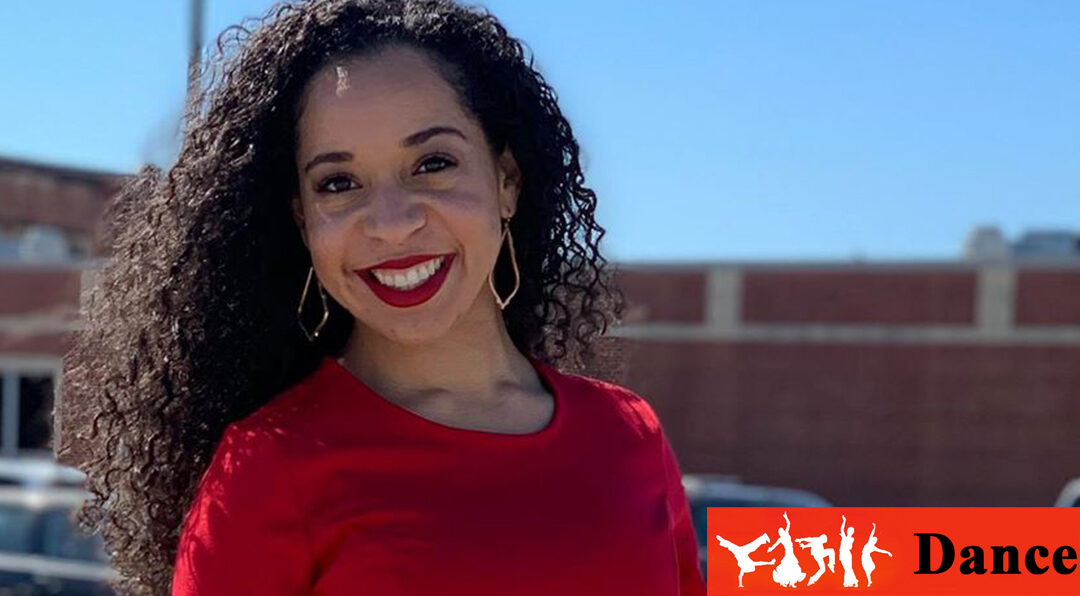
Marissa Cantu-Harkless talks about college life as a Texas Strutter, her career directing drill teams for public high schools, and her hopes for this summer’s virtual programming. Follow her at www.facebook.com/marissa.cantuharkless and www.instagram.com/@Harkless_dances.
DanceTalks with Marissa Cantu-Harkless: Full Transcript
Hosted by Andrea Cody, Director of Dance Houston. Originally released May 13, 2020. This transcript was generated automatically and may contain small errors.
Episode summary (SEO)
On this episode of DanceTalks from Dance Houston, host Andrea Cody talks with Marissa Cantu-Harkless, director of the Redcoats dance team at Heights High School in Houston. Marissa grew up in Austin taking jazz and hip-hop classes, fell in love with the Texas State Strutters at a camp in third grade, learned to high kick with Ginger Jarosek’s Tex-Anns at Crockett High School, and danced four years as a Strutter while majoring in dance at Texas State University. A chance meeting at a teacher job fair led her to build a dance program from scratch at Scarborough High School, where her Title I students taught her patience and how to teach true beginners, and in 2016 the Redcoats themselves chose her as their new director. She describes the day COVID-19 closed Houston ISD in the middle of her tryouts, losing spring show and prom for her seniors, keeping her team active on Zoom, teaching in the Dance Houston 24-hour dance marathon, and why she hopes online dance can bring siblings and new friends from around the world together. Recorded May 2, 2020.
Key takeaways
- One camp can set a dream. Watching the Strutters’ kick line in third grade is why Marissa chose her college, and she made the team.
- Learn the “why” of dance. Majoring in dance taught her kinesiology, improv and modern, and how to explain movement in words, which makes her a better teacher.
- Break it down to the basics. Teaching students who had never heard of a plié made her an expert in beginner dance and taught her patience.
- Make it their show. Giving students real responsibility for running their own shows builds confidence and ownership.
- Dance in a new space. Her assignment: dance in a room of your house where you never dance, and see what music and movement it inspires.
Transcript
This transcript has been lightly edited for readability: filler words and repeats were removed, and several passages that could not be heard clearly in the recording were left out.
[0:00] Introduction and first memories
Andrea: Hello and welcome to DanceTalks. Today is May 2, 2020, and my guest is Marissa Cantu-Harkless. She is the director of the Redcoats dance team at Heights High School in Houston. Marissa, thank you for being a part of DanceTalks.
Marissa Cantu-Harkless: Thank you so much for having me. I’m so excited and a little nervous to be with you today, so thank you.
Andrea: Sure. Tell us about how you got started as a dancer.
Marissa Cantu-Harkless: I’ve been dancing for as long as I can remember. The first memories I have of dance are from when I was five or six. My older cousin in San Antonio had a dance clinic or fundraiser with her high school team, and I went and learned a bunch of little stuff with them, and they had a performance. According to my mother, when it was time for the performance I said no, because I had been dancing all day and there was no need to continue dancing anymore. But I do remember learning the dance and moving around with my cousin. I guess once it was time to perform, I was done for the day.
Andrea: That’s great.
Marissa Cantu-Harkless: Then I did other dance clinics when I was in elementary and middle school, with the Junior Strutters, with the Texas State Strutters. At the time it was Southwest Texas. I did a bunch of camps with them through the years, and I performed at those too.
Andrea: Where are those?
Marissa Cantu-Harkless: In San Marcos, Texas. The college, Southwest Texas, now Texas State University, is in San Marcos.
Andrea: Oh, cool. Did you live there?
Marissa Cantu-Harkless: I did in college, but I grew up in Austin. My mom had gone to Southwest Texas when she was in college, and I’m not sure how she heard about the camps, but I ended up going and I really loved them. I wanted to keep going back, which is what inspired me to become a Texas State Strutter. I ended up going to college there and dancing with the Strutters for four years.
[2:15] Strutter camp
Andrea: Awesome. Was the camp a weekend? Did you spend the night, or was it just an afternoon?
Marissa Cantu-Harkless: They were overnight camps. The first one I went to, I might have been in third grade. We would go on a Saturday and spend most of the day dancing with the Strutters, eat, and spend the night there. The next day we’d get up, they’d put makeup on us and give us a little T-shirt, and then we’d have a performance at the coliseum. All the parents would go, and the Strutters would put on their own performance. I just remember looking at them, with their legs going up to the sky, when I was in third grade, and thinking, “This is amazing. I want to do it.” I think I decided right then, in third grade, that that’s where I wanted to go to college and dance. And I got to do it.
Andrea: Cool. What’s a Strutter?
Marissa Cantu-Harkless: The Strutters are the dance team at Texas State University. When it started at Southwest Texas, it was the only dance drill team at a four-year university. They’re over 50 years old now. I was mixing them up with the Redcoats, my other dance team, which is nearly 100. The Strutters are the drill team there, they’re famous for their high kicks, and they’ve traveled all over the country and danced all over the world. I actually got to go to Chile with them one year, and they went to Spain the year after I graduated. It’s a big tradition in San Marcos. It was an amazing experience in college, but watching them when I was younger, I was in complete awe of everything they did, how they danced and what they looked like. It was just gorgeous.
Andrea: Growing up, did you also go to ballet school or an after-school program, or was it really just with them?
Marissa Cantu-Harkless: I also did a program called Distinct Dance. My mom really got me into it. She had me and my brothers each sign up for a different class at the YMCA. My brothers chose sports, I think soccer, and I chose dance. I continued taking dance classes with them and other programs, mostly jazz. We did a little hip-hop, but it was mostly the basics of jazz and sometimes jazz funk. I never really took ballet at a studio or anything like that; these programs were at community centers. But it was a lot of fun. I remember doing parades and performances. I also did a little cheer, but I always liked dance way more. I did that all through elementary and middle school, switched for a little while, and then once high school started, around 2003 or 2004, it was dance all the way up until now. Dance, 100%.
[6:10] The Strutter style
Andrea: Do the Strutters have a specific style, or is it just dance?
Marissa Cantu-Harkless: They do everything, and the Strutters have evolved so much since I was there. Dance has evolved so much, but that’s a whole other topic. When I was there, we did hip-hop, jazz, high kick, contemporary, and advanced jazz, or jazz elite. But I think the Strutters are known for their high kicks. When you put over a hundred girls on the field from end zone to end zone in one long line, and everybody’s kicking for days, you watch them and you’re in awe of what they do, or what we did when I was a Strutter. So a little bit of everything, not one specific style.
Andrea: Do they ever go on to be Rockettes?
Marissa Cantu-Harkless: I would think there’s got to be one or two, or maybe more. I don’t think any of the girls I was on the team with did, not that I know of.
Andrea: For those of us who haven’t seen the Strutters, is it similar to the Rockettes’ high kick line?
Marissa Cantu-Harkless: Well, I don’t think we’re all as tall. I’m barely five-two on a good day; five-two and a half. But since we have the hats and the boots, it’s more Texas style.
Andrea: That’s kind of what I’d envision, as somebody who hasn’t seen them before.
Marissa Cantu-Harkless: Definitely that Texas attitude, emotion and sassiness. We have our big hats and our boots and skirts, and big hair. When I was on the team it wasn’t so much big hair, because we had our hats, but when the Strutters first started, they wore wigs and had big hair, and the bigger the hair, the better. That’s what I’d envision. Very precise, but just so much fun. Thinking about it makes me smile.
Andrea: Are the Strutters on YouTube?
Marissa Cantu-Harkless: Oh my gosh, everywhere, YouTube, Facebook. I follow them on Facebook. There are definitely videos on YouTube; I haven’t looked at one in a while because I usually see them on Facebook.
[9:09] Making the team
Andrea: Okay. When did you graduate from college?
Marissa Cantu-Harkless: I graduated from Texas State in May 2012.
Andrea: And how did you get on the team?
Marissa Cantu-Harkless: When I was in high school, since I had already decided that’s where I wanted to go, I went to their tryouts. They had several rounds, but the first round was in March or April, if I remember correctly. My mom drove me there, about a 30-minute drive. They taught us a jazz routine and a kick routine, and I remember being so nervous; there were so many girls there. I don’t remember whether I got a callback, but they posted the numbers of who made it not too long after, and I saw my number and of course started to cry. I couldn’t even tell my mom I’d made it because I was in tears. You were supposed to look at your number and then walk down this long hallway into the gym. At the time, I didn’t know what building I was in or what it meant. And when you got into the gym, all the current Strutters were there, and they sang the Strutter song for you as you walked in. You can always tell a Texas State Strutter. They sang the whole song as we walked in, and of course they were crying and clapping for you. At the time, Susan Angell was the director, and she was waiting at the end of the line, and we all gathered around her and she said, “Congratulations, you made the team.” It was just so crazy; I still remember that. Then I went back to explain to my mom that I had made it, and she said, “Okay, I didn’t know. You just left me.” I was like, “I’m sorry.”
After that, I got to go back to school and tell all my friends, and they announced it at our spring show in high school. And then in July, I was shipped off to boot camp with the Strutters, all before I’d even graduated from high school. It was a lot of fun.
Andrea: And your dream came true.
Marissa Cantu-Harkless: Yes. Like I said, I specifically remember going to that first camp in third or fourth grade, watching them dance, and knowing that’s what I wanted. Getting to see it actually happen was so much fun, and spending those four years in the Strutters was everything I wanted and more. Some days were hard and hot when we had to be out on the field practicing, but I had a great time and made so many friends. I remember on the first or second day of Strutter camp my first year, our captain, Becca Freeman at the time (she’s married now, so she has a new name), told us that some of our best friends would come from this team, and that some of these girls would end up being bridesmaids in our weddings. The first girl I met there was my roommate, and she asked me to be her bridesmaid at her wedding last year. I’ve been a bridesmaid for another Strutter before that too, but I think it’s funny how the first person I met in the Strutters really did become my friend. She’s also a dance director now. It was true, what they said that very first day of camp.
Andrea: Wow. I would love to see the bridesmaids’ kick line.
Marissa Cantu-Harkless: Oh, gosh. We would struggle. I could still do it, but it would be a struggle. You’d have to really stretch before; I can’t just do it.
[13:13] Learning to high kick
Andrea: When did you first get your high kick, or know you could do it?
Marissa Cantu-Harkless: In high school. I went to Crockett High School in Austin, and the dance drill team there was the Tex-Anns. In our freshman year, we couldn’t be on the team right away, so we took a pre-drill class, where they taught us the drill team way, the Tex-Ann way, what to do and what not to do, and developed our skills. I already had a good beginner base at that point, but I had never done a traditional kick line, where you line up linking arm to arm, right hand, left hand up, straight arms, straight back, kicking all the way up. That’s where we started to learn, freshman year, so by the time I made the team I already knew how to do it with the correct technique for your knees, feet and ankles: back straight, don’t hunch. I could go on and on about how to kick. That’s where I learned to high kick and developed my skills in jazz, contemporary and a little more ballet. My director there was Ginger Jarosek, and she’s still the director at Crockett High School. I love her and still have a really good connection with her.
[14:48] Majoring in dance
Andrea: What did you major in?
Marissa Cantu-Harkless: I majored in dance. I started off in elementary education, because I knew I wanted to be a teacher. My mom’s a teacher, and I thought I’d be really good at it. But then I took some dance classes at Texas State, I think beginning ballet that first year, and my passion for dance grew and grew with the Strutters and the classes. So I looked into what it would be like to be a dance major, and I switched. I’m so grateful for that. I learned so much more about my body, how it works, how to make it move in a certain way, and how to keep it healthy and safe. I also learned things like improv and modern, which you didn’t really get a sense of in high school, and which maybe weren’t as “popular.” It made me appreciate dance a lot more, not just “I like dance, I love dance.” I’m glad I learned how to explain it to other people, because at first dance is something you explain through your body, but being able to put it into words is different. And then I got my minor in communication, so hopefully I’m a good public speaker.
Andrea: It sounds like you learned to translate, from being a dancer to being a talker, so you can speak to people’s ears and let them clue into you.
Marissa Cantu-Harkless: Yes, especially now as a high school teacher, explaining to kids how their body moves and how to move it. If I just say, “Move your hips with the beat,” they don’t get it. But when I explain the body and the isolation, rolling it this way versus just moving it, or engaging this part of the body, it’s so different. I learned how to break that down in college, especially in my kinesiology classes and those improv and modern classes, learning how to breathe and connect your mind and your body, versus just your body moving to the music. That’s where that connection really grew.
Andrea: What’s a lesson from college you could share with us?
Marissa Cantu-Harkless: Oh, I learned so many lessons, really about myself and developing who I was, being okay with that, and not being afraid to be different in my movement and what I wanted to express. In high school, sometimes we just want to be popular, fit in, conform, be normal. In college, when you’re forced, not in a negative way, to step outside of that, you really learn who you are, and that it’s okay to be whatever you want and express yourself in whatever way works for you and makes you feel good. So I encourage my high school girls to be okay with their bodies and how they develop, at whatever rate they can.
[19:26] A job offer at a job fair
Andrea: How did you begin your career?
Marissa Cantu-Harkless: When I was getting ready to graduate in 2012, I really wanted to be a dance director in Austin. But at that time there weren’t any head director positions, just a few assistant director positions at some middle schools, and I really wanted high school. Then we had a big teacher job fair at Texas State. I had already become a member of Delta Sigma Theta sorority, and I was walking through the job fair with one of my sorority sisters. It was in the coliseum, so it was huge, with hundreds of districts from all over Texas. My sorority sister had a bag that said Delta on it, and a member of another sorority saw it and said, “Are y’all Deltas? Come talk to me at the Houston ISD table.” So we went over. She was an elementary principal, and she really wanted me to do elementary dance. I wasn’t too sure, but I talked to her, gave her my resume and my elevator speech about dance.
A gentleman next to us overheard, and he came up and said, “Excuse me, when you’re done with her, could you please come talk to me?” I said, “Sure, no problem.” When I finished, I turned around to him, and he said, “I heard you talking about dance. Tell me what you told her.” So I told him everything I did at Texas State: Strutters, spring show, football, high kick. He said, “Great, that’s everything I want at my high school.” I said, “Oh, high school. What do you have right now?” He said, “Nothing.” I said, “Oh, you want me to start a whole program.” He said, “Yes. I want all my students to take a dance class. I want a dance team. I want shows. I want a Christmas show. I want this, I want that.” And I hadn’t even graduated yet; this was in April. He said, “Let me take your resume, and we’ll set you up for a Skype interview so the rest of my team can meet you.” A few days later I had a Skype interview with him and the rest of the staff, and right away they said, “We like you. We want to hire you.” That was my first job offer; I didn’t have any others at the moment. I said, “Let me think about it.” He said, “No, we want you now. What do we have to do to get you? Do you want to come visit the school?”
So I took a trip up to Houston with my mom. By then I also had an interview at the elementary school with the first woman I’d talked to, so I visited both schools, the elementary first and then the high school. And he said, “We want you to sign now. We want dance, everything you’re doing.” I thought about it for a little bit, and I decided to take it, because I’d been searching, and this was a new program I would be able to develop on my own. It was going to be everything I wanted. I didn’t have to follow anyone’s steps; I had free range to do what I wanted. So I signed my letter of intent in April, around Easter. In May I drove back and held a tryout at the school, and a few people made the team. I moved in July. My family helped me move, I got an apartment all by myself, and I was living in Houston on my own with a job right out of college.
[24:13] Scarborough High School
Andrea: Where was that?
Marissa Cantu-Harkless: Scarborough High School in Houston. That was my very first school, and it was an experience. Like a lot of Houston ISD schools, it’s a Title I school.
Andrea: What does that mean?
Marissa Cantu-Harkless: Title I schools serve mostly low-income, at-risk students, so the students have a lot of issues outside of school and at home that affect things like extracurriculars. Sometimes those schools don’t have the funding that bigger schools or private schools have, or schools in different areas of Houston or other cities. With inner-city schools, you have inner-city kids, and it’s different and it’s hard. You’re not just trying to teach them; you’re trying to help them in life too. Some of the stories I have about students I helped through different parts of their lives are things I never would have experienced if I weren’t a teacher. But I loved being at that school. I learned a lot about myself and about dancing, and that’s where I really started to become a good beginner teacher, because a lot of my kids had never known traditional dance. Most of what they knew was what they saw on TV, mostly hip-hop, which is amazing. But when you started talking about ballet or modern or jazz, they didn’t know what that was. They didn’t know first position or a plié. Teaching those basics to true beginners was hard, but it made me break everything down to the bare minimum and build on that. Now I feel like an expert in beginner dance because of those four years. I had a lot of fun with those kids, and they taught me a lot too. I’d be lying if I said I didn’t learn anything from them. It was hard, but it was worth it, and I’m very glad I had that experience. And starting my own program was just so much fun.
Andrea: Can you teach us what they taught you?
Marissa Cantu-Harkless: They taught me to laugh at myself. I was such a young teacher, and our ages were close. I think I was 22 or 23 when I started, and some of my seniors were 18, going on 19. I was very nervous, and I had to learn that sometimes I’d get to three without going through one and two, or realize I wasn’t going to get past one. It’s okay to get nervous and trip over things, make jokes, laugh at myself and not be so serious. I used to love dance because it was play and fun, but when I got it as a job, I felt like it had to be business. That’s not what dance is for them. For them, it was always going to be fun, something to do and learn as much as they could. I had to step back and remember that, and they taught me that. Now getting on my kids’ level is a lot easier than it was when I first started.
They also taught me a lot of patience. A plié is second nature for us dancers; we can do it in our sleep. But teaching ballet to someone who doesn’t understand their body at all and has never heard that term is interesting. They’d say, “What’s my back doing? My hands, this is weird. How do you do it so perfect, Miss? Help me, I don’t understand.” And I had big class loads, so it was 30 kids doing a plié and one of me. I had to learn a lot of patience and different ways to teach, really breaking it down and thinking about how I would reach all of them at their level instead of bringing them up to mine.
Andrea: And what did you teach them?
Marissa Cantu-Harkless: I think the biggest thing I taught them was how to manage their own projects. I put on a few shows a year: a big winter or Christmas show, Dancing with the Stars, Cinco de Mayo, Black History Month. For all of these programs, I made them be the MCs, sell tickets, work the door and all that. I said, “This is your project. This is your school program. My high school career is done; this has nothing to do with me anymore. This is your high school moment. What are you going to do to make it everything you want?” Those were things they’d never done before, but they enjoyed it. When you give them responsibility and put that trust in them, they’re over the moon about it. It was fun to watch them develop their own shows and their own ideas. Sometimes they’d come to me: “Miss, I have this idea for Black History Month, or for Cinco de Mayo. How can we make it happen?” “Okay, let’s break it down.” As my four years went on, the shows really became theirs, not mine.
[32:11] Becoming director of the Redcoats
Andrea: Where did you go from there?
Marissa Cantu-Harkless: After four years at Scarborough High School, which I loved, there was an opening at what was Reagan High School, also in Houston ISD. It used to be called Reagan, and then it changed to Heights. I had a friend who worked there and knew the athletic director, so I slipped in my resume. I did a normal interview with the principal, the assistant principal and one of the current Redcoats, who I think was about to be a senior. Everything was great, and then they said, “Next, we want you to do a lesson with the Redcoats. We want you to teach the Redcoats a dance.” That had never been part of an interview for me, but I said, all right, fine.
A few days later I came back with a dance ready for the current Redcoats, who were all seniors. Interestingly enough, I had seen some of these girls dance before, because Scarborough and Reagan were in the same district, and I’d seen them at competitions. They were very, very good: a well-established program with a great fan base, and their director was strong and ran the team very well. People knew who the Redcoats were before I got there. So I was a little intimidated to go in and teach these girls. Their level in high school was way better than mine was at that age. And they were tall, and again, I’m only five-two. They’re beautiful dancers.
So I went in, and there were about eight of them. I explained what the dance was about, because I was working on something for Scarborough at the time, told them about the song, and said, “Okay, let’s dance.” I was so nervous I could barely press play. I did the dance for them, they loved it, and they had a lot of fun, and the whole time the principal and assistant principal were sitting at the front, watching. I taught it to them, and the girls said, “Okay, thank you.” I said, “Thank you, girls. I’ll hopefully see you again soon.” And they all ran away into their locker room and slammed the door, and I heard them giggling, and I thought, oh my gosh. That was it; I left. The next morning, they called me and offered me the position. I was so excited.
It was so funny, because months later, one of the girls I taught that day ended up being my colonel, my captain, that first year, and she told me, “Oh my gosh, Miss Harkless, we loved you. When you left after you taught us, we were all so excited; that’s why we ran into the locker room.” I said, “That’s why y’all slammed the door in my face? I was so nervous!” And the assistant principal who told me I officially had the job said, “The girls chose you, hands down.” I think there were two or three other candidates. That made me feel really good, because I was really nervous about that job. That was 2016. I got hired when it was Reagan, and right after, they changed the name to Heights, so I was like, okay, I’m at Heights High School now.
Andrea: And you’ve been there four years.
Marissa Cantu-Harkless: Yes, this is the end of my fourth year. My seniors were with me their freshman year, so it was their first year and my first year too, which makes the situation we’re in now harder for my seniors. But they’re great kids. Four years with these kids, and I love it. The team has grown so much and continues to develop.
[37:18] When COVID-19 hit
Andrea: It sounds a little like a fairy tale so far, but I know it’s hard right now. Go ahead and tell us.
Marissa Cantu-Harkless: Right now it’s surreal. Yesterday was supposed to be our spring show. Very sad. We had a group meeting on Zoom with my girls. We usually don’t meet on Fridays, but we met and talked about how at this time we would have been doing this, and this would have happened already, and Miss Harkless would have already gotten mad at some of us because she’s stressed out. And I was like, yes, some of y’all would definitely have gotten an earful from me today. We were sad, but we tried not to get too caught up in it. I’m always like, I don’t want to cry in front of y’all. My girls are very into working out, so they said, “Let’s do this,” and we did a little Pilates class and talked a little, and then I let them go, because if I’d stayed on any longer, they would have had me in tears.
Let me go back to the day it happened for us. On March 12, I actually had tryouts for next year. I usually don’t have tryouts until the end of March, but since we were getting ready to go to the national competition in San Marcos at Texas State, I moved them up to the week before spring break. Instead of Friday the 13th, because Friday the 13th is scary and it was the last day before spring break, I said let’s do it on that Thursday. I had planned this back in November, just to make it work for our schedule. Then by March 11 there was already talk about what was going to happen with school, and whether they would cancel. I remember thinking, oh man, I really hope not. I didn’t know how bad this was. I just wanted to have our tryout and get it done. I remember being angry, like, how dare they close the schools? Because at the time we didn’t know what was going to happen.
March 12 came, and we held tryouts. That whole day was very surreal. Everybody was really nervous. All the girls kept asking, “Are they going to cancel school yet?” Teachers were talking about it, and I’d been keeping track of the news. It was nerve-racking for the girls because they had to try out, and for me because I wanted to hold the tryout but still be safe.
Andrea: Had they already canceled the Rodeo? Was that the day before?
Marissa Cantu-Harkless: I think it was the day before, or that week. I remember the girls talking about it, because I had bought tickets, and the girls were upset about different concerts being canceled.
Andrea: I remember picking up my kid from school the next day, and the teacher said she’d had tickets too.
Marissa Cantu-Harkless: This was the first year I’d actually bought tickets in advance; usually I just buy them if I’m going. So I was upset about that, and they were upset, and we were like, we’re going to get through these tryouts. About halfway through, one of my teacher friends called me, and sure enough, before tryouts were over, HISD let us know school was going to be canceled and that we’d get more information by email later that night. So I sent the girls home, and since I knew we weren’t going back, I cleaned up, packed some stuff and put a bunch of things in my car. I was at school late that day, because tryouts usually take a while. That was our last day.
After spring break, I met with the girls. I said, let’s pray we’ll still be able to have spring show in May, so let’s keep practicing and working on choreography. Different officers were assigned different dances, I was working on a dance, and we started to learn things over Zoom, which was actually not my idea. The girls asked how we were going to teach the dances, and I said I didn’t know, and they said, “Oh, Miss Harkless, we’ll just do Zoom. You can meet on Zoom and see everybody, and it’s fine.” I said, okay, you’ll have to teach me. So I learned how to use Zoom from my girls. They started learning dances from each other, and when school got pushed back even more, we pushed spring show back to the end of May. Now we’re thinking maybe we’ll get a “summer show.” The only reason I want to do anything like that is that I feel I owe it to my seniors to have some kind of send-off. And not only me; all my other girls, the freshmen, sophomores and juniors, feel the same way. They say it’s so unfair to the seniors, and if there’s any possibility of a show, even if it’s just for them, they want to do it. So we’re still hoping for something in late June or early July. But I’ve also prepared my girls. I said, I want to be realistic with you; there’s a possibility we won’t be able to have anything. It’s still important for us to keep dancing and stay in shape, which is why we’re still learning dances, but I don’t want to give you false hope.
It’s so difficult. I feel so bad for them, and I can’t imagine being in their shoes right now. Their prom was supposed to be today, actually. Spring show was supposed to be yesterday, and they’re missing out on so much, and I hate that for them. There’s no way I could put into words what it would feel like, and saying sorry doesn’t even cover it. It’s actually kind of funny, because all these years as a director, my saying to them has been: “I don’t know what it’s like to be a Redcoat. I’ve never been a Redcoat. I don’t know what it’s like to be a dancer in high school in 2020. Things your generation has at this age, I couldn’t have fathomed when I was your age: your smartphones, your computers, Zoom, Google Meet and Microsoft Teams, the laptops you have at school, social media. I never have been a Redcoat, and I never will. This isn’t about me; it’s about you. So how can you make your high school career everything you want it to be?” I still say that to them all the time. They’ll ask, “What do you think?” and I say, it’s not always about what I think; this is for y’all. And this is where it hits home even more for me. I can’t imagine what it’s like for them, and my heart goes out to them. I just pray they can take away something positive from this. I don’t want it to crush their spirits or their dreams, because anything they want, they can still get. The only thing I can say is that in the grand scheme of things, this is just one part. That’s why I’m still praying for some kind of show or send-off, even if it’s in August at this point.
[47:04] How the shutdown hit home
Andrea: Wow. I’m sorry. When I first heard about the virus, I admit the first thing that really hit me hard was that people weren’t going to dance together. It just hurt to think of all that joy and fun and love of life and freedom just going poof. I cried, and my second round of tears was about the deaths it was causing and the loved ones. The numbers didn’t hit me like a wave until later. At first it was just, no, no, not all that joy. The stay-at-home order hit me before the virus did, if that makes sense, because it took a while to realize how bad the virus was.
Marissa Cantu-Harkless: I feel bad about this, but when it first hit and we stayed home, it was our spring break, so I thought, I’m just going to enjoy my spring break. That’s what I did. My sleep schedule was off. I didn’t look at my computer, I didn’t look at my email; I refused to think beyond spring break, because spring break is always a great time for teachers, since we get so drained and bogged down. Then after spring break, when we weren’t going back to school and were meeting with other teachers and administration, that’s when it started to hit me harder. I kept planning that things would get better. I’m a big planner. At first we were going back to school after Easter, so I thought, okay, after Easter we’ll do this. Then not until May, so, okay, in May we’ll do this. And now, what am I going to do? It has hit me, but I don’t know if it’s hit me to my core yet. I don’t know if I’m putting up a wall and don’t want to feel it or believe it yet, or if I’m just hoping and praying for the best. I keep planning and hoping that things will get better sooner rather than later, and that when it does, everything will be fine. But every day I hear something that makes me think differently. Even as states open back up and businesses phase back into real life, I think it’s still not over, and I think it could get worse, and that really scares me, because I’m such a big planner. I have my planner open right next to me, always writing things down.
Andrea: Different stages of grief.
Marissa Cantu-Harkless: Exactly. But my girls are so interesting. One of them texted me the other day, like, “I’ve never missed morning practice so much.” And I said, okay, you’ll say that now, but I want you to remember when we go back to school: y’all wanted this. Even just yesterday, we did our little Pilates workout together, and afterwards they said they wanted to do more, an ab workout, something else. It’s so funny, because before, they’d say, “No, we’re done; we’re tired.” Now they’re craving more. So I’m trying to figure out what else I can do to keep their bodies active and moving and make them feel good, because I know what dance does for everybody and how good it makes people feel. I know a lot of my girls are missing that, and dance is their escape from whatever life has them going through. So I’m trying to think of more ways to reach them and help them get through this time.
[52:38] Keeping a team active from home
Andrea: What have you been doing so far? Tell us a little more.
Marissa Cantu-Harkless: For them, I’m encouraging them to keep running. We run a lot, so I give them running exercises and assignments, because we’re still in school, so we give them assignments online that they can turn in. Different girls on my team had been choreographing dances and teaching them online, but now we’ve stopped learning new dances, because it’s becoming a reality that we might not perform any of them. So we’re focusing on keeping our bodies active and in shape as best we can with running, Pilates, exercises and stretching. I’m going to look into some dance classes they can take, not to learn dances, but to learn combos and keep their technique in order.
The problem I’m running into is that so many of them don’t have a lot of space. They don’t have room for fouetté turns or leaps or calypsos, and that’s becoming frustrating for them. They’re creating makeshift dance rooms, but it’s still not enough. A few of my girls said they cleaned out their parents’ whole garage to create a space. And on the other hand, I have girls I haven’t seen. They don’t want to show their house, where they live, and that hurts me. I know it can be a lot for them to show, so I can’t really help them with their bodies, like “fix your arm here, watch your hip, tuck in.” I can’t see them, and I can’t require them to show me anything, and I wouldn’t, because that’s a privacy thing. Those are some of the struggles I’m facing, and they’re facing. If I taught math, I could have the computer up and blur out my background, which is great, but for dance that’s harder. Some of my girls, I haven’t seen their faces since March, and I hate that. I just want to see your face, see you smile, and know you’re okay.
Andrea: Are you hearing their voices?
Marissa Cantu-Harkless: Yes, I do get to hear their voices, and they’ll talk a little here and there, but I can tell a lot of them are sad, and that this is a struggle for them. But we’re still trying. I tell them, I know we might not perform these dances, but it’s important for you to be active, especially at a time like this. Sitting at home watching Netflix doing nothing isn’t going to help you. I’m not encouraging you to lose weight or run five miles. I want you to keep your bodies active and healthy; that’s what’s important. So do something: a 10-minute leg workout, or a 10-minute walk with your brother or sister. That’s my main thing with them, keeping them active.
For me, on the other hand, I’m doing something I’ve never done before. My mom taught me how to use her sewing machine, and I started sewing a quilt out of all my old T-shirts. So I’ve been cutting those up and working on that.
[58:09] Summer camp, online
Andrea: What about summer?
Marissa Cantu-Harkless: I don’t know yet. Usually my girls’ summer camp doesn’t start until late July or early August, so I’m going to hold off until we get to that point. If they let us go back to school in August, I’ll be able to have camp in August like I normally do, but I’m not sure. One thing that’s already getting cut is my officer camp, which I usually have in June. The company I work with is trying to give us some rescheduled dates later in June or July, but that depends on what Texas does about letting those things back into play. I hate it, because it’s a lot of waiting, and like I said, I’m a big planner and I can’t plan anything right now. I just have to wait and see what happens.
Andrea: We’ll keep doing our summer camp, and we’ll just do it online, on Google Meet.
Marissa Cantu-Harkless: That’s what I was thinking too. If I had to, that’s what I would eventually get to, just online.
Andrea: I think our camp friends will want to see us and each other, and it’ll be fun. And potentially we can reach students beyond Houston who can’t travel here and stay for two or three weeks to learn all the different styles. Maybe they can access it in a way we’ve never made the effort to offer before, because we’ve been focused on the show.
Marissa Cantu-Harkless: I think it’s going to make a lot of dance teachers step outside their box, which is great. It’s always good to reinvent yourself, develop and adapt, and this is where that’s going to come into play. When I did the 24-hour dance marathon with Dance Houston, teaching online was very, very interesting, but so much fun. What you didn’t see is that my mom participated in that class with me. She stood off to the side and said, “I don’t want to be on camera,” but she did it, and she said, “That was so much fun. You did so good.” I was nervous, but when you cut out the fact that it’s online and just remember the dancing, it goes right back to what you loved in the first place and how much fun you have doing it. That’s what I had to remember as I started. At first I thought, this is going to be awkward, this is weird, I have to make sure of this and that. But when you cut all that out and remember what you love about it, it goes back to being fun. So if that’s something I have to keep doing for the next few months, I’m game.
Andrea: And the kids love your games, like when we play during the 45-minute activity period at camp. I don’t know what the Google Meet version of Ships and Sailors would be, but the kids love those games, and they can still get together and play, maybe charades or something.
Marissa Cantu-Harkless: I think we’d still have a lot of fun doing that.
Andrea: We’d still take our breaks and eat our lunch and clean up after lunch and get back to taking class. But one of the things I loved about the marathon was dancing with people from Singapore and Paris and Mozambique and Mexico and Arizona. We have such a wonderful group of friends anyway, but it would be nice to have more.
Marissa Cantu-Harkless: That’s one thing I love about working with Dance Houston and this camp: there are so many different cultures, and even though I’m teaching, I’m learning. If I get to step into a class when the kids do Chinese or Bollywood, I always think about how I can take this back to my students, even just a little piece. It’s so much fun to see them learn a whole new culture, and then they start asking questions: Why do you do this with your hand? Why is this dance done this way to this music? What are they saying in the song? I love when they start asking those questions. I’m excited to have something like this and keep dancing with the kids, because they need this movement. They need something to do besides YouTube and Netflix.
Andrea: Maybe now would be a good time to reach out to everybody and see if they’re prepared. Do they have a phone, Wi-Fi, a data package? Most of them may just need an upgrade, or the battery went out on their laptop, little things. We may need to help everyone get set up to dance from home.
Marissa Cantu-Harkless: It’ll definitely be a learning curve, but what’s interesting is that most of them are already learning how to do this at school. And if a kid has siblings, we’ll probably get all of them, which is great. It’s something siblings can connect over, when in other circumstances they might be completely opposite, one wanting to go outside and play while the other does something else. Now they get to do something together. It’s really interesting to see siblings come together, especially when they’re different genders. Usually you get girls doing this and boys doing that, but with dance, and the way our company is, we get boys and girls together, and it’s cool for both to do it. I think that’s what’s going to be interesting with online dancing: everybody’s going to be together, and hopefully we’ll get a lot of siblings.
Andrea: And maybe a parent will drop in. I would love to see it. If you want to get those steps and close those activity rings, this is how you do it.
[66:48] An assignment
Andrea: Cool. Can you give us some advice, an assignment for dance?
Marissa Cantu-Harkless: Let’s see. Do a dance in your house, but in a room where you don’t normally dance, somewhere the TV is not. Try a dance in a part of the house you haven’t danced in, and see how that works. If there isn’t a lot of space in your bedroom, how are you going to move around the bed, or dance on the bed? Something different. Dance in a different space and see what it does to your senses, what kind of music inspires you to dance there, and what kind of movement you’re inspired to do. I know we think we need a big open space, but dance doesn’t have to be in a big open space. Dance can be done in as many places as you see fit, wherever you feel comfortable and can express yourself. So think outside the box: dance in a different space in your house and see what that does for you.
Andrea: My guest today is Marissa Cantu-Harkless. Marissa, thank you for being a part of DanceTalks.
Marissa Cantu-Harkless: Thank you so much for having me. I had a great time, and I hope everybody learned a little something about dance and about me, and how it can keep inspiring you to do so many things all the time.