
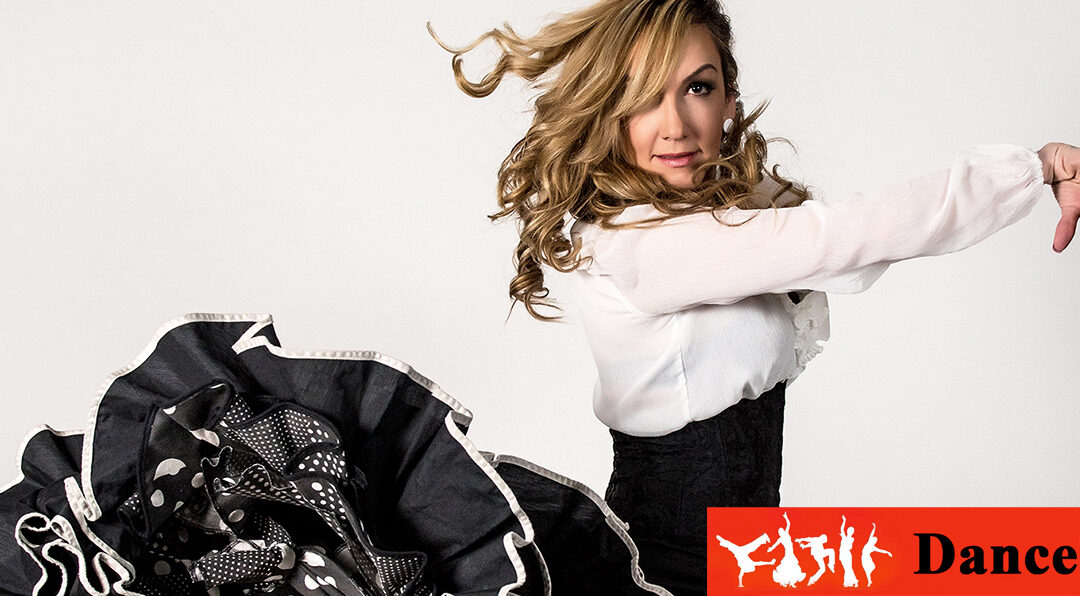
Maria talks about overcoming a physical disability and loss on her path to doing what she loves. Follow her work at https://www.facebook.com/DANMAR.ACADEMY, instagram.com/danmarstudio, and https://www.youtube.com/umf83.
DanceTalks with Maria Fernanda Urbaez: Full Transcript
Hosted by Andrea Cody, Director of Dance Houston. Originally released April 21, 2020. This transcript was generated automatically and may contain small errors.
Episode summary (SEO)
On this episode of DanceTalks from Dance Houston, host Andrea Cody talks with Maria Fernanda Urbaez, the Venezuelan-born flamenco and Venezuelan folk dancer, choreographer, teacher and producer who leads DANMAR Art and Dance Studio and the DANMAR Academy of Performing Arts in Houston. Maria describes dancing as a little girl in Venezuela, being diagnosed with severe scoliosis at 11 or 12, and having two rods placed in her spine, then learning to dance again by creating the illusion of movement she can’t physically make. She tells how she started teaching at 15 in her family’s living room in South Florida, how a university counselor in Houston pointed her from graphic design to a dance and theater degree, and how she and her sister Daniela founded DANMAR, named for the two of them, before Daniela’s death in 2007. Maria explains the roots of flamenco in Andalucía, the palos and their rhythms, the intimacy of a Spanish tablao, and how her styles, from flamenco and Venezuelan folk to Arabic dance and Latin rhythms, each carry a different feeling. She also talks about how dance has changed with technology, why students dance for different reasons, and keeping her students and teachers together on Zoom during the COVID-19 shutdown. Recorded April 18, 2020.
Key takeaways
- Adapt to the world. Maria’s university teachers told her the world won’t adapt to her disability, so she learned to make her body look as if it were contracting when it couldn’t, and to be an example rather than an object of pity.
- In flamenco, the older the better. Unlike ballet, flamenco rewards maturity, because it takes life experience to understand and express the emotions behind each rhythm.
- Thank every teacher. Even the teachers you didn’t connect with taught you something, and each one leaves a mark on where you are today.
- Read your audience. A restaurant crowd celebrating a birthday wants something different from a tablao audience, so Maria shapes each set around the event and the palo she is dancing.
- People dance for different reasons. Some students want a career, others a hobby or a way to relax, and accepting their different motivations made her a better teacher.
Transcript
This transcript has been lightly edited for readability: filler words and repeats were removed, and several passages that could not be heard clearly in the recording were left out or condensed.
[0:00] Introduction
Andrea: Hello and welcome to DanceTalks. Today is April 18, and my guest is Maria Fernanda Urbaez. She is an expert in Venezuelan and flamenco dance and culture. She is an artistic director, dancer, choreographer, instructor and producer. Her companies are DANMAR Art and Dance Studio and DANMAR Academy of Performing Arts. Maria, thank you for being a part of DanceTalks.
Maria Fernanda Urbaez: Hello, I’m very happy to be here. Let’s see how this goes.
Andrea: Let’s start with you just telling me about your life as a dancer, the whole story, from the beginning, from when you were a child.
[0:36] A little girl in Venezuela
Maria Fernanda Urbaez: Okay. I kind of wrote this down, because I try not to get off track. Well, let’s say that I’ve always been interested in dancing. According to my parents, I was dancing when I was a super tiny little girl. I was very interested in dance and music, and according to my parents I started developing a lot of talent for it, and I had a passion for it. I was living in Venezuela back then. I started dancing when I was five or six years old. I did flamenco, ballet, tap, hip-hop, Latin dances and folklore. Folklore was not my favorite at the time. I was young, so I just wanted to do anything hyper and fun, jumping, jumping, jumping. And eventually I started liking it more. I did a lot of gymnastics and sports, and different instruments: piano, cuatro, a little bit of harp. But my favorite was always percussion.
And I was doing all this with my sister. Her name was Daniela, and that’s where the name DANMAR comes from: “Dan” from Daniela and “Mar” from Maria. A lot of people think Mar is actually my name, and I just laugh. That name comes from my sister and me.
[2:03] Scoliosis and two rods
Maria Fernanda Urbaez: So I was dancing all this time, but around 11 or 12 years old, I started noticing that everyone dancing was super straight, and my back was kind of twisted and weird. I didn’t look the same as everyone else. It turned out I had scoliosis, a very bad scoliosis; the deviation in my back was insane. It got to the point where I needed surgery. So at 12 I had my first surgery, and I say first, because a year later I had to have another surgery, because the deviation kept going. During those two years it was rough, because I couldn’t really dance. I had to be in complete rest mode for a whole year. That made me fall behind; my sister kept going with the dancing, and I felt like I was behind. That made me very insecure, because in the dance world you have to be very flexible, able to contract, to extend, to do all these things. And I had two rods placed in my back, so my back completely solidified. There’s no way I can contract or do any actual movement with my spine.
I felt very sad about it. I thought I was never going to be a dancer, and I felt very unmotivated to keep going. So I started doing all these different things. I became a rebel: “I’m not going to dance again.” But deep inside, every time I heard music, I just wanted to dance. Every time I was mad, I just wanted to dance. I would go to shows and dance.
[3:49] South Florida and the illusion of movement
Maria Fernanda Urbaez: At 15, my parents got transferred and we moved to the USA, first to South Florida. And there I was like, “You know what? I love dancing. I’m just going to keep dancing.” I started taking dance classes and just learning how to deal with my new body. I said, “I’m not going to stop. This is what I like to do.” A lot of my teachers were surprised that I had two rods in my back and still danced the way I did. I managed it by looking at myself in the mirror for hours, to make my body look as if I was contracting when I wasn’t. I was making an illusion. That made me feel very secure, and I started gaining confidence.
My teachers started realizing that I really wanted to be a dancer, and they started noticing some kind of leadership. This is how they describe it; I’m not describing myself. They’d say, “You always have this leader personality within you.” People in the class, at a water break, would come to me: “Hey, Maria, how was this step?” That started training me to want to dance more and to start teaching. I noticed I had a passion for teaching as well, and that I was actually good at it. Just because you’re a dancer, that doesn’t mean you are a good teacher, and a good teacher isn’t always the best dancer. But I felt very good with both the dancing and the teaching, and my teachers inspired me. They started giving me classes to cover for them, teaching little kids and adults.
[5:37] Teaching at 15 in the living room
Maria Fernanda Urbaez: By 15, I started teaching in my house. It got to the point where I said, “Dad, where am I going to teach? I can’t rent a place.” I was 15; I wasn’t earning any money, and I was not going to spend it on rent for a space. So my parents gave me the living room. They put down some wood and some mirrors. It was amazing. Can you imagine a 15-year-old teaching every day, two hours a day, 10 students per hour?
Andrea: For our audience, can you tell me how big your room was?
Maria Fernanda Urbaez: I would say maybe eight by twelve. It was definitely smaller than this room right now. It was a tiny space; we had just moved to that area, so it was a tiny little apartment, kind of like a townhome. And it was great. I started building my name, which was very interesting at the time. I didn’t know; I was just thankful that I had such a great family, giving me everything I needed. I started seeing some kind of future, but I still never thought this was going to be my career for life. In Venezuela back then, if you’re a musician or a dancer or an actress, people would tell you, “You’re not going to make it. You need to be a doctor or a lawyer or a dentist.” You couldn’t live off of it.
So when we were here, we started doing this, and eventually it got to the point where I loved doing it, and I was already in 12th grade. I had to decide what I wanted to study at the university.
Andrea: Just to give us some context, what year did you graduate high school?
Maria Fernanda Urbaez: That same year, I was teaching and I chose graphic design. I told my mom, “I’m not good enough. I have two rods in my back; I’m never going to make it. I’m just doing this for fun.” So, long story short, I went to the university to study graphic design that first year. In parallel, I did my first show ever. I was so nervous, I was dying, but the whole thing was beautiful. And then my parents got transferred to Houston within that same year.
Andrea: Where were you before Houston?
Maria Fernanda Urbaez: Weston, Florida. That’s where I had my first show, right before moving here to Houston.
[9:24] “This girl just wants to dance”
Maria Fernanda Urbaez: So we moved here to Houston, and again I was studying graphic design, but I just wanted to keep producing my shows. I didn’t have my students. What was I going to do? New place, new people again. So we did the same thing: our living room, some wood, some mirrors. I started trying to be part of different groups and get to know the style here. And eventually we decided, “Let’s do this. Let’s start doing it again.” But there was something stopping me still: graphic design. I didn’t want to do it anymore. When I went to the university here, they told me I had to start again from zero, because the year and a half I had already done couldn’t be transferred. I started crying right there in front of the director, with my dad looking at me, and he said, “This girl just wants to dance.” And the counselor said, “Yes, we actually have a bachelor’s degree in dance and theater.” And right there I was like, “What?” My dad just looked at me and said, “Why don’t you study that? That’s what you want to do.” I was like, “Are you serious?” In three seconds, my life completely changed. So I decided to study that, and six months later we rented a studio. And here we are, 20 years later.
[11:00] Losing Daniela
Maria Fernanda Urbaez: It was amazing. I kept dancing with my sister, and everything was amazing. And in 2007, she passed away in an accident with her husband. That point was very hard for me, because I didn’t know if I wanted to keep going. I said, “The Dan of DANMAR is not there. I’m not going to do it.” But thankfully, we had six or seven years in business already, and I had a lot of support from the community and from my parents. My parents never let me down. And I’m still here, so thankfully I’m doing something right. I have a great team: my mom, my dad and my family.
[12:00] Flamenco, Venezuelan folk and more
Andrea: Wonderful. Thanks for catching us up; what a great story. Tell me about your specialty. What’s your favorite dance style, the main one? Tell us about it.
Maria Fernanda Urbaez: That’s always been the million-dollar question. I am never able to answer that one. I would say the ones I perform most are flamenco and Venezuelan folk; those two are what separate me from the rest. I also specialize in Arabic dances, which a lot of people here call belly dancing, and I do a lot of Latin rhythms, like salsa, merengue and samba. And besides that, there’s what I studied at the University of Houston, where the specialty was modern. Mind you, I couldn’t contract at all. When I auditioned there, I said, “I have a physical disability,” and it was scary. It was rough. They made it very hard, and they were all like, “If you really want this, you need to find a way, because the world is not here to adapt to you. You need to adapt to the world. You need to be an example for others. People shouldn’t have pity on you because you have two rods in your back.” It was pretty amazing. Since then, I haven’t been afraid of doing anything and everything, even if I can’t do it perfectly. I may be doing it wrong, but I try. So flamenco, folk, Latin rhythms and Arabic dances are the main ones that I do.
[14:07] Where flamenco comes from
Andrea: Tell us about flamenco.
Maria Fernanda Urbaez: What do you want to know about flamenco? Which part? Because flamenco is a whole world. We would be here for seven hours or more.
Andrea: Right, right. Let’s start with the origin story. Where does it come from?
Maria Fernanda Urbaez: There’s so much information about it. For those of you listening who don’t know, flamenco is originally from Spain. It was danced in Andalucía, the southern part of Spain, and back then it was more of a folk dance as well. But with all the influences they had over there, it became what’s known today as pure flamenco. So there’s a lot of history behind it. Even the cajón, which is like a wooden box, is actually an influence from Peru, which was the one that had that instrument first. And now you see it in the perfect cuadro; a cuadro is the flamenco group that you see performing.
One of the interesting things about flamenco is how it compares to ballet. In ballet, you need to be very young, and your body needs to be very capable. After a certain age, you’re not able to be a prima ballerina. In flamenco, actually, the older you are, the better it is, because then you have more maturity to understand the emotions behind it. I started at six years old; I’m 37 years old, and I’m still learning. It’s a beautiful art form. You have dances that are happy and sad, anything from joyful to painful, and you need to have a structure to dance to it. It’s not just a regular song. There’s a communication between everyone, and you need to know how to communicate with everyone, so it can take years to master. But it’s such a beautiful art form, and I always invite people to learn it. If you want to know more, there’s a web page called Flamencopolis, F-L-A-M-E-N-C-O-P-O-L-I-S, where you can find all kinds of information.
[18:00] Rhythms, palos and Spain
Maria Fernanda Urbaez: You can ask me anything specific. Besides that, we have binary rhythms, so you need to be able to identify whether you’re dancing in fours, in sevens, in eights or in twelves. And depending on the accents, the rhythm changes, the outfit colors change, the region where the dance comes from changes. Anything.
Andrea: Have you been to Spain?
Maria Fernanda Urbaez: Oh yes, many times. I would go every time I got a chance, before, because now I have a baby, so my trips there have stopped for now. The last time I went was in 2016. Every time I go, I try to stay for a minimum of a month, so I can actually train. Every time you learn something, it’s like medicine; you keep training yourself.
Andrea: How is it different there from here?
Maria Fernanda Urbaez: You find it there on every corner. You have guitars everywhere, and schools that are just for flamenco, where people study seven hours a day. Here it’s different, in the sense that maybe you do one show per year, because the flamenco community is small. I’m not saying people aren’t interested, but when it comes to dancing, there aren’t so many students. There, you’re living it, the pureness of it. Here we’re all aficionados, and it’s completely different. It’s like when I go to Venezuela: seeing my shows over there, or seeing people dancing it purely, is different from here. Here we’re trying to make a show to educate people, but it’s not the same essence as actually being there.
[20:22] The tablao
Andrea: And what is the environment like for flamenco in Spain? Is it in the street, and where else?
Maria Fernanda Urbaez: You can go to tablaos. The tablaos are the typical places where you would see flamenco shows, and I love tablaos. They’re tiny little places, not a big theater. A tablao is a small room, and maybe 40 or 50 people can be in it. They either have a small raised stage or it’s at the same level, and you see the person right there. It’s not like a theater for 3,000 people. You see right there the singer, the dancer, the guitarist. There’s not much lighting, and these days sometimes you find speakers and a microphone so everybody can hear. And on the street, you’ll see anyone just doing it right there. That one-on-one is just so spectacular. I love it; it’s so delicious. Every time I do a show here, I try to do the same, in small places, so people who haven’t been to Spain can get the vibe of what it would be like.
Andrea: I went to one in Seville, and the closest thing it reminds me of here is Mi Luna.
Maria Fernanda Urbaez: I used to perform there. It’s very different from a tablao, in the sense that in a restaurant, people are eating. They want to have fun, but they’re not really paying attention to the dancing. When I used to perform there, my set was completely different from one in a tablao. People in a restaurant want to see something fun. They’re celebrating a birthday, you know what I mean? So if you start doing something very, very deep in flamenco, you probably won’t connect with the audience, because they’re expecting something happy. They’d be like, “Why do you have that mad face all the time?” And it’s not that you have a mad face. It depends on the palo; palo means the rhythm you are representing, and you need to represent that. If you’re dancing, let’s say, seguiriyas, you’re dancing to something like death, something sad and angry. I can’t be happy about it. I can’t be wearing a pink outfit; I need to be wearing black. There’s so much to it. So when I get hired at a restaurant, I set my show based on my audience and what the event is for.
[23:31] Every style is a different feeling
Andrea: It’s interesting to think about how the different cultures and contexts for presenting this dance change it.
Maria Fernanda Urbaez: Totally. And that’s one of the things I love. When I think of flamenco dancing, it immediately takes me to passion, fire, strength, emotion, power. If I think of Venezuelan folk, it takes me to home, love, pureness, memories. Belly dancing, for me, is beauty and sensuality, not sexuality. And Latin rhythms, salsa, are fun, party, connecting, social dancing. They’re completely different. That’s why, when people ask me which one is my favorite, I can’t answer, because it depends on my state of mind at the time. One day I might be very happy, and that’s what connects with me. I might be very angry, and the first thing I hear is a very powerful flamenco song, and I just want to dump my heart out. Or I’m overwhelmed and want to hear something soft and mellow. It all depends. My body is meant to dance. Whatever I hear, I’ll just move to it, even if I’m doing it wrong. I’ll just go with the flow.
[25:00] Her teachers
Andrea: Who are your teachers?
Maria Fernanda Urbaez: Imagine, having tried so many different styles, and believe me, I will still go and sign up for any class I see, even if it’s not in my comfort zone. I’ve had many, many teachers in my life, and I’m very thankful to each one of them. Each one has made an impact on my life in a different way. My first teacher ever was La Madame; that’s what she was called. She was the one who introduced me to tap, contemporary, ballet and jazz. And then Omayra Oliveros was my first flamenco teacher. I was six or seven years old, and she was so sweet, and I just fell in love with it. I remember it was just three of us in the class. I’ll never forget how much fun she made it for me. You know how hard it is to teach kids; if they’re not interested, they’re gone. And here I am, 30 years later.
I’ve had amazing teachers. In flamenco, Antonio Granjero, who was here in Houston, and I took classes from him; Damaris Ferrer, from Miami; and teachers at the University of Houston. I’ve had a bunch of teachers who have impacted my life, and I always tell people who are hearing this: be thankful to all of your teachers, whether or not you connected with them on a deeper level. Every teacher teaches something. Sometimes students say, “This teacher never taught me this.” I’m sure they did, but maybe you weren’t in the zone at that moment, or you were thinking of something else, or it didn’t click with you. Every teacher teaches you something, and you have to compare yourself to how you started and where you are now. They always leave a mark on you. So I thank all my teachers for everything they did and everything I’ve learned, because thanks to them, I am where I am today. Each one of them taught me something that I still use today.
[27:44] How dance has changed
Andrea: Awesome. What have you seen change over time since you started, with how dance has evolved with technology?
Maria Fernanda Urbaez: In technology and in everything, it has definitely changed in the last two decades. Before, it was completely different. I remember when I used to belly dance in five restaurants around the Houston area, I would only dance with a veil, and that’s all you needed in order to be a belly dancer. These days, you need to have fire. If you’re not doing something like that, people don’t get that wow factor. So it’s not the same scene. The traditional, old-fashioned veil compared to now, dancing with fire all over me, doing all these tricks, and now I bring out the snake. It’s very different. I wouldn’t say better or worse; I just think it’s different.
And in salsa, social dance now isn’t the same; you need to be flipping the girl and doing all these stunts for the audience to stand up and applaud. Now one spin isn’t enough; you have to be able to do 20 million. You need to do over-splits and all this craziness. So in that sense it has changed. And when it comes to technology, I’m actually very thankful, because before it was so hard to have the whole set ready in less than two days, renting a theater for two days just to have the set designed and changed. So for me it’s actually been a great advancement, if that’s a word; forgive my English, my Spanish. I love it, and I think we are growing in that department. And in my own opinion, I’m saving money too.
[30:55] Why students dance
Andrea: And how have you seen your students change? You went from teaching peers, I think you said, when you were 15. Why were they dancing then, compared to why they’re dancing here and now?
Maria Fernanda Urbaez: That’s very interesting. Since I started teaching, I thought students would keep dancing the way I did. I’ve always been very focused on dancing; my life revolves around it. I go to the mall and I see something and think, “How can I use it in a show?” I figured they thought the same way. But then they graduated high school, college started, and they stopped. In my head I was like, “Why aren’t you dancing still? You can still go to the university.” I went to the university and worked full-time. My life consisted of university from 8 a.m. to 4:30, then teaching from 5 to 10, then homework until 2 in the morning, and showers at 3 in the morning. I was taking eight courses per semester, and I graduated magna cum laude. “How can you not, with only four?” I was very judgmental at the time. I was younger, and I think I wanted people to do what I wanted them to do.
But then I realized that everyone has different purposes and motivations to dance. There are people who dance because they want to become professionals, people who want to do it just to relax, people who do it as a hobby or to compete. So that has definitely been a challenge for me, to understand it, and back then it was rough, because I expected them to grow with me. But I’ve had people who keep going because they really like it. They don’t do it as much as I do, because this is my profession, my career; they do it as a hobby. And maybe four or five I’ve seen go on to study it at the university. Either way, I’m happy, and I hope that whoever does it, does it for whatever reason. I just invite people to dance, because it’s so much fun, and it’s therapy. There are so many beneficial aspects of dancing: coordination, memory, speed, flexibility. There are so many good things about it.
[34:17] Dancing through the shutdown
Andrea: What is dance doing for you right now?
Maria Fernanda Urbaez: It’s hard for me to answer that one, because I hear from my students that it’s a moment for them to relax. I relax when I’m with them, but in the back of my mind I’m worried. I’m trying to help some people, and I’m not producing enough. I just shared some money with friends of mine who have another studio, and a friend said, “I saw you donating to them. They’re your competition.” I said, “They’re not competition. We’re all trying to survive.” At this moment so many people are trying to figure out what to do. We’re teaching through Zoom, and it’s been great, but I don’t know how long this is going to last. It’s relaxing while I see them for that hour, but as soon as I shut down the computer, it’s like, “Do we know this is going to continue? What’s going to happen with us artists? What are we going to do?” We’re in the middle of week five.
Andrea: How has your relationship with dance changed from six weeks ago? I would imagine it was your best friend. Is it now your counselor? Have you lost touch?
Maria Fernanda Urbaez: I don’t think it’s so much about me today; it’s more about my students. If I don’t have an answer for them, I feel bad. At this point I have so much going on with my family, my daughter, and my parents just moved back here, so to a point I’m kind of distracted. But when I put my feet on the ground and see the other people, I think, “What are they doing? What am I going to do to help them?” That’s more of what I’m thinking about than my own connection with dance. I’m always connected to dance. It’s a love-hate relationship. There are moments when something doesn’t work on me and I hate it and want to quit, moments when the routine kills me and I just want to stop. But if I hear some drums on the radio, my body automatically dances. So I can’t say, “I quit, I’m done.” I can’t. You keep going.
Andrea: It sounds like it’s really changed. It went from being something that was really self-expressive to doing good for others and staying connected.
Maria Fernanda Urbaez: Yes, definitely, that has made a difference. And right before this break, we were doing competition teams. These girls had just competed, and thankfully we won the whole thing, the highest trophy, and these kids were super excited. The weekend this whole thing started was our second competition, and now there’s no competition. And all the preparation for my end-of-year show in June, all the little shows here and there, collaborating with so many people. So what do we do? When you’re in love, everything is pink. Right before this, I was in pink mode, and right now it’s some kind of gray. It’s not black or white. I can’t see through.
Andrea: A fog has set in. Your relationship with your students is so important, and it’s wonderful that you’re keeping that alive and being here for them. They really need you.
Maria Fernanda Urbaez: I know. It’s insane; 20 years of teaching.
Andrea: It shows. You’ve been wonderful. We can take a breath.
Maria Fernanda Urbaez: This didn’t happen before. I didn’t realize I was feeling like this for them. I just feel for them.
Andrea: My kids are so happy to be spending time with their teachers. It’s just awesome for them to get to see them and their classmates. It really takes us back, at least in our imagination, to those places and that community that we long for. I know you want to get back there. Have you thought about any alternatives, what you’re hoping to do next?
[40:20] “We have to make it work”
Maria Fernanda Urbaez: We’ve been mainly concerned with the studio. We have to pay our bills, the rent, and that has been our main concern. If we don’t have the studio, well, we do have a solution: I used to teach in my house, and I can still do it. That isn’t stopping me. What’s stopping me is that I have a staff, an amazing group of teachers, and they’re depending on what the studio does so we can pay them. To them this is also an escape from reality. If we can’t pay for the studio and we close and teach through Zoom, what do I do with my staff? Do we still work together? They’re teaching through Zoom from their houses, and we’re helping them. But the unknown is what’s killing me. How do we help these people? I’m thankful that I have my husband, and thankfully he still has his job. But some of these dancers don’t have a husband who’s producing. They probably don’t have a job; maybe they’re the main income in their house. So how can I help if I’m not able to continue? If I’m not helping myself, I cannot help them. That’s the scary part. I want to keep doing this for me, but for them as well. And now that I’m a mom, I think that’s why I got like this. Now that I’m a mom, I’m feeling even more love toward these kids. I’ve always loved my students, but now it’s even more.
Andrea: You relate to them; you know them better. I think I’ve gone through that transformation as well. My students have always been my kids, my favorite people. But this last summer my heart just exploded when one of them, who had grown up, came back as a choreographer and did a dance to a song whose chorus said, “I found love where it wasn’t supposed to be, right in front of me.” I was standing there watching all of them dancing, and I loved them so much, and I thought, “Oh my goodness, this is what this song is about for me.” I was so proud and blown away.
Maria Fernanda Urbaez: They definitely teach us to become better. I think I’m a better teacher every day thanks to them. They’re the ones who teach you how to teach. There’s no formula to get to know each student; everyone learns differently. As a teacher, you have to get the best out of each kid and teach them in the way they’re going to understand. You make connections with all of them, even the toughest one, the rebel one, the sweet one. I don’t know if it’s our mom spirit or what, but we always want to make them better.
Andrea: It’s beautiful.
Maria Fernanda Urbaez: It is. I think we’re going to stay together.
Andrea: We need each other as always, if not more than ever.
Maria Fernanda Urbaez: Totally. So we’ll see how that comes to be. We have to make it work. I have faith that this is going to be fixed sooner rather than later. It’s just the not knowing when. And like I said, there are some people who can’t wait. I’ve lost some students right now because they can’t pay, from low-income families, and I worry about that. Where are they now? If this was their only escape, and I was seeing them every day, even for one hour, I was keeping them from doing things that probably aren’t okay. I worry about them. Are they okay? Are they in school? Are they doing what they’re supposed to be doing? And what about the people who don’t have computers, who can’t take classes now? My mom tells me not to stress so much about it, but I can’t help it.
Andrea: You have already given them the gift of dance. They have every one of those moves you gave them, and the ones you cheered them on as they made them up themselves, and the ones you helped refine that they brought in with them when they showed up. So they have that to keep them going, strong and healthy.
Maria Fernanda Urbaez: Definitely. I feel good about that.
Andrea: And like you said, when they show you a dance or their improvement, or even if you don’t see them again and they dance somewhere else, in another country, it’s so rewarding to know that you put a little bit into that, and that they’re growing thanks to what you injected.
Maria Fernanda Urbaez: And in one way or another, I think it helps them learn discipline, teamwork, love for their friends, love for their teacher, respect. There are so many good things about this, and I love it. I’m in love with this.
Andrea: My guest today is Maria Fernanda Urbaez. Maria, thank you for being a part of DanceTalks.
Maria Fernanda Urbaez: Thank you so much. It was super fun. Thank you for getting this out of me.
Andrea: Oh, great. Take care.
Maria Fernanda Urbaez: Thank you.