
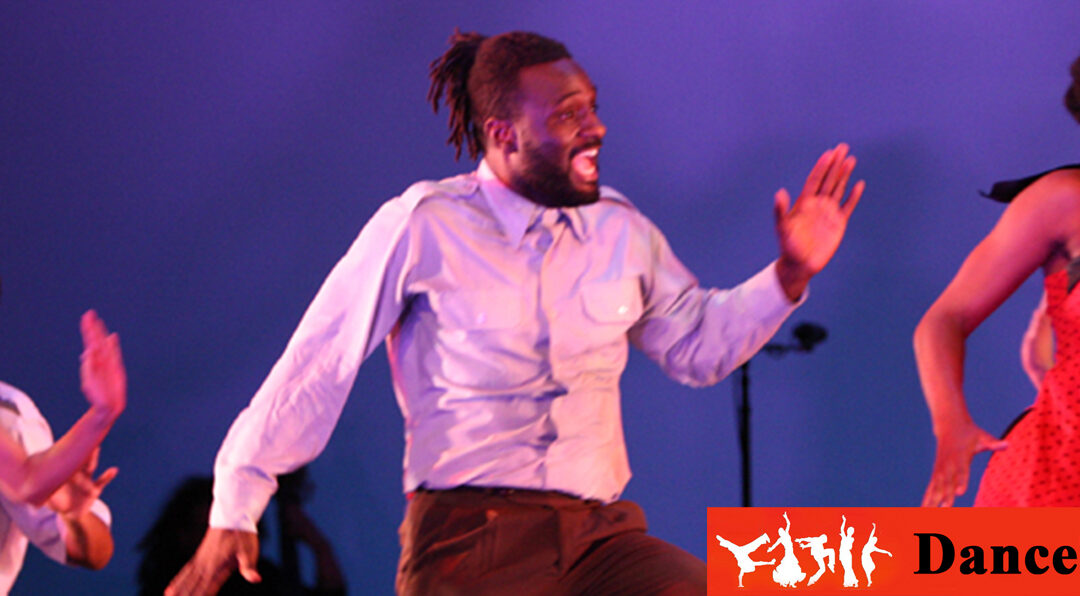
Le’Andre Douglas talks about why and how he learned to dance, black dance history, and his career as a freelance artist. Follow him at https://www.instagram.com/andredouglas2 and https://www.facebook.com/leandre.douglas.9.
DanceTalks with Le'Andre Douglas: Full Transcript
Hosted by Andrea Cody, Director of Dance Houston. Originally released July 20, 2020. This transcript was generated automatically and may contain small errors.
Episode summary (SEO)
On this episode of DanceTalks from Dance Houston, host Andrea Cody talks with Le’Andre Douglas, a Houston dancer, choreographer and teacher whose career spans street dance, theater, commercials and concert stages. Le’Andre started dancing in seventh grade after watching a classmate win over the whole school with his moves, then learned popping and breaking from shared VHS tapes of the Electric Boogaloos, Mr. Wiggles and Poppin’ Taco, sharpening his skills at Houston teen nights and clubs. He bartered hip-hop classes for his first ballet and modern lessons at Southwest Dance Academy, found mentors in Chris Gomez and Chris “YungChris” Thomas, and had his first big theater break in the Motown Revue at Miller Outdoor Theatre. He shares stories from the worst gig of his career, opening for Kendrick Lamar at Day for Night, and joining the sets of touring artists such as Jason Derulo. Le’Andre also talks about the history of Black dance from the slave ships to the Savoy Ballroom, Master Juba and Five Points, working with Lindy Hop legend Norma Miller, learning through rhythm and cadence, and why the music is the choreographer. Recorded July 17, 2020.
Key takeaways
- Learn from the culture, then seek out the source. Le’Andre started with VHS tapes and club battles, but he went on to find the dancers he admired, take their workshops and build relationships with them.
- Say yes and show up. Many of his biggest gigs came from random phone calls, hanging out with other artists’ dancers, and spotting a gap in a show that he could fill.
- It’s the rhythm, not the step. Working with Norma Miller taught him to hear dance as cadences, the same way rap and hip-hop beats carry rhythm.
- Every style comes from the same place. He describes his dance as “everything Black,” connected by the feelings and consciousness behind the music rather than by any one step.
- Listen to the music. Don’t just hear it. Listen to the same song a thousand times if you need to, and let the music tell your body what to do.
Transcript
This transcript has been lightly edited for readability: filler words and repeats were removed, and several passages that could not be heard clearly in the recording were left out.
[0:00] Introduction: why he started dancing
Andrea: Hello and welcome to DanceTalks. I’m your host, Andrea Cody. Today is July 17, 2020, and my guest is Le’Andre Douglas. Welcome to DanceTalks. Thanks for being here. I actually do not know this: how did you start dancing?
Le’Andre Douglas: How did I start dancing? Okay, so I actually started dancing because in seventh or eighth grade there was a school dance, and by far the ugliest guy in our school, I’m not trying to be mean, he wasn’t very attractive, but at this party he could dance. He danced really well, exceptionally well, and I was kind of captivated by that, mainly because the school dance happened on a Friday, and by Monday all the girls were still talking about his dancing. By lunchtime on Monday he had a girlfriend. She was not the prettiest girl in the school, but she was up there; she was not unattractive by any means. During lunch they were asking her, “Why are you dating him? What’s up with that?” And she said, “He can dance!” And all the girls were like, “Yeah.”
And that was it. I was like, I need to learn how to dance. Not only was it captivating just to see him move, but his physical features had nothing to do with him getting a girlfriend. It was just the fact that he could dance. So that’s when I started dancing, in seventh grade. When we would go to teen nights and all the parties, the guys who could dance the best got to dance, and at the end of the night, when the slow songs came on, the guys who had danced the whole time were the ones the girls went to. I wanted to be a part of that life. So that’s how I initially got into dance. I just wanted a girlfriend.
Andrea: That’s so sweet. My kids are in dance for this dream I have for them, the same thing: so they won’t be socially awkward, so that one day they’ll see a girl or boy, offer their hand and say, “Do you want to dance?” And let the magic happen.
Le’Andre Douglas: Yeah. Like Beauty and the Beast. I feel like they fell in love when they started dancing on that grandiose dance floor.
Andrea: It’s interesting. Was it a foxtrot, or whatever that was? I think it was a waltz.
Le’Andre Douglas: I’m pretty sure, but I feel like the song is not in 3/4 time. It looked like a waltz, but it was a foxtrot, and they look similar.
Andrea: So many of the couples who come to me are getting married, and so often one or both of them have never danced, so we take it from the top.
Le’Andre Douglas: I just feel like dance is one of these arts that everybody is going to encounter sooner or later. There’s always going to be a situation in everybody’s life where dance is expected, whether it’s a wedding or some kind of celebration. When you talk about couples who say, “I’ve never danced,” it’s like, you’ve never been to a club? You’ve never done a victory dance? I just find it odd.
Andrea: I think they can “tree dance.” That’s what one of them called it. They can sway back and forth with their arms around each other, but they specifically say, “We have no rhythm.”
[4:07] Learning from VHS tapes
Andrea: Okay, so how did you learn all these moves and get there?
Le’Andre Douglas: My smooth moves? So, as a kid, there was this guy named Muhammad. I was telling you about the teen nights we went to. It was actually at Funplex, something like 7 to 11. One of the best dancers was Muhammad, and he had a collection of VHS tapes: the Electric Boogaloos, Rock Steady Crew, Skeeter Rabbit, Mr. Wiggles, Poppin’ Pete, all kinds of popping and breakdancing videos. I got real friendly with him and his friends because they were the best dancers. I would go to their house after school and find combos watching these tapes, and then we started borrowing them. There were five or six of us and three tapes, so every week we had to pass the tapes around, and we would practice what we saw. Poppin’ Taco was another tape. That was one of my favorites.
Andrea: Were they educational tapes or just dancing?
Le’Andre Douglas: It was just them dancing, clips of them dancing in a club or a show or on the street. Now, Mr. Wiggles had more of an instructional tape, floor moves and floor combinations. He didn’t necessarily teach them; he just did them, and you interpreted it: rewind it, play it back, try to figure it out. That was my initial education, VHS tapes, which is why I don’t really get mad at people who learn from YouTube, because to me it’s kind of the same thing. But I think the difference is I actually sought those people out, found out where they were, started going to their workshops and developed relationships with them. But my first learning was these VHS tapes that we shared among each other.
Andrea: So did you go to dance class?
Le’Andre Douglas: Not coming up. I didn’t take my first dance class until much later. For hip-hop and popping, there were no structured classes, especially in the South. It was just these tapes, and I was practicing. YouTube was just starting, so you could catch a little bit of that, but it was with your peers. We just met up and battled. If there was a battle and they recorded it, we would go buy the tape, watch the battles back, and battle to sharpen our skills. But there were no classes. It was all street. The only thing that would be considered a class was the club. We would go to the teen clubs or the clubs we could get into. There was one called Club Coco Loco, and there were different clubs around town.
Andrea: I remember those, yeah. And the Roxy, right off Westheimer. Those clubs weren’t my jam; I was into ska and punk. I went out to ska every night from ’93 on.
Le’Andre Douglas: I just learned about ska maybe three years ago. It’s so fun.
[8:16] The club was the classroom
Le’Andre Douglas: But anyway, we would go to the clubs, and that’s where we got our education. You would dance, and you knew if it was good or not based on the people watching you. We would record ourselves dancing in the club. We would sneak in a camera, or have a relationship with the doorman, and we always got in free because they knew we were the dancers. So we’d get in with these big cameras and record ourselves dancing in the club, doing what we saw on the tapes. I don’t know where those tapes are now. My brother says he has some of them.
Andrea: I have a box of VHS tapes in my garage of every swing dance ever, up until about ’95 or ’96, when I got into it. I was dancing to ska music, wanting to know what more I could do. I was already dancing with my friends out there, twirling them around, and I was like, there’s a dance to that, you know? So I started collecting VHS tapes, and they made the rounds for sure. And Joel was there too. Joel was going to the Roxy.
Le’Andre Douglas: Yeah, he was coming to the Roxy. We shared a mutual friend named Julian, and he was the best among us.
Andrea: Where is he now?
Le’Andre Douglas: I don’t know. Last time I saw him, he actually lived not too far from here.
Andrea: In my era, I grew up with live music, and all I wanted to do was go dance to live music to show my appreciation to the band: you’re sounding good, I’m smiling at you, keep playing that music. As far as I knew, those clubs were DJed, and I wasn’t interested.
Le’Andre Douglas: Right, they were all DJs. We would record each other, and then you wouldn’t just look at yourself dance, you would look at the audience. If people were watching you, you knew you had something, and if nobody was watching you dance, that’s how you knew: this move doesn’t work. Did you see what they did when I did this right here? That’s a no. That was our class. I didn’t take my first actual professional class until after I graduated high school. I was maybe 20 or 21, and it was a ballet class. I actually bartered for my first classes. I said, “Teach me ballet and modern, and I’ll teach hip-hop classes for you for free.” It was more like popping and a little breaking at the time, but it was: I’ll teach these street classes if you let me take your ballet classes.
Andrea: So when and where was that?
Le’Andre Douglas: This was Southwest Dance Academy in Houston, coming up on maybe 11 or 12 years ago. That was my first introduction to class structure.
Andrea: In my era of live music and all-ages clubs, it was about catching the attention of the band members. That’s how you knew. And it was such an aggressive place that you would literally get elbowed out. If you weren’t supposed to be front and center, right in front of the lead singer, you’d get elbowed out, so I had to dance to maintain my position. I wanted to sing along to all the songs to let the band know: I know these songs, I follow you, I’m a fan.
Le’Andre Douglas: I know what you mean. We didn’t really have many live band situations, just because of the way the music was structured at the time.
[13:29] Mentors and the first professional gig
Andrea: Okay, so is that it as far as class?
Le’Andre Douglas: That’s pretty much how I got my basics. After that, of course, I sought these places out and got under some people. Chris Gomez and the good folks over at HaviKoro were kind of my first teachers for street styles like hip-hop and breaking. Chris Gomez was mentoring me and Chris Thomas together, and that’s how we started linking up and doing tours and things together.
Andrea: Okay, so tell me about that first step into professional performing.
Le’Andre Douglas: So I was dancing at this event. My cousin invited me to dance at her church. She said, “Hey, you dance, can you come dance at my church?” And I was kind of like, eh, all right, whatever. She kind of begged me. So I came and danced at the church, and this guy said, “Yo, man, you’re really dope. You should link up with my guy, Chris.” He gave me his number, and I called him for almost a week straight before I even got an answer. I would call and it would go to voicemail, and I’d say, “I met your friend. I’m a dancer and I would like to dance. They told me you had all the insight.” I called and texted off and on for about a week with very little response. Then one day he said, “Hey, come to this show we’re doing.” It was in River Oaks.
I had to catch the bus. I’d never been to River Oaks before, and I’m about 20 or 21. I get the MapQuest directions, catch the bus, and miss the stop. The stop didn’t look familiar, and I was like, I don’t think this is right. I get off the bus, lost, trying to figure out the directions, and my gut just led me. I walked three or four blocks, and there it was, the school. So I get there, and Chris Thomas, young Chris, is already there working for Chris Gomez. I had seen him off and on because we were both teaching classes at the time. I had gone to his class and he had come to mine, but he was not trying to mess with me at the time, he really wasn’t. I show up and I’m like, “Hey, Chris,” and he’s like, “What are you doing here?” He thinks I’m following him. And then Chris Gomez says, “No, he’s coming in. Okay, show me what you got.”
So I danced at this show for free, and he said, “Okay, you’re pretty good. Start coming around.” Then he started paying me to come out and dance in these gigs and shows. They were in the daytime, school shows, and that was my introduction to professional dance. He already had a company that had a contract with the U.S. Embassy and had been traveling the world. I basically bugged him until he gave me a job. That’s pretty much how I got in. And then he taught me and Chris the business side of it.
Andrea: So did you get to travel internationally through the embassy contract?
Le’Andre Douglas: Not with him. By the time I met Chris, they were phasing out of the embassy contract, but they were still traveling, and we did travel quite a bit.
[18:43] The Motown Revue at Miller Outdoor Theatre
Andrea: So what was the next highlight for you? Big break, big move, got on a plane?
Le’Andre Douglas: It’s kind of hard to say, because a lot of things started happening, even while I was traveling. But I would say the Motown Revue was a pivotal thing. One of my dance teachers, a lady I worked with, said, “Hey, you should audition for this show.” It’s a concert show. I think I was 22 when I found out about the Motown Revue. I did the first year and it was great. The next year, another choreographer came on who had performed in big shows, and Chris was her assistant choreographer.
Andrea: Young Chris?
Le’Andre Douglas: Yes, he was her assistant. It was at Miller Outdoor Theatre over a holiday weekend, and it was the first time I had performed in front of thousands of people at one time. I think it was something like 30,000 people over a three-day weekend, and it was packed. That was the first time I got on that kind of stage. I didn’t understand performing that first year. They wanted me to wear this costume, and I was like, this is not me, I’m not wearing this. I had to get a lecture: “Listen, you’re not you, you’re a character, and this character wears this outfit.” I was begrudging about it, and it was a solo. I remember getting schooled about that. It was my first big theater thing.
From there I rode that momentum and started doing all these other theater shows. I was still traveling and learning, going to New York, going to clubs and classes every summer, and people started asking, “Who is this guy who keeps showing up?” I was taking these different classes and coming back with that information, so I was getting better and better at theater dance. I started learning about Fosse, and I just wanted to be great at it, because if I was going to do this, I wanted to do it right. So that was the next pivotal thing, realizing, oh wow, I can really perform. At 22, that was my first time performing on that level, on that type of stage.
Andrea: Awesome. And there’s a band and singers?
Le’Andre Douglas: It was a band and singers, the whole production. It’s long, too, with a lot of big dance numbers. When we were doing it, there were a lot more big dance numbers and a lot more stunts, so it was physically demanding, but we were 22 doing that show.
[22:56] Building a freelance career
Andrea: Then what? Bring us along.
Le’Andre Douglas: So many things. I feel like I’ve got to get my resume out. Oh yeah, I did that, and I did the Sprite commercial, and then I did…
Andrea: Obviously you didn’t just join a company and dance in it for a decade. You’ve somehow pieced it together.
Le’Andre Douglas: Yeah, random, ragtag gigs.
Andrea: Do you have a manager?
Le’Andre Douglas: I had one for a brief moment.
Andrea: How did Sprite find you?
Le’Andre Douglas: I don’t know. I cannot remember. I’ll just get a random phone call from people saying, “Hey, I’ve got this thing coming up,” or a music video. Just saying yes and just showing up to places.
Andrea: Did the Motown Revue contribute a lot to your network, and to a relationship with Music World Entertainment?
Le’Andre Douglas: No. They didn’t link up with Mathew Knowles until I was definitely the choreographer; I worked my way up to choreographer. That relationship wasn’t there from the beginning of my journey. But Motown did help my visibility, because thousands of people saw me every night, 5,000 people a night. People were asking, “Who’s that guy?” And I was always around, going to different things. At that time I was married, and I just needed the gigs to keep coming in, so I kept digging and searching and making myself as visible as I could. If something came to Houston, I was trying to be a part of it. And my network came from trying to be around as many different types of people and dancers as possible. But I think I need to pull out my resume.
[24:58] The worst gig ever
Andrea: Worst gig ever?
Le’Andre Douglas: Worst gig? Oh, God. Okay, so it was a bar mitzvah, and I don’t even want to say the venue’s name, so leave it out. It’s not a place you should have a party under any circumstances. The ceiling was really low, maybe a foot above your raised hand, and it was a slanted outdoor concrete floor, and they just built a party room around it. We called it the taco hut. We were like, why would they put a dance in here? It was terrible. People kept breaking glass, and I was like, I’m not performing on this dance floor with broken glass all over it. We’re breakdancing; we put our hands on the floor and slide on our knees. That’s not happening. The equipment kept going out because there wasn’t enough power for the speakers, and it was hot. I did not enjoy that one at all. That was the worst one.
[27:02] Opening for Kendrick Lamar and dancing with touring artists
Le’Andre Douglas: But then you have things like the Day for Night festival, and a lot of openings, like opening for Kendrick Lamar, with a lot of people.
Andrea: What did you do for Kendrick Lamar?
Le’Andre Douglas: An opening performance, just me and three other dancers.
Andrea: Cool. So what was that like? How’d you get it?
Le’Andre Douglas: I got a phone call and they said they needed more Black people. To be honest, that’s what they said.
Andrea: Are you serious?
Le’Andre Douglas: They said, “We need more Black people.” The guy who called, I think he does a lot of circus work now, maybe Cirque du Soleil, and he lives in Vegas. He said, “Hey, you’ve got three rehearsals, and you’re basically freestyling.” And I said, “Yeah, sure.” It was a gig. I get to the venue and drive around, show my pass, and I see this giant stage and all this stuff, and I’m like, what is this? I pull up, and they say, “Oh, your section is right here,” and I’m like, a section? There are massage rooms over there and all this wild stuff. I’m like, okay, cool, what is this thing? And they say, “Oh, it’s Day for Night, and you’re going to open for Kendrick.” I was like, what? So I put a little extra on it. But it was basically a phone call saying, “Hey, we need a little color up there.” That’s honestly how it happened, and again, that was just from a random network.
So many things happened like that. With my crew, a friend of mine who’s a DJ said, “Hey, we need an opener, somebody who can fill this time before the main act. Can your guys do it?” I said yes, and we did that. And then I got the opportunity to dance with a lot of these artists just from dancing on the side while they were preparing, and they’d say, “Yo, that’s tight. Can you do that in my set?” “Yeah, most definitely.”
Andrea: Oh man, that takes me back. Getting pulled up on stage was the ultimate destination.
Le’Andre Douglas: I was always trying to get on the stage.
Andrea: So have you worked with recording artists collaboratively?
Le’Andre Douglas: Yeah. I did quite a few, and it’s been quite a while since I revisited it, but Big Daddy Kane, for example, as far as being a part of the production.
Andrea: Can we see it? Is it online?
Le’Andre Douglas: Look for it. It happens sometimes when artists are coming to Houston. Some of it comes from developing a relationship with the radio station: “Hey, we need an opener,” or, “Can y’all be a feature in this concert?” Then I go from being a feature to an act. When the managers come for sound check, I see the opportunity and say, “Okay, we can fill this gap right here.” Just to say we did Wu-Tang. So that’s how that happened. It’s just being there, recognizing an opportunity, saying, “I can fill this in, and this is how it works,” and having your paperwork ready: this is how much it costs. Or developing relationships with the dancers from the agencies, linking up with them, chilling backstage with dancers from another state, and while you’re there y’all are sessioning, and somebody says, “That’s tight. Can you come here?” Oh, Jason Derulo. I forgot about him. That happened from just hanging out with his dancers. “You can dance? Let me see. Turn that music on. Okay, can you do that in this set?” Every performer has a part of the set where they feature their dancers, like Madonna. So it’s, “You want to come out? You want to get off on this part?” Because I can’t learn the choreography the day of, unless they’re here for a week. And that’s happened too: “Hey, somebody hurt themselves, can you fill in? You’ve got two days.” Mostly it’s just saying yes and being at the right place at the right time. I’m lucky and blessed to have those opportunities. But once you have them enough times, you realize this is not luck.
[34:24] Creative process and musical influences
Andrea: So what’s your creative process?
Le’Andre Douglas: When I’m creating, my approach is to dig into a bag and say, oh, this music is invoking this and this and this. So what can I do with these sounds, and how can I bring this story or this music to life? Whatever I freestyle to, if I hear a song and dial into it, that’s most likely going to be the choreography. My dance is an amalgam of the styles I’ve learned, so if the music leads me to do something, it fits, and I don’t force it. I just throw it in there.
Andrea: Who are your favorite musicians?
Le’Andre Douglas: My favorite musicians? Prince. I really like Prince. I like D’Angelo, Miles Davis, Coltrane, Thelonious Monk. Those are the ones I really grew up with. I grew up with a lot of vinyl, so a lot of the studio drummers too, the resident studio musicians who played on a lot of albums for Motown or Sony or whatever. I can’t think of their names, but I know them.
Andrea: Session drummers. Right.
[36:31] “Everything Black”: what he calls his dance
Andrea: So what do you call the kind of dance that you do?
Le’Andre Douglas: What do I call it? I call it dance. It’s not really a mystery. It’s hip-hop, house, breaking, waacking, Lindy Hop, jazz. It’s all street-based; all of it is street dance. When somebody asks me what style I do, I say everything Black. Everything that Black people did, I do, and I incorporate it all into what I’m doing depending on what the music is telling me to do.
Andrea: Is there a common denominator across all of those styles that links them together, in addition to being Black?
Le’Andre Douglas: It’s not in addition to it. It’s the consciousness. It’s coming from the same creative space that I believe created us, created me. I’m tapping into who I’ve always been and who I will be. That’s the link. We’ve always done these dances, and I’m not really doing anything new. I’m just tapping into them, and the essence of them all comes from the same place.
Andrea: Do you think we all came from the same place, as in every person came from Africa?
Le’Andre Douglas: Somebody says we’re all from the same place, and certain genes changed based on geographic location and how close you were to the sun. Certain things in your DNA change the way your hair is or your eyes are. If you’re in the Caucasus Mountains and there’s snow and very little sunlight, your skin doesn’t need to be dark.
Andrea: So when you say you do the dance you’ve always done, from Africa until Le’Andre Douglas, how would you describe the common thread movement-wise? You’re saying consciousness. Is it not physical?
Le’Andre Douglas: It manifests itself physically, but I think it all comes from the same place, in different areas. The music changes the way you move. Think of music as vibrations. If you look at music in Pro Tools or some other music software, you see vibrations, right? That’s why people say, “It’s a vibe.” The energy the music puts out makes the dance take on certain characteristics. How fast the vibe is moving invokes a certain type of movement, but the intention behind why it was created is the same, which is what I mean by the same consciousness. If the consciousness is frustration, you can hear the frustration in the music, even if it seems melodic. The essence of it is frustration, which is something I can relate to, something I have felt. So that invokes the movement. It might be twitchy, or whatever it is. For me, it’s the intention behind the music. The feelings that humans, that Black folks, have felt, good or bad, are the common thing. That’s why you see the same characteristics of certain movements over and over in different places, because you’re tapping into a consciousness and not so much a step. Does that make sense?
Andrea: It does.
[42:40] From the slave ships to the Savoy
Andrea: So if you take us back to the call of the drum, can you give us touch points along the way up to Lindy Hop? I feel like you know a lot about the history between Africa and the Savoy Ballroom that I never knew until you told me, so I’d love for you to share it, however you want to phrase it.
Le’Andre Douglas: You mean when we talk about slave ships, and being forced to dance on slave ships?
Andrea: You can start there.
Le’Andre Douglas: Okay. There’s documentation of how, for the voyage, under the whip, they would force Black folks to dance and play the drums so that they would stay healthy. Not every ship did it, but the ships that did were able to keep more “stock.” Then you get to the Caribbean, and some got off there, or to Virginia, Louisiana, the Carolinas, wherever you landed after you were sold off. People kept the drum until it was banned, because it was leading revolts. We were sending messages through the drum, and they figured it out. Then messages went into the songs, letting people know things. A song like “Wade in the Water” is giving information: if you’re going to run, “God’s gonna trouble the water” doesn’t necessarily mean God is going to save you through the water. It means if you jump in the water, the bloodhounds can’t smell your scent anymore, so stay near the water if you’re going to escape. A lot of the songs were sung with coded language, and we see it now in hip-hop. Hip-hop has a lot of coded language that if you’re not part of the culture, you’re not going to understand. You think they’re just rapping and rhyming, but no, we put a lot of messages in the music. And the dance was also a way of protecting ourselves. Fighting styles like capoeira: we couldn’t have sticks or weapons, so they called it playing, but it was really training, through music and the drum, in how to protect yourself. That’s what I mean when I talk about genealogy.
Andrea: I’ve heard that after the drum was banned, there was tap dancing, and that the Irish played a part in that, because they came as indentured servants and they brought their dancing with them.
Le’Andre Douglas: If you were poor, you stayed in the same place. Gangs of New York actually has a small excerpt where a guy is watching a Black tap dancer and says something like, “Look at this, it’s African dance mixed with an Irish jig.” So people linked together, and as different cultures came together, different things got picked up. Slaves weren’t coming from just one part of the world. The word “slave” comes from “Slavic,” and Africans are not Slavic. So these people were coming together and mixing and matching different dances and sounds of music, picking up characteristics from each other, and these things were grafted into what we identify now. And it’s still changing, always changing, because people are putting their own seasoning into it.
[48:19] The words “black” and “white”
Andrea: So where does the word “black” come from?
Le’Andre Douglas: “Black” and “white” come from color codes, and they really deal with law: black in law and white in law, and white is presumed to be right. It’s dealing with your place in society and in law. White is granted to be right automatically, and it’s a construct created to further enslave people and to justify slavery. If I say black and white, I can’t tie you to a nationality. Japanese or Chinese people don’t come here and say, “I’m yellow.” They say, “I’m Japanese,” “I’m Chinese.” But if you name people so that they’re not part of a nation and don’t have a history, you say black or white. There is no landmass that calls itself black. There might have been concepts of it, but no nation calls itself black. When you talk about Marcus Garvey, Malcolm X, the Honorable Elijah Muhammad, or Noble Drew Ali, they talk about building a nation and Black people being tied to a landmass, and that’s where you get your justice, because a nation is responsible for you in law. If a Mexican person gets arrested in the United States, in order to charge them, they first have to contact Mexico and say, “We’ve got one of yours here. We’re either going to send them back, or can we charge them here?” If a Chinese person gets arrested, they have to let the Chinese government know. But if you’re black or white, it’s chattel property; you’re not treated as a real person because you’re not tied to a nation. So it’s dealing with color in law. That’s why white is presumed to be right. It has nothing to do with your actual pigment. It’s a way to grant rights to certain types of people, a construct when it comes to world government and world law.
[51:28] Master Juba and Five Points
Andrea: Will you please share about the history of the period when people were traveling around in shows, and somebody went to Europe? You know who I’m talking about?
Le’Andre Douglas: Master Juba? Oh, yeah. He was a dancer in Five Points. What’s the famous white writer? I’m drawing a blank. The guy who wrote Huckleberry Finn?
Andrea: Mark Twain.
Le’Andre Douglas: Thank you. Mark Twain wrote about him. He was a great dancer, one of the best, and he battled a lot to get his place. He battled the best white Irish dancer, and he ended up winning, and he was actually the first Black person to have his name on a marquee. He was written about by Mark Twain, and he traveled to Europe as a performer.
Andrea: Do you have any idea what he was doing?
Le’Andre Douglas: He was dancing. The accounts just talk about how fast his feet moved, and he was doing some kind of jig. I was trying to remember his real name, and I’m drawing a blank. I’m just not prepared.
Andrea: Have you ever done your Master Juba?
Le’Andre Douglas: Have I ever done my Master Juba dance? I don’t think so. I’ve done Master Juba-like battles where you just keep going at it until the first person falls. Actually, we battle like this: the first person to put their hands on their knees loses, because that shows you’re tired. So if you just keep going and keep coming up with stuff, you win.
Andrea: Cool. What’s Five Points?
Le’Andre Douglas: It’s not there anymore, but it was a place in New York where it all met up, at this one nucleus. It was an Irish and Black community, with a couple of others, but mostly them, kind of like a town square.
Andrea: Oh, I see, where the five streets meet.
Le’Andre Douglas: And Gangs of New York is about Five Points and its development, and how the different cultures were all meeting at this place.
[54:39] His motto
Andrea: So what’s your motto?
Le’Andre Douglas: Do I have a motto? I can’t necessarily take credit for the motto I have. “Live true, dance free” is one of them, and that’s from Marjory. She’s not on this earth anymore, but she’s with us in our hearts. She was a dancer from my big brothers’ and elders’ crew, Dance Fusion. So that’s a motto I adopted.
Andrea: One’s enough.
[55:47] Working with Norma Miller
Andrea: What was it like for you to work with Norma Miller?
Le’Andre Douglas: Okay. So I had a chip on my shoulder at that time. I remember it was a time of really trying to prove myself. I was there to learn and absorb the information, but I was also there to show what I could do, because I felt like it was a part of me anyway, close to what I do. But that was fun. I always love getting corrected by older people, especially about dance, because they just don’t lie. Old people have the liberty to just say it. I remember she said something like, “That ain’t jazz.” I like those kinds of notes. Some people get hurt by them, but I appreciate that, because they’re not going to lie to you, maybe because they don’t have time to. I like being under someone where I’m not the best, where you have to earn their respect. Respect has to be earned, and even if you don’t like what I’m doing, or you don’t like me, you know that something is there. So that’s what I took away from that experience. It was a great experience, but I definitely had something to prove, and I wanted to prove it to myself.
Andrea: What did you learn from Miss Miller?
Le’Andre Douglas: Rhythm. Rhythm cadences, like “be-bop-de-bop,” those different rhythm nuances. That’s how she would teach, and I understood it, because we talk in those rhythms. When you think about boom bap or hip-hop, I can hear it in the cadences, rap cadences or beat cadences. If you take something like “I said a hip hop, the hippie, the hippie, to the hip hip hop,” or “Up jumps the boogie,” that type of cadence is the same thing for me. It’s a rhythm, not a step. It wasn’t that we were getting the steps wrong; it was that the rhythm wasn’t right. So for me, it merged the worlds. You think these things are separate, but they were doing the hip-hop of their time, and we’re doing the hip-hop of our time, and everything in between is the hip-hop of its time, even though they were called different things. A lot of the characteristics, which again is the consciousness coming up, come from people wanting to party and be social. These are all social dances. At the beginning of the interview, I talked about going to clubs and looking at each other. They were going to clubs and doing their thing and looking at each other too. They didn’t have VHS tapes, but the essence of all that is the same. So being around someone that old and listening to her teach through cadences was the glue that made everything link for me.
[59:51] Frankie Manning and learning through rhythm
Andrea: Cool. Did you ever watch Frankie Manning teach a Shim Sham?
Le’Andre Douglas: Yeah. That’s how I remember it, because of the rhythms. That’s why I love it. If I’m remembering choreography, I’m putting it to a cadence. The way it’s said to me is how I internalize it. It’s been a while since I heard Frankie Manning. Who was that lady he was dancing with?
Andrea: Erin Stevens. She’s the one who called him up and said, “Are you Frankie Manning the dancer?” after he had been out of the public eye for decades.
Le’Andre Douglas: So yeah, hearing it in time and rhythm helps me remember it, know what it is and internalize it, because we’re all rhythmic. I don’t care who you are, we all hear music the same; it’s just the way we link to it. The way I’m clapping right now and talking, you hear it as music, because we all do things to a time. Even your heart beats in a rhythm, and no matter how fast the music is, your heart can sync to it.
[61:57] Why do we dance?
Andrea: Cool. Circling back to asking you what kind of dance you do, I figured you’d say dance. We always have to say something like “hip-hop with Le’Andre” so people know what it is before they see it. But I think that concept of “hop” is an informal word for dance, and everybody’s been doing it forever. It’s just that thing we do, with no rhyme or reason.
Le’Andre Douglas: Yeah. Why do we dance as humans? It doesn’t serve us for a purpose the way other arts do. Fashion can be explained: humans need clothing, so the art of fashion, the designs on our clothes, is an embellishment of a necessity. Architecture is an embellishment of the necessity to shelter ourselves. Culinary arts: there’s a necessity to eat. We’re adding art to things that are necessities. But is it a necessity to dance? Why do we do it? I don’t know. I like doing it. I think it’s something spiritual for everybody who engages in it, and I think we do it just because we can. It’s not like other arts where it’s a means to survival, the basic necessities of life.
Andrea: I mean, life’s got to be worth living.
Le’Andre Douglas: Right, for sure. I think we dance because we can. That’s why most of the people in your classes have never danced: it’s not a necessity for them to live. They’ve got to eat, they’ve got to wear clothes, and they’ve got to have a house, so those are the things they can relate to. Dance is a luxury, with no real rhyme or reason. It could be argued that it’s courtship, or a way to get closer to God. Think about Thailand and the way they dance for their gods, where every posture has to be exact, or dancing to honor a time and season, or a rain dance to get God to show mercy on you. Those are spiritual things, which is why I say it’s more of a spiritual thing.
[65:08] Advice: listen to the music
Andrea: Cool. So let’s close with your advice. If we wanted to dance more like you, but we can’t take a class from you and we’re just listening, what can we do? Give us an assignment so we can be better. I’m not trying to win a competition.
Le’Andre Douglas: I get you. So, don’t just hear the music. Listen to the music. If that means taking the same song and listening to it a thousand times over, listen to the music and let the music choreograph you. That’s another motto: the music is the choreographer. That’s from Tyrone Proctor. The music is going to tell your body what to do, and if you listen and let the music tell you what to do, you’re never going to not know what to do. Even if you don’t have the vocabulary, even if you can’t physically do it yet, your mind is going to see it. A lot of people say, “I can see it, but I just can’t physically do it.” That’s because your body knows what to do; it’s just a matter of connecting it with the music. So start with the music.
Andrea: My guest today has been Le’Andre Douglas. Le’Andre, thank you for being a part of DanceTalks.
Le’Andre Douglas: Thanks.
Andrea: Thank you for listening. Please subscribe and share our podcast, and reach out to us on social media if you’d like to talk.