
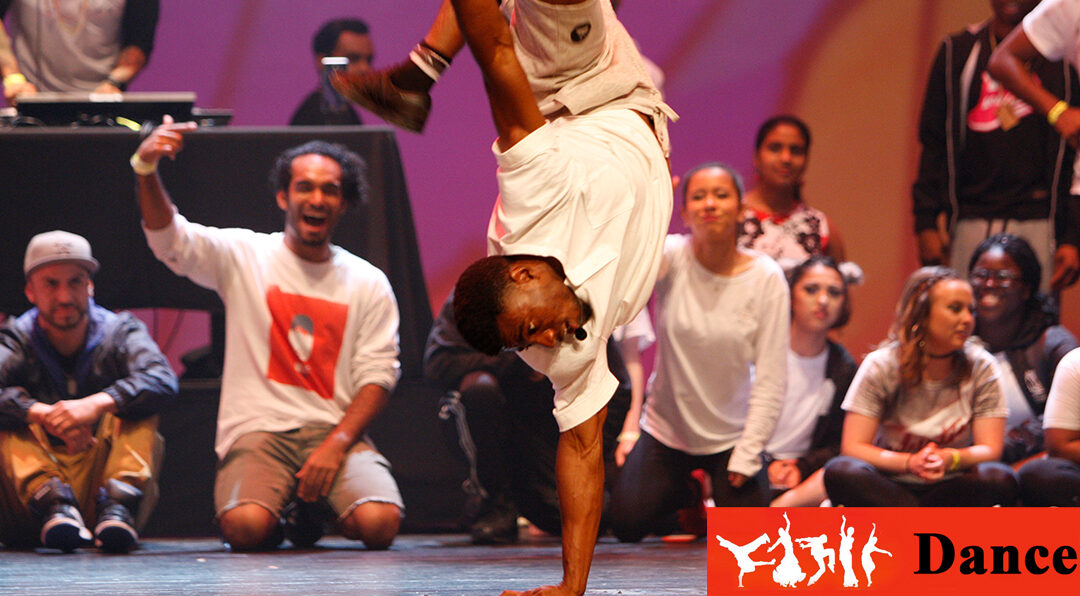
Jeffrey talks about being a sponsored athlete for Monster Energy and his new online training program FitBreak. Follow Jeffrey at https://www.instagram.com/jeffrorad and https://www.facebook.com/jeffrey.louis.90. Follow FitBreak at https://www.youtube.com/channel/UCPZZ9nUb6E7rZe9lxdNVuJg, https://www.instagram.com/fitbreakgym, and https://www.facebook.com/fitbreakworkout.
DanceTalks with Jeffrey Louis: Full Transcript
Hosted by Andrea Cody, Director of Dance Houston. Originally released April 28, 2020. This transcript was generated automatically and may contain small errors.
Episode summary (SEO)
On this episode of DanceTalks from Dance Houston, host Andrea Cody talks with Houston breaker Jeffrey “B-Boy Jeffro” Louis, a performer, personal trainer and choreographer with RAD Crew, FLY Dance Company and the Houston Rockets Launch Crew, and the founder of the FitBreak workout program. Jeffrey’s older brother taught him his first breaking moves in fifth grade, his middle school teacher Nasty Nate gave him his first class, and Westside High School’s Inertia Dance Company, founded by Sharon Roberts, turned it into real training, with B-Boy Judo teaching him how to move and Jesse Jordan teaching him the foundations. The son of Haitian parents who expected him to get a “real job,” he planned on physical therapy until B-Boy Moy invited him to become a sponsored athlete for Monster Energy. Jeffrey explains the four elements of hip-hop, how DJ Kool Herc’s looped breaks gave b-boys and b-girls their name, the building blocks of toprock, footwork, power moves and freezes, and his “explosive” style. He also talks about building FitBreak for dancers and anyone who wants a dancer’s physique, training clients over FaceTime, and getting ready for Break Free Worldwide’s online breaking championship during the COVID-19 shutdown. Recorded April 19, 2020.
Key takeaways
- Feel it, don’t just watch it. Jeffrey calls his style explosive: you may not understand what he’s doing, but he wants you to feel it.
- Hip-hop has four elements. DJing, MCing, graffiti and dance, and b-boys and b-girls are named for the “breaks” DJ Kool Herc looped for dancers in the Bronx.
- Learn the foundation. Breaking is built from toprock, footwork, power moves and freezes, and a lot of dancers are bringing it back to the fundamentals.
- Train like a dancer. FitBreak started as conditioning for dancers, then opened up to people who simply want a dancer’s strength and physique; repetition protects your form.
- Work hard now so life is easier later. Jeffrey’s motto, borrowed from a crewmate: if you take it easy now, life will be harder later.
Transcript
This transcript has been lightly edited for readability: filler words and repeats were removed, and several passages that could not be heard clearly in the recording were left out.
[0:00] Introduction and first moves
Andrea: Five, six, seven, eight. Hello and welcome to DanceTalks. Today is April 19, 2020, and my guest is Jeffrey Louis. He’s a breaker, performer, personal trainer and choreographer. He’s a member of RAD Crew, Team Monster Energy, FLY Dance Company and the Houston Rockets Launch Crew. His company is FitBreak, which offers workouts and personal training sessions. Jeffrey, thank you for being a part of DanceTalks.
Jeffrey Louis: Thank you for having me.
Andrea: Take us back to the very beginning, to when you first remember dancing as a little one.
Jeffrey Louis: I remember in fifth grade, my brother first introduced me to breakdancing. He took some classes in middle school, and then he would come home and teach me. So that was my first introduction to breakdancing. Then when I was in middle school, in sixth grade to be exact, I took that class, and it opened up my mind to breaking and the possibility of me actually breaking.
Andrea: Wait, was that kind of cheating? You already knew all the moves; your brother taught them to you.
Jeffrey Louis: Kind of. But it was only about half a year, so I just got a little head start. I was like the best, so it was pretty cool. That was my first introduction to dance, any dance really, but breakdance to be specific.
Andrea: Cool. And where did it go from sixth grade on?
Jeffrey Louis: It’s funny, because my sixth grade teacher, his name is Nasty Nate, by the way, only taught me for half a year. It was a semester, and then he just stopped coming to class. In seventh grade I tried to get back into it, but I didn’t really learn anything because he wasn’t there, and in eighth grade I stopped dancing and played basketball. Then when I got to high school, I went to Westside High School. They had this amazing dance program over there called Inertia, and that pretty much started my whole career. I was taking it a step further and actually learning, beyond that one semester of teaching. It gave me real experience: dancing, performing, competing, all of that.
[3:04] Inertia at Westside High School
Andrea: Take us inside the hallowed halls of Westside and tell us what’s going on in there. Is it classes, a studio, a program?
Jeffrey Louis: The dance program over there is unique, one of the first of its kind really. Inertia is a co-ed dance company. It’s changed a lot since I was in high school, because Sharon Roberts, the lady who was running it and the creator of Inertia, stepped away from it, so it’s been run by someone new. The main style of Inertia used to be breaking for the guys, and the girls would usually do contemporary or modern, and the shows were a mix of that. Being able to dance, travel and compete was just another thing to do as a kid.
Andrea: Was that your favorite subject in school?
Jeffrey Louis: My favorite subject was Inertia.
Andrea: Really? Cool, good for you. When did you graduate from high school?
Jeffrey Louis: 2013.
Andrea: So what was your real first step after that?
[5:03] A real job, and a call from Monster Energy
Jeffrey Louis: This is a real story. I graduated in 2013, and honestly, I didn’t expect to see myself dancing as a career. I came from a poor family that didn’t have much. My parents came here from Haiti expecting us to get a real job, quote unquote. So I didn’t really have support from my parents as far as dancing went, and it wasn’t an option for me. I would still do it on the side until I got my career.
Andrea: Oh, so you were envisioning dance as a hobby for your future?
Jeffrey Louis: Yes, it was more of a hobby. I knew how to dance, so I would do some gigs to pay for school. I wanted to be a physical therapist at the time. So I was in school, dancing on the side, and then two or three years after I graduated, I got a call from Moy about the possibility of me being a sponsored athlete for Monster Energy. I was like, what? I was just dancing for fun, and I wasn’t really invested in dancing. Being presented that opportunity, I realized I could actually make money as a dancer, as a breakdancer. That call was the start of my career, which led to FitBreak, which is the reason I do this now.
Andrea: We’re going to get to FitBreak. Before we go on, how did you meet Moy?
Jeffrey Louis: The first time I met Moy was at Westside in Inertia. He was brought in as a special instructor, so he came and taught us, even though I didn’t really know who he was at the time, because I wasn’t looking at dance that way. I just liked the moves; I wasn’t really looking at the history. He taught us some moves and how to approach the dance. I didn’t think much about him; he was just a normal guy who came and taught us. He was very humble. He didn’t say, “Oh, I did this, I did that.” He was just teaching. Later on, when I got more into the scene after I graduated, I knew of him, but I wasn’t really close to him. He’d throw events, so I’d go to his events to dance, battle and compete. That’s how I got to know him, through the competition world. And then that opportunity just came out of nowhere.
Andrea: How long have you been on the team?
Jeffrey Louis: This is my second official year with Monster Energy, but I did one year before as kind of a prospect. I did some of the competitions with them and we won, so I was like, all right, I guess it works, I must be a good fit. He always tells me, “Trust the process.” I did that for a year, and then I became a part of the Monster Energy Breakers.
[9:32] Being a sponsored athlete
Andrea: What’s that job like?
Jeffrey Louis: Being an athlete for Monster Energy is not strict at all. It’s the best job. They just want you to do you; they’re sponsoring your lifestyle. At the same time, they have expectations they want you to hit, as far as going to compete, going to events, and branding yourself and the Monster Energy brand. But ultimately it’s a lifestyle brand, and you doing you is what they’re sponsoring you for. So it’s pretty chill and fun.
Andrea: Describe the lifestyle. There’s breaking, that’s your thing. What else?
Jeffrey Louis: When Monster sponsors athletes, it’s a lifestyle brand, meaning they don’t want you to change what you’re doing. They see your social media, they like the way you present yourself, the way you carry yourself, the way you compete, the way you fit with the company. So don’t change. Just do you. That’s the best way to say it.
Andrea: Cool. Our listeners can find you on social media. Can you tell us where we should look for you?
Jeffrey Louis: On Facebook, Jeffrey Louis. On Instagram, @jeffrorad, all together. We’ll get to FitBreak later, so I’ll give you that handle afterwards.
Andrea: Okay, great. I’ll put the links in the show notes.
[12:20] A style of explosions
Jeffrey Louis: I like to call my style explosions. What I mean by that is, you could watch me dance and you probably won’t even understand it, but you will feel it. I guarantee you’ll feel it. When you see a true dancer dance, you can see what they’re feeling. So when I dance, you might not understand what’s happening, but it’s a feeling. It’s a vibe.
Andrea: Who inspired you in that way? Is there somebody in dance history you feel like you’ve reincarnated, or are called to be?
Jeffrey Louis: My inspirations came from friends and teachers. My biggest inspirations are B-Boy Judo and B-Boy Jesse Jordan. Judo taught me more of the dance aspect. As a kid who was into sports, I didn’t know how to move my hips; I was stiff. Judo taught me how to just move and dance, even when I was only watching him. And Jesse taught me more of the breaking aspect, so I learned two different styles from the two of them.
Andrea: How did you know Jesse?
Jeffrey Louis: He came in when I was a junior in high school, for no more than a year, and that year he put in some work on the guys, actually teaching us the foundation and the fundamentals. That was the first time I met him; I didn’t know anything about him before.
[15:23] The four elements of hip-hop
Andrea: Tell us about what they taught you.
Jeffrey Louis: Like I said before, coming into hip-hop culture and the dance, I’d seen it from a sports aspect. I wasn’t into the history, so I had to learn about it, and Jesse put me on. There are four elements to hip-hop. First is the DJ, which is the backbone of hip-hop. DJ Kool Herc is known as the father of hip-hop. Then we have the MC, the master of ceremonies, which is sometimes a rapper. Some people get those mixed up; they’re two different things, but they can be the same. Then we have the graffiti artist. Graffiti was actually there before hip-hop as an urban thing, and it was brought into hip-hop. And then we have the dancers, the b-boys and b-girls.
What DJ Kool Herc would do is play tracks and loop a part of the song, which we call the breaks. He looped the breaks, and the dancers would go out and dance to them. That’s where the term came from: b-boy and b-girl, for break boy and break girl, because we danced to the breaks of the songs. That’s pretty much the build-up to the start of hip-hop in the ’70s and early ’80s.
Andrea: Nice. I didn’t know where it got its name; that’s great to know. It started in Brooklyn, right?
Jeffrey Louis: In the Bronx.
Andrea: The Bronx. Got to get my boroughs right. And where did it go from there? How did it get out of the Bronx?
Jeffrey Louis: Unity, really. Once everybody united, it started to spread and get more attention. There are some people we could mention, but that would be a lot.
Andrea: It was before MTV, right? Kind of the Soul Train era, so it wasn’t on the screen; it was just people moving around.
Jeffrey Louis: MTV is actually what made it go global, because hip-hop music wasn’t seen as prestigious or anything. It was just something that started in the Bronx and was kept over there in New York. When MTV came about, it pushed it out. It was great exposure for hip-hop. It’s pretty cool how prominent MTV’s position in hip-hop was. MTV really did this.
Andrea: Really. And you look at Michael Jackson, Beyoncé and Janet, and it’s like, whoa, MTV. Well, I guess Beyoncé is probably a little after MTV, more the technology era.
Jeffrey Louis: The internet. The internet does wonders.
[19:33] How breaking has changed
Andrea: How has the dance itself changed since the beginning? Have you watched the first videos that were captured? How does it look?
Jeffrey Louis: Breaking has always kind of been breaking. But with hip-hop dance, you can see a change, even the fact that there are new hip-hop dances being made now, like ones from the early 2000s. It’s grown, and it’s all under the hip-hop umbrella. Some people will say freestyle dancing or choreo isn’t hip-hop; people will say, “I’m doing hip-hop choreo,” and others will say it’s not. So there are a lot of things that emerged from hip-hop dancing. But breaking, the dance itself, looks kind of the same now. It’s a lot more focused on tricks and dynamics, so a lot of people are trying to bring it back to the foundation, which is a good thing. But back then a lot of people were doing dynamics and tricks too. So breaking has always been kind of the same; I just think a lot of hip-hop styles emerged after hip-hop started.
Andrea: Do you see any breaking in the Soul Train videos? What’s the difference?
Jeffrey Louis: I’ve seen breaking pull moves from, let’s say, the Nicholas Brothers. Dancers would see something and say, “Let me go ahead and add that.” There are also moves you might see in gymnastics, like the flair. They do it in gymnastics and we do it in breaking. It’s pulled, but at the same time breaking has its own elements. The core, the fundamentals of breaking, is the footwork. There’s a lot to it, but we do pull from different things.
Andrea: I’ve seen Jesse’s presentation on the composition of breaking, and it was toprock, power moves, footwork and freezes.
Jeffrey Louis: Perfect. The power moves would be what you’d probably recognize from gymnastics if you were just a random person watching. Toprock is dancing up top, what breakers do before they go to the floor, and you can find that in different dance styles. Footwork is the part that’s specific to breaking: you’re on the floor doing all that for that long. That’s the core element of the four. It’s pretty interesting where we pull from.
[23:57] Why breaking became a youth dance
Andrea: If dance is an expression of a people, why is this your dance? Why is it the emblem of youth culture? What are you trying to say?
Jeffrey Louis: It’s the way it came about. It was basically the kids. Disco was the older people’s dance, and the kids were like, “That’s their dance; this is our dance. We can’t afford to go out and do that.” That’s how it came about. It’s the same way for a lot of people who found hip-hop, like my brother teaching me: we’re bored, doing nothing, you teach me some moves, and now I get to do it, I get to perform. It’s an outlet, for sure, for a lot of people, and I think that’s really what drove the dance.
Andrea: What inspires you today? When you find yourself getting up and dancing, why are you doing it in that moment?
Jeffrey Louis: It just feels good. Dance is an act, or a feeling, but it’s an expression too, so it’s you expressing yourself. I just move the way the music moves me. I let the music lead and I follow, without too much thinking. It’s pure, and it just comes from the music. If it tells me to go, I go.
Andrea: What music inspires you?
Jeffrey Louis: That’s a good one, because I listen to a lot, but I could say old school hip-hop. That feeling just puts me in the zone.
Andrea: Who are your favorite artists from that era?
Jeffrey Louis: No favorite artists, really. It’s mainly the beat and the feel. I just feel the music.
[27:36] FitBreak
Andrea: You recently launched a workout program with videos, and I’ve done one. It was awesome; I highly recommend it and can’t wait to do another one. These are really fresh; they’re coming out now. How’s it going? Who are your students?
Jeffrey Louis: I initially made it for people who are like-minded, or have the same mindset as me, because I was once told that if you train somebody, you should train somebody who’s like you, like you were in the past, or like you’d like to be in the future. Those are the best people to train. So I thought, I’m an athlete, I have to train my body and eat right to compete. How about I create a program that’s not just for me, but for dancers looking to optimize and boost their performance? That’s my main audience. But I still create programs for people who just want to lose weight. And something I didn’t take into consideration is that a lot of people want the physique of a dancer, even if they don’t dance. They’re like, “Dancers are fit; they’re doing full-body exercise; I want to look like a dancer.” That actually impacted the program, so I opened it up to people who just want to train to lose weight, whatever it is. But the focus at first was training dancers who want to boost their performance.
Andrea: Cool. I wonder if the people who come to look like a dancer will start feeling like a dancer, and then realize we’re all dancers.
Jeffrey Louis: Yes, that’s kind of how it goes. Some people like that feeling, like, “Okay, I’m breaking.” So it’s a good way to actually get people into dancing.
Andrea: What are you hearing back from your students?
Jeffrey Louis: Everybody’s liking it. I’m getting a lot of positive feedback, and also ways to improve the program, and I’m open to it. After I dropped my first video, people would say, “How about you do this?” and I implemented it in the next video, like, “If you want, you can do this.” So I’m always getting feedback, and it’s positive: they feel like they’re losing weight, they feel stronger, they have more body awareness and feel more comfortable. That’s what most of my feedback has looked like. People are suffering, but ultimately it’s good. And I enjoy being able to help people out and modify my programs for people. It’s a lot of fun.
Andrea: It is so challenging. The 30 seconds you’re doing a move feel slower and slower as you get through the program. But I love getting to learn new moves and improve, and you repeat them over and over again, so I can follow along and dance with you, and it’s fun. So I really appreciate it. Keep it up.
Jeffrey Louis: Thank you. I’m trying to push everybody, and doing a move over and over gives you a chance to actually get it down, because I think form is most important. I don’t want you to go to the next exercise without getting the full grasp of that movement, because I don’t want you to compromise your form; you might start using a different part of your body to compensate. So repetition is key. Plus, I don’t give you much breathing time, just to help you push through. This is how it feels whenever you’ve got to push and still keep going; that’s what it takes. So I try to throw that into the exercises.
Andrea: Awesome. Have you done Pilates before? It’s all about form. I like the floor work, so it’s really just you working your body on the floor. But you don’t feel like you’re getting cooler while you’re doing it. You may be getting stronger and looking better, but they have some music on in the background and it might as well be spa music. I like what you’re doing because it also uplifts me.
Jeffrey Louis: Thank you. And I hope you’ll get cooler; you’ve done one, so that’s already one step. It’s a long road, but you’ve got it, and it’ll be fun. Just bust it out at the next event once this is over. I want to see some breakdancing. That’s the ultimate goal.
[35:58] Training over FaceTime
Andrea: Are you doing live sessions?
Jeffrey Louis: I have been doing personal training over FaceTime.
Andrea: How does that work?
Jeffrey Louis: It’s been going. Obviously I prefer person to person, but it’s still possible. There are limitations, but overall it’s working: they’re still getting results, I’m still getting positive feedback, and I’m learning and adapting to this new change. The part I need to figure out is the music. I want them to be able to hear the music too, so they can go to the beat while exercising. The workouts are timed, but at the same time I want you to get inspired by the music. That part is lacking, because you’re watching a video and hearing the music being played, and at the same time you’re hearing me.
Andrea: Have you tried radio? I don’t know about the lag time, but FaceTime seems very live; I don’t feel like I’m on a webcam. It’ll freeze a little bit. But I wonder if you all turned on a radio station, like 104 KRBE, waited for some good songs to come on and just worked with it. Call in and make a request.
Jeffrey Louis: That’s one way to go about it.
Andrea: Or I wonder if KTRU at Rice or KTSU might do an old school hip-hop hour for you.
Jeffrey Louis: That would be cool. The problem would be hearing me.
Andrea: Oh, right, they’re on FaceTime with you and they’ve got their radio on. I hear what you’re saying.
Jeffrey Louis: But that’s one thing I’m going to try to figure out.
[38:50] Dancing to the radio
Andrea: I grew up dancing in my bedroom to the KTRU ska show. Ska was the thing in 1993. I was 13, and I had the time of my life. I started going out to all-ages clubs with live bands, and there were a lot of them. I went to my first ska show at 13, but I grew up in a band, so I was already going to concerts from the time I was about nine. Not every weekend, but we went all the time, and over the summer we might go every weekend, to kids’ festivals and children’s festivals, because we’d be the warm-up act that went on at noon, and then my family would stay and dance.
Jeffrey Louis: That’s cool.
Andrea: By high school, this station blasted old dance music into my bedroom for one hour a week, I think, and I would tape every show. So I’d have the music, from reggae through British ska through new wave. Then when I went out to see the bands, I knew maybe one of their songs. It was fun.
Jeffrey Louis: So you really had to know what time they were playing the mix.
Andrea: I think it was Thursday at some time. But we listened to the radio. I wonder if we need to tap into some new technology during this, because we don’t know how long it’s going to last.
Jeffrey Louis: I’m down to figure it out.
[41:16] Going out dancing, then and now
Andrea: We’ve been in this isolating mood for a long time, staying glued to our phones. From the time I was going out as a kid, before we had phones, to now, it’s all about social media and what we look like on our phone, kind of in front of a mirror. It went from going out dancing to ska and swing and salsa, and then going out dancing kind of vanished.
Jeffrey Louis: You know what’s crazy? As technology progresses, you would expect our communication and in-person skills to get better, but they actually go down. Now we have the ability to reach people from all over the world, but for some reason it’s backwards. That’s a crazy thing.
Andrea: Yeah, all the dance clubs, all these social nights, it’s not that much of a thing now. You still see people dance at weddings and bar mitzvahs.
Jeffrey Louis: Right, weddings, festivals.
Andrea: Maybe a little dancing at a gala, but nothing over the top.
Jeffrey Louis: It’s interesting. It’s just crazy. What’s it going to be like in 10 more years?
Andrea: You tell us. I think it’s exciting to see what you’re doing and how your generation is going to do it. You’re going to lead us, and we’re going to follow, and we’re going to figure this out.
Jeffrey Louis: For sure. I’m excited. It’s going to be fresh; it’s going to be something new. We love change, and we always want to be doing the next thing. It’s crazy, a little scary, but fun to be on the front line of what’s coming, trying to predict what’s happening and how to go about it. I look forward to it.
[43:58] If we were in lockdown forever
Andrea: If we were to live in lockdown forever, what would you do as a dancer?
Jeffrey Louis: That’s literally what I’m trying to figure out. If we’re locked down, we’ll have to change up our whole plan, our future, because a lot of the things we do are live. Let’s say we can’t perform at live events. A lot of artists tour, and the money comes from those tours, and if promoters aren’t willing to book people because they can’t sell out the venue, or if we’re just in lockdown forever, there’s no way for that to work.
Andrea: One of the things you want to do is give people that feeling. There’s a transfer: it comes from the music, it wells up in you, it comes out and spills out, and you want to give it to someone like a hug. How are you giving it to them now?
Jeffrey Louis: That comes with the whole program, FitBreak. That’s where the music and following my lead come in. Like I said before, I don’t think anybody can feel exactly what I feel, but this type of energy is the closest thing I can get to them feeling what I’m feeling. So I try to lead them the best way I can. I’ve been getting messages from people training with the videos. Somebody from South America made a video of themselves doing the whole workout and sent it to me. That’s crazy. I’m excited to see where it goes, and I actually have some plans. I’ll save that for later; I can’t reveal it until I’ve put it down. But I have some things I want to do.
Andrea: It’s amazing that you’re connecting to people through an internet cable that literally runs from your home across the bottom of the Atlantic Ocean and into their house. These little light pulses of Jeffrey Louis are reaching people. That’s a kind of dancing with someone else that we never could have done before.
Jeffrey Louis: I think a time like this is kind of what we need to just unite. It slows down the pace. Everybody’s refreshing their life, in a sense, focusing on what matters, on themselves and their families or whatever it may be. It gives people a chance to slow down and appreciate things. And the internet is how we transfer these energies.
[49:02] Sharing dance online
Andrea: I feel like this sharing is so awesome for the recipient, in a way that I don’t think dance shows on TV ever did. There was a decade where we wanted to see all the different cultures; we wanted everybody to have their moment in the spotlight, and we’d cheer for them and give them a 10 and say we love you. And now we’re alone, and we still want to teach, and there are these people reaching out who want to learn. They really are finding a way.
Jeffrey Louis: I’m not even sure how to describe it, but everybody who’s been reaching out has been all positive and good: the energy, the love, the support, and wanting to move more. People really just want to move, and it’s amazing. I don’t know if people get that from watching it on TV. Maybe they get off the couch and go take a dance class or join a team. But there’s watching something and wanting to learn it, and there’s watching something and just wanting to move. Those are two different feelings.
Andrea: Oh man, I have been going stir crazy. At a Beyoncé show, I only get the spot right in front of my chair, and I can’t do anything, and that’s my jam. And when I go to the theater, to a dance show, wanting to dance and having to sit there can be brutal. My favorite place is Miller Outdoor Theatre, because if we get in the front row, we can dance. You’ve got to keep it low, but the kids can run around a bit; there’s a little wiggle room. Before all this physical distancing, 30,000 of us wanted to be together. In a way it was confining, but you were in a crowd. And now you’re at home, exploring your space.
Jeffrey Louis: It’s a huge change. We just have to find that feeling again. It’s crazy, but I think we can do it. Whatever it is, we just have to find it. That’s our goal: find that feeling.
[53:06] Break Free Worldwide
Andrea: So what’s on your plate right now? What’s next for you?
Jeffrey Louis: Everything is either a FitBreak focus or competition for me. I plan on doing an online competition. I’m still not 100% sure how it’s going to work, but everybody submitted videos, and you get into the bracket through video submission. They’re doing four regions: the Americas, Europe, Asia and Africa East. Each region has its own competition up to the regional finals, and after that you’re basically competing for your region, with everybody on your back, going at it with the other winners until there’s only one winner. It’s a pretty cool concept, and I’m excited to see how it turns out. It actually starts Tuesday. It’s Break Free Worldwide. I’m locked in.
Andrea: Where do we go to watch it unfold?
Jeffrey Louis: You can go to the Break Free Worldwide website, something along the lines of breakfreeworldwide.com, or just put it in Google and you’ll find it. I’m actually driving to Austin to stay with a friend so I can use his internet, because I know he has real good internet. Our Wi-Fi at home has been acting up. I tried to have a technician come and fix it, but due to the pandemic they’re not allowed to come in. So I’m going to make sure I have a fair chance in this competition; I need some good Wi-Fi.
Andrea: So it sounds like what would be nice is a clean room we could go to, that we could air out and clean, that had awesome Wi-Fi. If we could be allowed one spot where we do everything we can to keep it healthy, with great Wi-Fi. Where’s the Google hub? I know there’s one in New York. I don’t know if we have one here, but there are cables all over the place.
Jeffrey Louis: Something like that would be nice.
Andrea: So in this sense, this is like an underground movement.
Jeffrey Louis: It’s pretty big, though. I’m just excited to get back to competing; this is the closest thing we have in the scene right now. I had a few competitions canceled. I had at least three flights I had to cancel because of this, and all events have been canceled. But I think this was good for a lot of people’s mindset, and I’m ready to get back in.
Andrea: Who’s running Break Free?
Jeffrey Louis: Moy. He’s running that whole competition, and he has Jeremy and his crew. They’ve been doing a good job providing for the community, and this is their next big project.
Andrea: Good luck.
Jeffrey Louis: Thank you, I’m going to need it. I’m going against the world.
[58:52] Jeffrey’s motto
Andrea: Hey, what’s your motto?
Jeffrey Louis: I actually took this from one of my crewmates. I don’t know if he made it up. Let me get it word for word; I’m trying to word it so it’s the positive version. Basically: if you live life easy right now, your life is going to be harder later. But if you work hard now, later your life is going to be easier. I just think that is so true. People have to literally think about it and ask themselves, “Do I really want to be working this hard when I’m not able to work that hard? Or can I handle it right now while I’m still able to?” So you’ve got to work. I’ll rest later.
Andrea: My guest today is Jeffrey Louis. Jeffrey, thank you for being a part of DanceTalks.
Jeffrey Louis: Thank you for having me.