
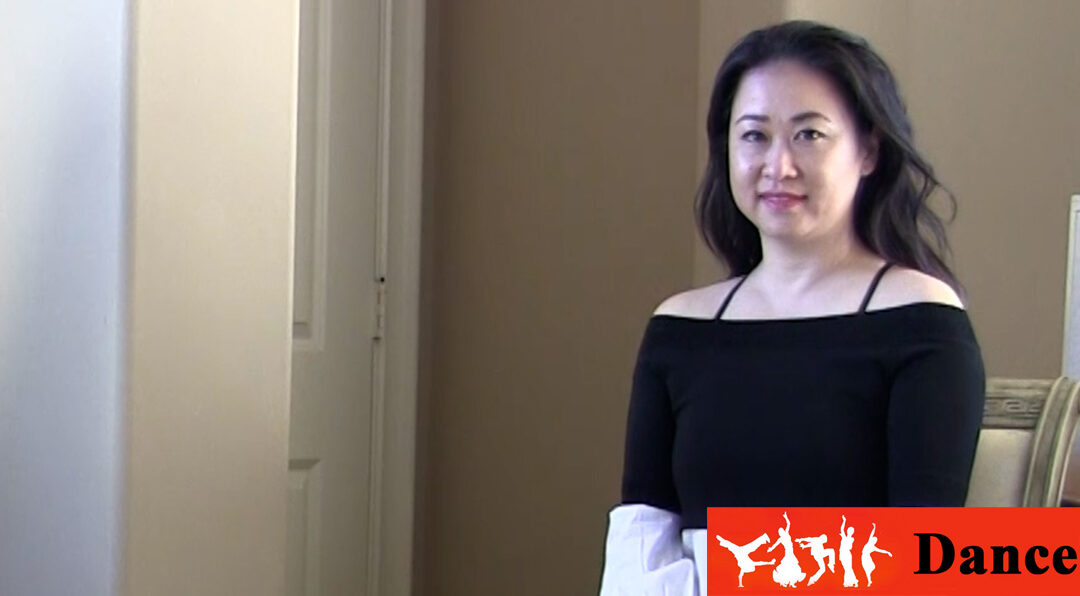
Janie Yao talks about her journey from China to America, from her mother’s living room dance studio to primetime on America’s Got Talent. She is the founder and director of Dance of Asian America. She explores the qualities of Chinese folk, classical and contemporary dance. See her work on America’s Got Talent: https://www.youtube.com/watch?v=JCUcCDYs-iM and ABC’s Holiday Special: https://youtu.be/HfJU0XiG8QE
DanceTalks with Janie Yao: Full Transcript
Hosted by Andrea Cody, Director of Dance Houston. Originally released April 19, 2021. This transcript was generated automatically and may contain small errors.
Episode summary (SEO)
On this episode of DanceTalks from Dance Houston, host Andrea talks with Janie Yao, founder and artistic director of Dance of Asian America. Janie came to Houston from China at age seven and grew up in her mother Mitsi Shen’s living-room dance studio. She trained at Houston Ballet and Southern Methodist University, then built Dance of Asian America from a 500-seat show at the Hobby Center to audiences of 3,000 to 4,000 a night at Miller Outdoor Theatre. She explains the difference between Chinese classical and Chinese folk dance, how her “East Meets West” and “Splendid China” shows built new audiences, what it took to rework the Thousand Hands Dance for America’s Got Talent, and how her company handled the pandemic. Recorded March 4, 2021.
Key takeaways
- Chinese dance has two main branches. Classical Chinese dance comes mostly from the Han majority and dynasty court traditions such as ribbon, long-sleeve and sword dances. Chinese folk dance reflects ethnic groups such as the Dai, Mongolian, Tibetan and Xinjiang peoples.
- Folk dance grows out of daily life. Dai dance, from a tropical bamboo-forest region, uses slender lines, long fitted skirts and umbrellas that echo the land and the clothing.
- Mixed programs build audiences. “East Meets West” paired Chinese dance with ballet, modern and jazz, which brought new viewers to Asian dance and introduced Asian families to Western forms.
- Performing often builds resilience. Dancers who perform 50 to 100 times a year learn to keep going when the music cuts out, and the nerves of performing before 5,000 people become a life skill.
- Success means service. For Janie, a nonprofit dance company succeeds when audiences learn to see the variety within a culture, whether at Miller Theatre or on national TV.
Transcript
This transcript has been lightly edited for readability: filler words and repeats were removed, and a few short passages that could not be heard clearly were left out.
[0:00] Introduction and early years
Andrea: Hello and welcome to DanceTalks. I’m your host, Andrea. Today is March 4, 2021, and my guest is Janie Yao. Janie is the founder and director of Dance of Asian America. Janie, welcome to DanceTalks. We would love to hear your story. Can you take us from the beginning, how it all began with dance for you?
Janie Yao: Sure. I came from China when I was seven years old, and before that I really didn’t have any dance experience. My mother was a professional dancer. She trained at the Beijing Dance Academy and the Shanghai Dance Academy, and she danced with the Shanghai Dance Troupe. When I came here at seven, she started me dancing at her studio, which was in our house, in our living room.
In China, a whole family pretty much gets one room. When I got here, we had one of those houses with three or four bedrooms, and oh my goodness, I was in heaven. I was running from room to room. I counted all the rooms, including the bathrooms and the closets. And then a week later, they decided to tear up the living room and turn it into a studio, and I was heartbroken.
It was just a regular living room, not even very big, but it had the fireplace. So I grew up in the studio setting, and after a couple of years we moved the studio out to an actual studio. My mother was a very strong ballet dancer, and of course she also had very strong Chinese dance training, so I learned those two styles growing up. Then I went to Houston Ballet in middle school and high school and went through the levels there, so I did a lot of ballet training.
[2:52] College and founding Dance of Asian America
Janie Yao: Then I went to Southern Methodist University on a scholarship as a dance major. There I got a lot of training in ballet, modern, jazz, pointe, choreography and production, and I really do love production. When I came back to Houston, my brother and I started Dance of Asian America. My mother always had the school, but the problem with a school is that there isn’t enough funding for public performances, for really bringing the art form to the general public as a performing art. A school is more about teaching, which is very important, educating future generations.
With the company, we grew slowly. I think we had our first show at the Hobby Center around 2003, barely 500 people. We kept at it for a few years, moved to Miller in 2006 and had a little over 500 there, and built from there. By 2008 or 2009, we probably had about 4,000 people at Miller.
I think one of the greatest things about Dance of Asian America is that we take the art form to the public and educate the public, youth and people of all ethnicities, helping them appreciate Chinese dance, Asian dance, and dance as an art form.
Andrea: Wonderful, and accessible.
[4:54] Her mother, Mitsi Shen, and the Cultural Revolution
Andrea: Tell us a little more about your mom, Mitsi Shen. I’d love to interview her too, but give us a snapshot of how she trained. I know she came to the United States around the same time as Li Cunxin. I don’t know if their stories overlapped at all.
Janie Yao: Oh goodness, when did she come? Let’s see, I was two, so around 1982 or 1983. She started her studio and started teaching. I remember she had about seven students to start, probably from the same family, and then people figured out she was a great dancer and a great teacher.
One of the things she really wanted was to bring Chinese culture to America. Part of what made her want to come in the first place was the Cultural Revolution in China. My mom’s family and my dad’s family were both pretty well-off, but the Cultural Revolution left them penniless and sent to work on farms. She would wake up in the middle of the night and go out and practice on the dirt ground, in between her farming. She was really into it.
But what they learned was very strict, almost like an army ballet. Everything was about communism, so dance was really restricted, not only in production, the shows they did and the storylines, but definitely in technique, because not many new things or new people were coming into the country.
When they started opening the doors after the Cultural Revolution, Janie Parker came with Ben Stevenson. Ben Stevenson brought her to Shanghai, and my mother saw her dance. They saw Romeo and Juliet and Sleeping Beauty, versus the revolutionary ballets with the Red Army guns. It was so different, and it made her realize there was a whole other world of dance out there. And that’s why I’m named after Janie Parker.
Andrea: Oh, that’s so funny.
Janie Yao: And even now she can’t say my name. She can’t say Janie. She calls me Jenny, or any form of that except Janie. But she just knew that was Janie Parker’s name.
Andrea: So just to back up: Janie Parker was the principal ballerina for Houston Ballet, and Ben Stevenson was the artistic director. Your mom met them and was inspired. How did she leave?
Janie Yao: That’s a whole other story. She applied to come out and study dance, and she got approved, but my dad didn’t. Then they had to apply again, and they couldn’t bring me, so I stayed with my grandma. I didn’t see my parents except in pictures. It was a really long distance. I pretty much didn’t have them for five years.
Andrea: I’m not quite sure about the timeline with Li Cunxin.
Janie Yao: I know that when Ben Stevenson came to China, he also saw Li Cunxin and invited him to come and dance. I remember seeing him at Houston Ballet, taking class and in rehearsal, and he was pretty amazing.
Andrea: So your mom made her way somewhat on her own.
Janie Yao: Oh, for sure. When they were able to come out, I think they each had $60 on them, and that’s it. They weren’t allowed to bring anything more than that, maybe a suitcase full of stuff and $60. It’s pretty crazy.
Andrea: Amazing.
[11:31] Growing up in the studio
Janie Yao: It’s funny, when we moved to our first studio outside the house, we had two studios, a waiting room, a dressing room, an office and my dad’s violin room. All these rooms were next to each other, but the walls didn’t go all the way up. There was about three feet open at the top. So dance just kind of grew on me.
Andrea: Did you ever question it? Did you ever think you might do something other than dance?
Janie Yao: I definitely have a lot of interests. I’m a multifaceted person, and I love all aspects of life. I told my mom I wanted to be a veterinarian, and she kind of laughed, because she’s not really into animals to start with. There were a lot of things I was interested in, but dance just kind of fell in my lap.
Andrea: It’s always been one of the focal points of your life.
Janie Yao: Yes, and there are so many parts of dance that are dear to me. Growing up in a studio, I started assistant teaching for my mom in high school, if not earlier. Looking back, teaching is really good for relearning, for thinking through steps in detail, because you have to break everything down when you’re teaching.
Andrea: Even correcting mistakes you never made yourself.
Janie Yao: Yes, and I think that’s what makes me good at fixing things. I enjoy seeing the progress all the way to performance. After college, starting Dance of Asian America, I found I really enjoy production, because I want to bring the art form to the public. Dance is a way of communication, so why stay in the classroom?
[15:15] Performing for the public
Andrea: Right. And you are one of the only companies that performs not only 50 or 100 times a year in public, but also does big main-stage shows at Miller Outdoor Theatre, with full lights, backdrops and costumes.
Janie Yao: Whenever we can, yes. I think that’s one of the reasons our dancers are really great, really presentable. One time we had a performance, and one of my really good dancers was dancing a solo when the music started cutting out, over and over. I eventually switched to my backup speaker. She did not miss a beat, and I was so proud. Because they perform so much, they know not to show that anything is wrong. If you played her video without music, you wouldn’t even think anything was wrong.
[17:00] Chinese classical and folk dance
Andrea: You are the expert in Chinese dance. Will you tell us what it is from a historical perspective?
Janie Yao: Sure. There are tons of different styles of Chinese dance, but there are two main categories: classical Chinese dance and Chinese folk dance. China has 56 ethnic groups, as you’ll hear me say many times at my performances. There’s one ethnic majority, the Han, and a lot of classical Chinese dance comes from that.
Chinese folk dance represents the other 55 ethnic groups. Not every group has a dance at the level of international performance; some groups are more developed in their performing arts. When you see Mongolian dance, Dai dance, Tibetan dance and Xinjiang dance, those are Chinese folk dances.
Andrea: Is it a canon of movement, or a canon of choreography?
Janie Yao: Take the Dai, for example. It’s a very tropical region with bamboo forests. Different regions eat different foods, and the people often look very different. The Dai women are very slender and feminine, and a lot of the dances are choreographed around their clothing, a long, slender skirt, so you usually don’t see them lifting their legs high. The movements resemble the shape of growing bamboo, and because it’s a tropical region, they also use umbrellas in their dances. It all developed through the lifestyle and traditions of the people in that area.
Andrea: And the costumes are part of it.
Janie Yao: Oh yes, absolutely.
Andrea: So how are these dances preserved and passed on?
Janie Yao: Over time, these dances progressed from a basic folk dance, like “it’s a happy day, let’s dance in the yard,” to adding skills and more contemporary movement. Now each group has its own technique and style: the Dai, the Mongolian, and the Han. Han classical dance is probably the closest to ballet. It has a lot of technique; they do have an adagio, they do have a grand jeté. Of course they’re not called those; they have Chinese names. They have their own style of turns and flip turns. And dances from the dynasties, like Tang Dynasty or Han Dynasty dances, the ribbon dances, court dances, long-sleeve dances and sword dances, all fall into the classical Chinese category.
Andrea: It’s a lot.
Janie Yao: It is a lot, but it keeps things fresh. It’s a lot of people and a lot of diversity, and that’s why every year we’re able to bring different styles to our shows with different choreography.
Andrea: When you say technique, are the moves called the same thing across the classical and folk styles, or do they have different names?
Janie Yao: They’re quite different. For example, this is the classical Chinese dance hand, and this is the Dai hand. Within Dai there’s also the peacock hand. Mongolian is different again, and Xinjiang is more like a flower instead of straight. There are so many.
Andrea: It reminds me of Indian dance.
Janie Yao: Yes, they definitely have even more hand movements, much more intricate.
[24:01] Building audiences: East Meets West and Splendid China
Andrea: What’s your creative process when you put together a show? How are you able to bring so many different looks?
Janie Yao: I’ve taken two different approaches over almost two decades of our shows at Miller. The first was East Meets West. If I just said “come watch a show about Chinese dance,” I’d mostly get people who are already interested. But I wanted to bring in people who are interested in dance in general. So for East Meets West we had ballet, modern, jazz and contemporary, with guest companies as well as our own dancers. One of the biggest things for us is working with other companies.
A lot of people came the first time saying, “I don’t think I’m going to like it,” and then, “Oh, it’s not that bad.” The second time they’d say, “Wow, I kind of like it,” and they’d keep coming back. That’s how we built our audience. Every piece is a little different, and if you don’t like one, it’s three to five minutes of your time and we move on. That’s one thing about Miller: we don’t want it to feel like a closed black-box theater. I enjoy full-length pieces too, but we can’t do that when we’re introducing people to new styles.
And East Meets West didn’t only introduce non-Asians to Asian styles; it worked really well the other way too. A lot of Asian families don’t see a lot of ballet, pointe, tap or jazz. So they’d see an excerpt from Madame Butterfly and think, “I might want to see the whole ballet.” It really worked both ways.
Andrea: Very cool. Tell us about Splendid China.
Janie Yao: My other approach was Splendid China, which was, “Let’s see what we can bring from the other side of the world.” It was really popular. Splendid China ran two nights, we ran it for 15 years, and we had about 3,000 to 4,000 people each night.
It’s funny, I’ll meet people randomly and they’ll say, “Do you know about the show at Miller where they bring over guest artists from China? It’s really good, every year it’s something new.” And I’ll ask, “Who’s it by?” and that’s when they stumble. “Dance of Asian America” may be a little hard to catch. But it’s really great that we were in people’s hearts and they wanted to share it, and they can’t wait for it every year.
[28:27] Changes after the pandemic
Janie Yao: Due to the pandemic, we’re changing things around, like the whole art world. After 15 years, we’ve hosted the Shanghai dance company, the Nanjing dance company, China’s national folk dance troupe and others. Now I’m considering two directions. One is a Contemporary World Festival, an international mix of styles and cultures. The other is focusing on Asia, because I feel we need to explore not just China but so much more of what’s around us. Chinese dance will always be on our program, because that’s my homeland, but I would love to explore other styles as well. We’re Dance of Asian America, after all.
Andrea: Will you tell us about contemporary dance in the Asian region?
Janie Yao: It’s continued to grow. Before, a dance academy department would just be classical Chinese dance or Chinese folk dance. Now there’s modern dance and contemporary dance, so many more styles. I’d say contemporary and modern are stronger in China than jazz or hip-hop, where I feel they have a totally different take than what’s out there in the world. I’m sure they’ll catch up.
Andrea: I know we had Di “Moon” Zhang here for many years, and I heard he went back to China. We’ll have to reach out and catch up with him.
Janie Yao: I think it depends on where you go. Moon was pretty awesome, and some of the people I see on TikTok are great, but in an actual dance department, not as much. It seems more freelance, something that still needs to grow.
Andrea: We see that here a lot too. A traditional studio teaching ballet, tap and jazz may offer hip-hop because people ask for it, but it’s not really hip-hop. It’s close. How is your company handling the pandemic?
Janie Yao: Like all arts organizations, it’s really hard. It was shocking at first, but now we’re dealing with it. We’ve done virtual shows and some outdoor shows. We work with other companies that present our shows to the public, so a lot has been postponed or canceled. We have a lot of classes online. I’m ready to go back. Everybody who wants to be vaccinated is going to be vaccinated, so we’ve got to start living. I see a return to some normalcy in the summer, and we have a show coming up in October, hopefully with a live, in-person audience at Miller. I’m thinking of a contemporary world festival or exploring Asia, maybe going from Asia into the world, something that lets our dancers explore different styles.
Andrea: So your dancers will be learning styles from outside China?
Janie Yao: Yes. I have a really great Korean teacher. She’s a Korean contemporary dancer, which is great, because that’s kind of what I am. I do traditional Chinese classical and folk, but a lot of times I put my contemporary style into it to speak to more people. I completely respect the traditional styles, but I think it’s nice to have a fusion. I also have a teacher from Taiwan. Our dancers are already very versatile in ballet and modern, and we want to be versatile in culture as well.
Andrea: I can’t wait to see the new dances.
Janie Yao: Me too. It’s going to be exciting.
[37:04] Masks, kids and dancing in the moment
Andrea: I think if we had all worn masks and carried on with life instead of shutting down in March, we would have been okay. What do you think? My family is healthy, we’re young and active, and we’re somewhat risk-takers. Working in the arts, I take risks creatively, economically and physically. That said, I don’t have a 93-year-old grandmother, so I completely understand that when someone in your life is vulnerable, you have to take that on yourself.
Janie Yao: Looking back, I’ve definitely missed everybody. We had a camp last summer. We started off normally, and the mask order was put in place about two weeks into camp, so we followed the law.
Andrea: Dance is so close to me, and I love it so much. Our most expressive feature is our face. We say so much with it: nonverbal cues, what we’re really thinking. With kids, I just want them to be able to smile at each other and at their teachers, and share the joy only a child’s smile brings. So I believe in thinking about the trade-offs: how long are we going to give up our ability to express ourselves and see each other?
Growing up, dancing for me was something I did out and about. We didn’t have phones. You made your own fun. You danced to have a good time, and you were in the moment, for the people in the room, the audience, the band and each other. No one was taking pictures or videos or thinking, “Maybe this will go viral.” It was spontaneous, improvisational and interactive.
Janie Yao: A lot of times when I see something amazing, I kind of wish I were videotaping. But I really just want to watch it. I don’t have a photographic memory, but I can remember my life without documenting it. In the past year, everything went online, and life, to me, is not about staying at home on my phone. I’d prefer 99% of my life not be on it. We always told the kids to get off their devices and jump in the pool. Now it’s, “Did you finish your work? Get back on the computer. Make sure your camera is on.” Hopefully virtual learning ends soon, because they really need to get out of that.
Andrea: There was always a gray area with dance in Texas. You were supposed to distance and wear a mask, but is a studio a gym? It wasn’t stated in black and white. A lot of dances are partner dances, and you don’t know how close you can be.
Janie Yao: And then all we had was online, and then the winter storm hit and we didn’t even have electricity.
Andrea: It was like, “Not happy with your online Zoom? None of that for you this week.” So now you’re the mom. Are you a dance mom?
[47:20] Raising young dancers
Janie Yao: I wouldn’t say I’m a dance mom. I diversify my kids’ activities, because one thing I missed in my childhood was the other aspects. I didn’t go to camps for other things. I was always good enough academically, but it would have been great to go to science camp or learn chess when I was young, to expand my horizons. My kids definitely dance too.
One thing that excites my daughters and my other dancers is performing. For example, at 10 they perform at an outdoor theater for 5,000 people. Before the show, they’re all really nervous. One of them will actually throw up, another gets a stomachache. But they do a great job, and afterward they ask, “Can we do that again?” They love the adrenaline. I think it’s great training for anything, like giving a presentation at a company later on.
Andrea: Life’s a dance. You’ve got to be able to get out there and show yourself, no matter what you do. Do they like it?
Janie Yao: They do. I wouldn’t say they’re born dancers, but they benefit a lot: the discipline, the technique, the presentation, performing, and learning their own heritage.
[50:16] Defining success
Andrea: You’ve been at this a long time, maybe mid-career. How did you define success when you started Dance of Asian America? Have you achieved it, and what is it now?
Janie Yao: Dance of Asian America is a nonprofit, so I’ve always thought of it as a service to the community. We want people to really appreciate the art, and I think that brings harmony. Houston, like the rest of the world, is a melting pot. I want people to see someone and realize, “You’re not just Chinese, you could be from a different part of China,” and that Chinese food isn’t just one food. It’s really rewarding.
When I was younger and assistant teaching, I always enjoyed figuring out how to fix an issue and help a dancer. I have dancers who come to me as teens who haven’t danced before, and I tell them, “No worries, welcome.” That’s part of the success and the joy of teaching for me. And with production, going from 500 to thousands a night, it’s not just production I enjoy; it’s the sheer joy of people loving what I’m able to provide. When we went to America’s Got Talent, I didn’t know people were interested on a national level. Bringing that to millions of people was pretty awesome.
[53:16] America’s Got Talent and the Thousand Hands Dance
Andrea: It was an awesome performance. I’ll put a link to it in the show notes. You were representing Mitsi Dancing School then, and it was still Dance of Asian America performing.
Janie Yao: Yes, that was before somebody else took over Mitsi Dancing School. We went to America’s Got Talent in 2013, and in 2015 someone else took over the school. Since 2015, my mother, Mitsi Shen, and I don’t run Mitsi Dancing School; we run Dance of Asian America. Actually, America’s Got Talent originally contacted us because of our public video of the Thousand Hands Dance.
The original Thousand Hands Dance is quite different from what we performed on America’s Got Talent, because I had to condense everything to 90 seconds and keep it fast-paced and moving. That was great training for me on the production side. There were six to eight directors asking us to make this part more exciting, take out that part. They were all great suggestions, but basically they were asking me to rechoreograph, and it was pretty stressful. We spent so many hours in the Rockettes’ rehearsal room, maybe four hours a day, and tour groups would walk by and take pictures of us while we were busy rehearsing. We didn’t even think to take a picture ourselves. It was such a great experience.
Musically, I think it was really well received on AGT because I made nine different edits of the music. I went through tons of music, Hans Zimmer, The Dark Knight music, and I really enjoy putting it all together.
[57:03] Holiday production
Andrea: And working in production, you also did a holiday spectacular.
Janie Yao: Being on a TV set was really great for me to experience. We just recently did a mayor’s holiday special, and that was also a production, and boy did we give them a production. It was amazing.
Andrea: I’ll put a link to that too.
Janie Yao: We really only put that together in about two or three weeks. And the great thing about it is it wasn’t just one piece. We had a little bit of the Thousand Hands, some ribbon dance, handkerchief dancers, spear dancers, and a giant feather dance finale. So it was just bam, bam, bam, everything in three minutes. Pack it tight; don’t make people click away.
Andrea: I definitely was enthralled from beginning to end. Congratulations.
Janie Yao: Thank you. I definitely enjoy putting together projects.
Andrea: When you do another one…
Janie Yao: For sure.
[58:25] Closing advice
Andrea: So let’s close with you giving us some advice that you’d give your own kids, your own students, or just your audience. Maybe a lesson from dance that we can apply to life, or whatever you want us to do right now when we turn off the podcast and get on with life.
Janie Yao: Wow, there are so many lessons.
Andrea: Take your time.
Janie Yao: I think one of the best things to take away from my overall experience with dance is that there’s a whole world out there. And it doesn’t just apply to dance; there’s a whole world out there for all of us. But there’s a whole world of dance out there, so I would really encourage everybody to go explore it, to see it, and like your son, to explore it in their bodies, and more importantly, to share it. I think that’s what we’re doing.
[60:00] Closing
Andrea: My guest today has been Janie Yao, founder and director of Dance of Asian America. Janie, thank you for being a part of DanceTalks.
Janie Yao: Thank you.
Andrea: I’ll put the links in the show notes.
Janie Yao: Thank you very much.
[End of episode, 60:18]