
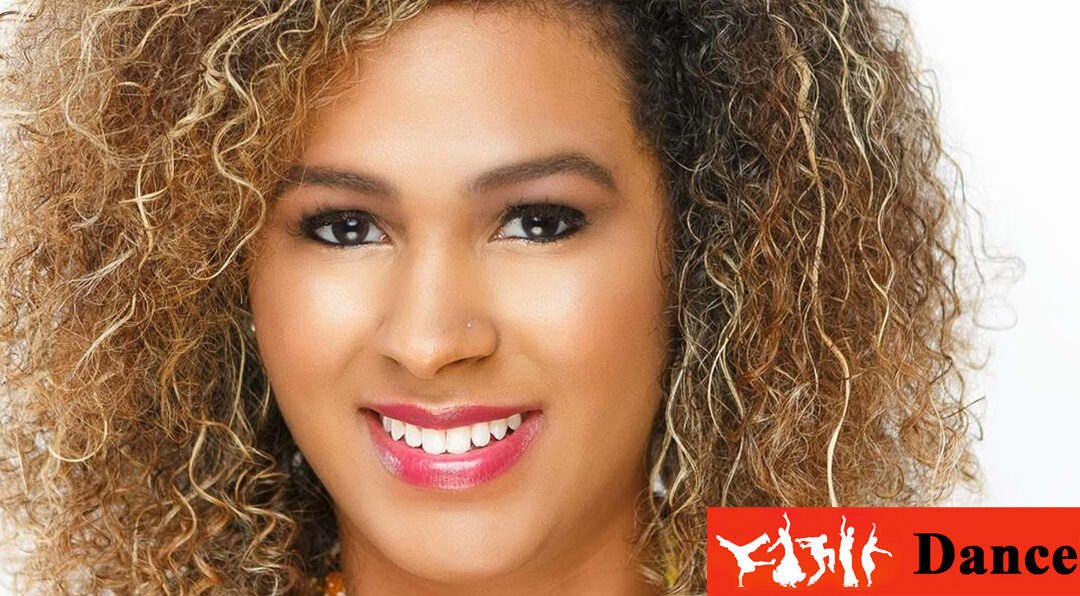
Janel Caminos talks about travel for social dancing. She is a newly published author of Curly Gyal Affirmations available on Amazon at https://smile.amazon.com/Curly-Gyal-Affirmations-Janel-Caminos/dp/0578754886/. Follow Janel at https://www.instagram.com/janel.danza/ and https://www.facebook.com/jcaminos
DanceTalks with Janel Caminos: Full Transcript
Hosted by Andrea Cody, Director of Dance Houston. Originally released November 2, 2020. This transcript was generated automatically and may contain small errors.
Episode summary (SEO)
Houston dancer and dance instructor Janel Caminos joins host Andrea on DanceTalks from Dance Houston. Raised in Puerto Rican culture, Janel grew up dancing salsa in her living room, founded Ritmo Latino Dance Company at Texas State University, performed and competed in samba with Houston’s LD Dance Company, learned kizomba at Angolan family parties, and became Houston’s first Brukwine dancehall fitness instructor. She shares where to find Houston dance socials, her favorite festivals, including the Houston Salsa Congress and the Sawa Sawa Kizomba Festival, tips for budgeting a dance-travel lifestyle, and the story behind her book Curly Gyal Affirmations. Recorded October 22, 2020.
Key takeaways
- Start with the music. Learn each dance’s music, rhythm and history first. Salsa “on one” and “on two” is really about which beat you hear.
- Learn from the culture. Janel learned kizomba and semba at Angolan parties, not in a studio, and she respects each dance’s roots.
- Houston has a dance social for everyone. Studio socials have separate salsa, bachata and kizomba rooms, and they’re a safe alternative to clubs. Facebook is the best place to find them.
- Dance travel takes a budget. Pick a few festivals a year, use travel reward cards, and split festival hotel rooms with friends.
- Love your natural hair. Curly Gyal Affirmations gives 30 daily affirmations for every skin tone and hair texture.
Transcript
This transcript has been lightly edited for readability: filler words and repeats were removed.
[0:00] Growing up dancing
Andrea: Hello and welcome to DanceTalks. I’m your host, Andrea. Today is October 22, 2020, and my guest is Janel Caminos. Janel is a full-time healthcare professional for Harris County and a part-time dancer and dance instructor. Janel, thank you for being a part of DanceTalks.
Janel Caminos: Thank you for having me today.
Andrea: I’m really excited to hear more about you and what you do. I’ve known you as a dance teacher, but how did you get started dancing?
Janel Caminos: I’ve been dancing my whole life, since I was probably five years old, maybe even younger.
Andrea: Where are you from?
Janel Caminos: I’m from Houston, but my family is from Puerto Rico and I was raised in that culture. My mom always says I could shimmy before I could walk. People ask me all the time how I learned to dance, and I say, at home in my living room. I grew up mostly with salsa. That’s still my number one passion and my dance of choice. I love all other dances, but salsa is my true love.
[1:00] Social dancing and Ritmo Latino
Andrea: Like with a partner? Traditional salsa?
Janel Caminos: Yes, dancing with a partner. The partner doesn’t have to be a man. You can dance with your mom, your sisters, your cousins, your dad. And of course there’s social partner dancing. I’ve done the competitions and the performances, but I call what I love social dancing. It’s not the ballroom technique you see on Dancing with the Stars. I’m more on the street, cultural side. But I do both: the technical side and the fun side.
Andrea: Did you take classes?
Janel Caminos: For some genres, yes. For salsa I never really took classes, but I was on teams, and I started my own Latin dance company in college at Texas State, Ritmo Latino. I would teach people the basics of salsa, but I never professionally trained in salsa.
Andrea: Do you lead?
Janel Caminos: I can. Honestly, after this pandemic I’m going to have to brush up on everything. But yes, the basics. When you teach, you have to learn both parts.
[2:28] Where to dance in Houston
Andrea: What are your favorite places to go out in Houston?
Janel Caminos: It depends on the event. I don’t just do salsa. I dance kizomba, and I like Caribbean dancing like soca and dancehall. Whether it’s a Latin party, an African party or a Caribbean party, I’m going to be there. I don’t really like clubs, so I go to dance socials. We rent out a dance studio, there are DJs, and we dance all night. At a Latin social there might be a bachata room, a salsa room and a kizomba room. You don’t have to deal with the club life, the drunks or anything inappropriate. Everyone is there strictly to dance, and it’s a safe environment.
Andrea: Where are those?
Janel Caminos: Usually at the studios. I like to go to Salsa Rica; I think it’s at the Palladium now. Salsa Eddy has his at the Houston Dance Factory. There’s Amaya Dance, and dance studios all over have their own events. It’s really important to be connected on Facebook. That’s where I find out about most of the socials going on each weekend.
[4:06] Knowing the culture: kizomba and dancehall
Andrea: Do you know much about the history of each dance?
Janel Caminos: Yes, actually. I think that’s the most important part. My friends say I’m a purist. I’m not really into fusions. I appreciate them, especially in a performance, but that’s not my thing. For example, I used to teach kizomba, a dance from Angola. I only know it because in high school one of my best friends was from Angola. She introduced me to her culture, and I would go to their parties at home. It was very similar to how I grew up, but they speak Portuguese, and they even dance samba like in Brazil. That’s how I learned kizomba and samba, at Angolan parties. I didn’t take classes for kizomba either. Now it’s a hot thing and people ask me what studio I learned at, and I say, no, I grew up going to parties. To me, learning from the actual people is the best way.
Andrea: And how did you get into Jamaican dancehall?
Janel Caminos: I’ve always loved reggae and dancehall. In Puerto Rico we have reggaeton, which is pretty much Spanish reggae. It’s a little more hip-hop, but you wind and move your waistline. I also loved watching dance videos. I’m a visual learner: I watch a video and practice the moves.
[6:10] Brukwine and the essence of each style
Janel Caminos: I was also a Brukwine instructor. That’s a Caribbean, dancehall-inspired dance fitness class. The founders were dancers for Sean Paul, and they trained other dancers to teach their style. There aren’t many classes like that here; there are more on the East Coast, like New York. Only in the last two or three years have there been Caribbean dancehall classes in Houston, and I was one of the first Brukwine instructors here.
Andrea: Can you give us the essence of each of those styles? What makes them distinct?
Janel Caminos: I get that question all the time. Educate yourself. People love kizomba because they think it looks like tango or bachata, but they’re different. Listen to the music first. With kizomba, the music might be kizomba, ghetto zouk or semba. If you don’t understand the beats, the counts and the drops, you can’t dance to it. You don’t have to understand the lyrics. I dance to so many songs where I don’t know what they’re saying. It’s about the music and the rhythm.
[8:15] Musicality
Janel Caminos: Always learn the history and the music, and you’ll know the difference. In salsa, there’s salsa on one and salsa on two. A lot of professional dancers will ask you first what you dance on, because it’s about how you hear the music. It’s like an unspoken language. And sometimes I struggle with musicality depending on the genre. Lately I’ve been training a lot in heels class, which is very sensual R&B music, with hits and tones you have to listen for. On a clave beat I know what to expect. This is different, and it’s the hardest challenge for me.
That’s why there are musicality classes, where they break the song down: do you hear this beat, do you know how to count this?
Andrea: I love those classes. Sometimes I learn the names of the instruments, and all of a sudden it’s like, oh, that’s what that sound is.
Janel Caminos: Yes, you enjoy the dance a lot more because you understand where it’s coming from.
[10:18] Soca and a trip to Trinidad
Andrea: And what about soca?
Janel Caminos: Soca is always a good time. It’s very festive and reminds me of carnival. It’s not a technical dance; it’s more of a feeling, moving your waistline fast and slow, which can be intimidating to some people. It’s very freeing. You can dance by yourself or with a partner.
Andrea: Where’s it from?
Janel Caminos: Soca is Caribbean music, along with calypso. It’s mostly from Trinidad, which I’d call the motherland of soca, plus Barbados, St. Lucia and a lot of other islands. Reggae and dancehall are from Jamaica. Knowing where a dance comes from gives you more appreciation for it. I actually went to Trinidad this February, right before COVID. I landed back in the U.S. and the world shut down. I didn’t grow up in that culture, so I really had to study it, and being there made me enjoy it so much more.
[11:58] Dance festivals
Andrea: Have you traveled a lot to dance?
Janel Caminos: Yes, for years. This is the first time in years I haven’t traveled for dance. Almost every month or every other month, I’d go to a dance festival in another city for the weekend. There are dance festivals all over the U.S. and internationally. People travel to dance in different places, meet different people, and use it as an excuse for a vacation. That’s what I miss most about my dance life.
Andrea: What are some of your favorites?
Janel Caminos: My favorite for kizomba is the Sawa Sawa festival in the Washington, D.C., area, always Fourth of July weekend. I go every year. The quality of the dancers, the training and the instructors is great, and I love the museums and the food in D.C. My favorite in Houston is the Houston Salsa Congress. I go every single year.
Andrea: Who does that?
Janel Caminos: Houston Salsa Dancers, a nonprofit. It’s one of the biggest salsa festivals in the U.S., and people come from all over the world. It’s not just salsa: there are other Latin and African classes, and artists come in for live concerts. There are workshops all day, like a work conference for dance, plus musicality classes for beginner, intermediate and advanced levels. They do challenges where you learn a routine during the week and perform it at the night show. You don’t have to be a professional to attend. You can go just to dance for fun and learn different styles.
[14:23] Traveling internationally
Andrea: Have you been traveling internationally much for dance?
Janel Caminos: Not this year. I made it to Trinidad, but not to Canada or Jamaica. Last year my favorite international trip was Portugal; I went to Spain too. I loved the culture, the food and the country. I didn’t even go for a festival. It just happened that there was one, and I ran into a couple of people I knew from the U.S., even one from Houston. The dance world is tiny. You will meet someone you know somewhere at a dance festival. That’s one of the beauties of dance: you meet people from different backgrounds, cultures and languages, and we all share that common love for dance.
[16:00] Budgeting for a dance lifestyle
Andrea: Do you have to budget a lot for dance?
Janel Caminos: I’m not going to lie, it’s an expensive lifestyle. If you’re going to make it part of your life, you need a budget. I’m not about going broke for dance. Plan which events you want to attend, say three festivals a year, plus the local ones. We’re fortunate in Houston. I feel like we have every dance genre here, and before COVID you could find somewhere to dance any day of the week. People in other places may have to travel. And even being on a dance team in high school was expensive: costumes, shoes, training.
Personally, I use my travel card. A lot of travelers have travel cards, buddy passes or points, because we travel so much that it pays for itself.
Andrea: Is it when you earn them or spend them?
Janel Caminos: Both, depending on the card. Sometimes when you sign up, if you spend, say, $3,000 in three months, they’ll give you 50,000 points. I use the Chase Sapphire Reserve, which is one of the top cards, but to start off I’d suggest the Chase Sapphire Preferred. I also have a United card and a Southwest card. Whatever airline you fly most, you build your credit and points and save up for that trip. And a lot of festivals offer discounted hotel rates. You get four roommates and split it, and sometimes it’s cheaper than an Airbnb.
Andrea: What do you do for food?
Janel Caminos: I don’t eat hotel food; it’s way too expensive. I like to find the best local restaurants, so I do my research beforehand, ask someone who’s been there, or post on Facebook or the event page. A group of dancers will go try a restaurant together. You don’t just go for the dance; you explore whatever city you’re visiting. A lot of those cards also give you points for eating out. And with this pandemic, I’ve canceled about eight flights, so I have so much credit I don’t think I’ll pay for a flight for at least a year. But I would love to go back to a dance festival. I miss social dancing so bad.
[20:44] Dancing during the pandemic
Andrea: What have you been doing?
Janel Caminos: Working on my fitness: weights, cardio, walking and running outside. Surprisingly, I’ve lost 15 pounds during the pandemic. I guess my body is so used to dancing that it doesn’t burn as many calories for me. At first I did virtual classes, but that’s not for me. I’m over anything virtual at this point.
Andrea: Have you taught virtually?
Janel Caminos: Twice. It was okay, but it’s weird. I feel like I’m talking to myself. In person you feel people’s energy. But I’m proud of the people who always wanted to take dance classes and are taking advantage of this time to do it from home. I think the dance scene is going to grow after this, because people who were intimidated by in-person classes will show up once studios open.
Andrea: And without the mirror and everybody else intimidating you, you can connect with yourself.
Janel Caminos: Yes. I’m excited for the future of dance. We’ve been isolated for so long, and we’re all desperate to partner dance, social dance, go to festivals and perform again.
[22:45] Heels class and always learning
Andrea: Are you dancing at home?
Janel Caminos: I do, but it’s not the same. I’ve been taking classes at the studios, but it’s very limited, and you wear a mask the whole time, which is hard. But safety and health first. I’ve been focusing on heels class, which is new for me since I usually do social partner dancing and Caribbean and Latin cultural dances. It’s different movements, different timing, different musicality. I feel like a beginner. That’s the good part about dance: you’re always learning. I’m never satisfied.
Andrea: It’s a really complicated instrument. A musician tries to master one instrument, and you’re trying to master everything you could possibly move.
Janel Caminos: Yes. Sometimes I get frustrated: I hear it, but my body’s not moving to that part. You have to learn to be patient with yourself. Keep practicing until you get it. Some people get it fast and some take time. We all learn at different levels, just like in school.
[24:47] Training, samba and LD Dance Company
Andrea: When did you start training?
Janel Caminos: I trained in ballet and jazz from about 5 to 16 or 17. I loved jazz, especially in high school, and I did some lyrical and modern in college. But in college I wanted to expand beyond jazz and ballet, which felt restricting. That’s when I started my Latin dance company, to get back into my culture. It’s a lot more fun, with not as many rules.
Andrea: When did you get into samba?
Janel Caminos: There was a Houston company I followed, LD Dance Company. I met the owner at a Brazilian party and fell in love with her, so whenever I was home from college for the summer, I’d train in her classes. One of my goals was to join LD Dance Company once I finished college, and I did. You have to audition. That was one of the most challenging styles: a lot of cardio, very intense, very athletic, dancing fast in heels. But it’s so fun, with that carnival energy. I did it for about three years and competed in a samba competition. We performed almost every weekend at festivals, weddings and corporate events. People would think I was Brazilian, which I take as a compliment. I love the culture, and I hope I represent it well. Even within Brazilian dance there are different styles: a kids’ version, the carnival version, axé, and even the formal styles.
[27:55] Admiring hip-hop and becoming a Brukwine instructor
Janel Caminos: Just because I love a dance doesn’t mean I can dance it. I can’t dance hip-hop to save my life, but I love watching it, and I’ll support the dancers who can. You can’t be good at everything, just like we’re not good at every subject in school.
Andrea: Brukwine looks really fun. Big groups of women having an amazing time together. How do you get into that? Do you get certified?
Janel Caminos: There are two owners, based in New York. One of them moved to Houston, and she trained me to become the first instructor here in Texas. I didn’t have to get certified, but they’re working on a certification program so more people can teach in their own cities. I think it’s delayed because of COVID.
Andrea: Where should people check that out?
Janel Caminos: On their website, brukwine.com. I’ll send you a link. They still have classes online. Honestly, teaching online hasn’t been my focus during the pandemic. Dance takes a lot of your time, and I’ve used this time for other personal goals. I still love dance and miss it a lot, but I can wait for in-person.
[30:02] Curly Gyal Affirmations
Andrea: You published your first book.
Janel Caminos: I did. It’s called Curly Gyal Affirmations. People ask what “gyal” means. It just means girl; I wanted that Caribbean cultural influence. I actually wrote it almost two years ago and did nothing with it, and the pandemic was like, you have this sitting here, what are you going to do about it? I write affirmations to myself on my mirror and my counter. It’s one of my self-love practices.
People may be shocked, but my hair was a big insecurity growing up. Curly hair wasn’t popular when I was young, and I was teased for it, so I straightened my hair every single morning. People in high school didn’t even know I had curly hair until the last month of my senior year. I had dance practice every day and sweated it out, so I had to straighten it every day. I used relaxers, chemicals, because I wanted straight hair so badly. Then senior year I just stopped caring. I was going to college to be my own person.
As an adult I battled with it again in corporate America, interviewing for jobs and hearing that natural hair isn’t professional. Even in dance, you need your hair in a slick bun or ponytail. I still catch myself wishing my hair looked a different way. I know other girls have the same struggle, so I made sure everyone in the book is represented, all skin tones and all hair textures. There are 30 affirmations, one for every day of the month: love yourself, love your hair, love who God made you, and remember you don’t have to go by the world’s standards of beauty. Now curly hair is a trend, with wigs and everything, and I wish it had been cool when I was younger. But I’m glad things are evolving. People still ask me all the time, “Is your hair real? Can I touch it?”
[34:11] Where to find the book
Janel Caminos: Dancing, curly hair and traveling all represent me, and I’m happy I had the chance to focus on this.
Andrea: Congratulations. How can people get your book?
Janel Caminos: It’s on Amazon. Search for Curly Gyal Affirmations, with “gyal” spelled G-Y-A-L. Before I published, I searched to see if there were any hair affirmation books, and there were none.
Andrea: I’m more “wavy hair, don’t care.” Growing up, it was still all about straightening. It’s one thing to have curly hair like Kate Winslet in Titanic, but wavy, only in parts? I look forward to reading it. Will you give us an affirmation?
Janel Caminos: Absolutely. This is one of my favorites. Affirmation 15: “God took his time creating each curl.” He knows what he’s doing; he knows every hair on you. If he took his time on this, you’re fine. Don’t question yourself. The book is for all ages, for anyone whose hair isn’t straight and has made them feel that straight is the only pretty, perfect way. I want to change that norm.
[36:15] Working in HR during the pandemic
Andrea: You work in HR in healthcare with Harris County. Can you tell us about the job that supports your dance life, and what it’s been like since the pandemic began?
Janel Caminos: I’m blessed to have a full-time corporate job that supports my lifestyle and my passion. I know dancers who are having a hard time because dance was their full-time job. That’s why I always say have a backup. Dance has always been part-time for me. My background was oil and gas, but I’ve been in healthcare for the last two years, and they’ve been very supportive of my book.
With the pandemic it’s been busier than ever, even working from home. We need nurses and medical staff. It’s stressful but rewarding, because right now the heroes are in the medical field, and we all make a difference in patient care. People forget that there are still so many other health issues besides COVID, so it’s normal healthcare plus COVID on top.
Andrea: So you’re working from home?
Janel Caminos: Yes. If you’re not doing direct patient care, you don’t need to be on site. Some people are hybrid and come in once or twice a week. In HR I have no direct patient contact. A lot of nurses working directly with patients were getting hazard pay. The good news is it’s very low now. There was a time when the ICUs were full, but we haven’t been there since July. We were nervous about Labor Day weekend and school starting.
Andrea: Yes, it has gone up some, but it’s not out of control.
Janel Caminos: And a lot of young people recover pretty quickly.
Andrea: Bars haven’t opened yet. Some bars were getting taco trucks in their parking lots to pass as restaurants.
Janel Caminos: People are trying the loopholes. It’s been a hard time for certain careers, like entertainment and dance. And teachers and healthcare workers are really putting their lives on the line.
[40:24] Traveling again
Janel Caminos: I just want us all to get back to dancing. It’s a stress reliever for so many of us, and it’s my escape from life and work. I literally can’t go a week without dancing, so it’s been hard.
Andrea: Is there a sign you’re waiting for that says, okay, I’m going on a trip or going to this party?
Janel Caminos: I decided not to live in fear. I went to Mexico a few months ago, and I’m going again next weekend for my birthday.
Andrea: Happy birthday!
Janel Caminos: Thank you. Honestly, I felt safer in Mexico than here. Their precautions were much stricter: masks were mandatory everywhere, and every doorway checked your temperature and gave you hand sanitizer, in the cars and the airport too. I went to Tulum, where pretty much everything is outside, with lots of water activities. There were no parties; it was relaxing, just the sound of the ocean. I thought about Jamaica or Puerto Rico, my favorite islands to go out and dance, but they’re restricted. Going there and not being able to dance would feel like punishment. In Puerto Rico the beaches were closed. In Mexico the beaches are open.
Andrea: I’ve actually never been to Mexico, even though I live right here.
Janel Caminos: Take the opportunity to travel, even domestically, to cities you’ve always wanted to visit. A friend of mine always wanted to go to Seattle, so she went for two days by herself. Right now a lot of people are travel-shaming. Someone in one of my Facebook travel groups called me the loser of the year because I traveled. I’m not going to encourage or discourage anyone. It’s whatever you’re comfortable with. Before, I’d go somewhere every month to de-stress; now it’s every three months. Just be safe: wear a mask and keep your distance.
Andrea: I’ve heard airplanes have some of the most sophisticated air filters.
Janel Caminos: They do; it’s cleaner air. At this point we shouldn’t tell people what they should and shouldn’t do. Sending your kids to school, going to dance class, traveling: those are personal decisions. There’s a lot of judgment going on. Just mind your business.
[45:32] Closing
Andrea: My guest today is Janel Caminos. Janel, thank you very much for being a part of DanceTalks.
Janel Caminos: It was fun.
Andrea: Thanks for listening. Please subscribe and share our podcast, and reach out to us on social media if you’d like to talk. To support DanceTalks, donate to Dance Houston. Talk to you on Monday.