
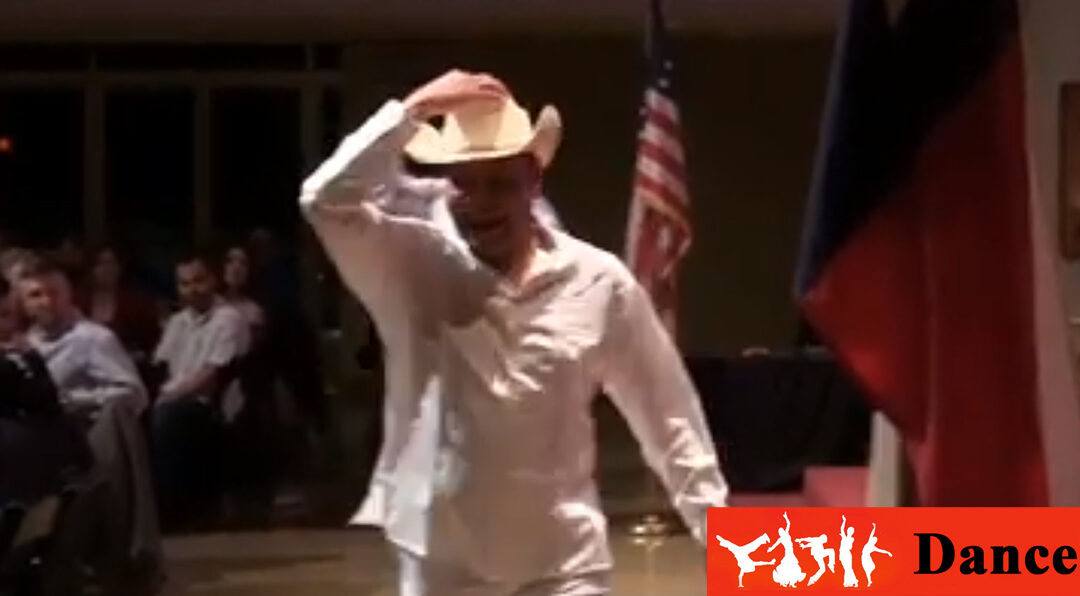
Maestro Isidro Salas tells his story of barriers and breakthroughs sharing Mexican culture through spectacular innovations in ballet folklorico. Follow his company Compania Folklorica Alegria Mexicana (https://www.facebook.com/Compa%C3%B1ia-Folklorica-Alegria-Mexicana-CFAM-150110105187444) on Facebook.
DanceTalks with Isidro Salas: Full Transcript
Hosted by Andrea Cody, Director of Dance Houston. Originally released October 5, 2020. This transcript was generated automatically and may contain small errors.
Episode summary (SEO)
On this episode of DanceTalks from Dance Houston, host Andrea Cody talks with Maestro Isidro Salas, artistic director and founder of Houston’s Compañía Folklórica Alegría Mexicana, with interpreters Hugo, production coordinator at MECA, and Leila Cantú. Isidro describes starting to dance at eight in school in Nuevo León, training for eight years with Estampas Mexicanas, and joining the Ballet Folklórico Magisterial de Nuevo León under his lifelong mentor Jaime Guerrero Hernández, whose research trips took dancers to live in villages in Guerrero, Michoacán, Puebla and the Sierra of Chihuahua to learn dances, costumes and traditions firsthand, followed by tours to France and Greece. He explains how ballet folklórico grew from pre-Hispanic dances for the gods into a theatrical art that blends tradition with ballet, jazz and flamenco technique. Isidro tells how he founded Alegría Mexicana in Houston in 2000 with one dancer at Ripley House, debuted at Miller Outdoor Theatre with a famous mariachi, and choreographed the Mexican dancers in a Colombian-Mexican fusion at the 2008 Latin Grammys at the Toyota Center, even though he was kept in the basement and never paid. He also talks about his company’s appearances in New York, Washington, Monterrey and Disney World, dancing Nuevo León at his teacher’s 50th anniversary, discipline and inclusion with young dancers, the company’s 20th anniversary show, costume maker and administrator Eva Santos, and his advice: follow your dreams and do it with conviction. Recorded October 1, 2020.
Key takeaways
- Go to the source. Isidro learned folklórico by living with village communities, who taught their dances, costumes and the humility behind them.
- Respect the base, then create. Students should learn the traditional foundation first; new colors, bigger flowers and theatrical choices can come after.
- Ballet folklórico is a fusion. A dance group becomes ballet folklórico when trained dancers bring ballet, jazz and flamenco technique to the theater stage.
- Stand up for each other. At the Latin Grammys, Isidro’s dancers refused to perform unless their maestro was allowed in.
- Discipline builds a company. With only an hour or two a week, students who commit can match groups that rehearse four hours a day in Mexico.
Transcript
This transcript has been lightly edited for readability: filler words and repeats were removed, and several passages that could not be heard clearly in the recording were left out or condensed. Isidro Salas answered mostly in Spanish; his answers are given here in English as interpreted during the interview by Hugo and, later, Leila Cantú, with some of his Spanish translated directly where the interpretation was incomplete.
[0:00] Introduction
Andrea: Hello and welcome to DanceTalks. I’m Andrea Cody. Today is October 1, 2020, and my guest is Maestro Isidro Salas. He is the artistic director and founder of Compañía Folklórica Alegría Mexicana, and he’s joined today by his translator, Hugo, who is the production coordinator at MECA. Maestro Salas, bienvenido a DanceTalks.
Isidro Salas: Gracias, Andrea.
Andrea: Thank you so much for talking with us today. I’m really excited to share your story; it’s fascinating. Please take us back to the very beginning, how you came to dance.
[1:19] Starting in school
Isidro Salas: I really started at eight years old, in elementary school, and then at 12, in middle school, I got more interested in the culture of Mexico: the dances, our traditions and our roots. That’s where I started to see the diversity of the costumes, and I got more interested in the costumes and the hats, and why they wore a certain thing in a certain color. It caught my attention, and I started going deeper into Mexican dance.
After finishing middle school, I started with Estampas Mexicanas ballet folklórico. I started there with the basics and kept getting more knowledge from my teacher. That was eight years with the maestro. After that, I went to the Ballet Folklórico Magisterial de Nuevo León, which was dedicated to the investigation and the fusion of Mexican dance. There was an institute for this, like a college, where we learned the basics and then went to investigate the culture firsthand.
[5:02] Living in the villages
Andrea: Tell me about that. How many places did you visit, and how long did it take?
Isidro Salas: The institute makes a call, for example to go to Guerrero, and we all get together with all the teachers and get to know the community for a week. We live in the little villages and sleep there, so we learn everything: what they use, what they eat, what they dance, what their clothing is.
Andrea: And there’s a big difference between the cities and the rural areas that you visited?
Isidro Salas: Yes, a lot of difference. But I think the villages are the base, the roots. Without them, we couldn’t be growing, and we couldn’t get to where we are right now. That’s where we absorb all the knowledge, all the little things we have to share with everybody. He’s from Nuevo León, so he goes to other places, like Guerrero, Michoacán and Oaxaca, to learn and share that information.
Let’s take Puebla as an example. There is a dance called the Danza de los Quetzales. You go to that town, and they show you how to make the penachos, the big feathered headdresses. It’s pure emotion every year when the call is made. For just one week, we get to know them, learn and feel how they do things, and that’s what keeps us going, because we wait all year for it to come.
Andrea: So I understand it was after eight years of training that you got the opportunity to be part of this research. Was it a career, or something you had to pay to do?
Isidro Salas: We paid a small part of it, to cover food and lodging. It was really worth it. After that, I went back to my roots and kept making dance in my own words, putting what I learned into my own work.
[9:50] Touring abroad
Isidro Salas: From there came the trips: France, Greece. Taking your roots to another country, where people have a different view of us, is something you can’t explain. It’s a great pleasure when they announce Mexico and give us the opportunity to share our traditions. Everything I got from the Magisterial is what I’m made of. To this day, I still call my teacher to ask him things.
Andrea: What’s his name?
Isidro Salas: Jaime Guerrero Hernández. He’s the director of the Magisterial.
[11:30] What the villages taught him
Andrea: Do you think the people who lived in the villages understood how this process was going to spread their dances around the world?
Isidro Salas: I think the people in the small villages understood what was going on. From the moment we arrived, people were very emotional and very kind. In Chihuahua, for example, in the Sierra, they open up to you. They knew what we were there for, and they taught us everything. They make their costumes by hand from their own resources, and they offer you and give you everything. The sharing was mutual, and so was the happiness of being together. It was great. What I learned from them was the humility and simplicity of the people.
Andrea: Did they dance for tourists, or for themselves?
Isidro Salas: In the cities, dance is presented for culture and for tourism, but not in these places. There, they dance by descent, by tradition, by culture. The dance is a synonym for our ancestors. The people of the community believe very much in their gods, and those are the roots they keep going; they didn’t want it taken from them. The dances are a thanksgiving for the harvest they received that year.
Andrea: Wonderful, thank you.
[15:46] From student to professional
Andrea: We are now joined by our second translator, Leila Cantú. Thank you so much for being here.
Andrea: I’m wondering how Isidro’s profession started, how he went from student to professional.
Isidro Salas: I’ve always tried to take it to the next level, but I wouldn’t consider myself professional, because of the way I feel about it. That’s just the way I would describe it.
Andrea: I understand. So tell us what happened next. How long were you doing international tours?
Isidro Salas: That was my stage of gathering experience. I learned a lot from my teachers in Mexico. I watched how they sewed the costumes and how they developed choreography the whole time I was with the Magisterial, and I took the opportunity to learn how to make costumes and everything used in folklórico, from headpieces to hats to knives. I was with them until I was 24, in 1995.
[18:17] Tradition and evolution
Andrea: Do you think the dances in each region have stayed the same?
Isidro Salas: They have had their variations. The intent of the institute is precisely for us as instructors to preserve the traditions. But right now the youth are evolving, putting in more modern techniques. We as instructors want to continue the tradition, but the new generations have been changing it toward performing arts, where they can convey more artistic presentations, with louder colors, more makeup and more artistic expression. My students have the base. I tell them, “This is the traditional base, but we’re going to build on it.” I’ve taught them the traditional basics, and also how to evolve the dance so the public is more interested.
[20:17] Where ballet folklórico began
Andrea: Where do you think ballet folklórico began, and when?
Isidro Salas: Speaking in general, I think ballet folklórico began decades, even centuries, ago. It was born from the traditions of the pre-Hispanic culture, where the tribes and communities would dance to their gods because of their beliefs. That’s exactly where it originated.
[21:22] Coming to Houston
Andrea: What inspired you to come here?
Isidro Salas: First, I felt I had to give something to the community. One time I came to the United States, and I was invited to perform at Ripley House, and I saw folklórico at a parade they used to hold here on September 16. That’s where the idea was born to come to the United States and create something for the youth, for the children, so they would continue the traditions and bring the students together.
Andrea: And how did you start your company?
Isidro Salas: I arrived in 2000, and practically within a month, I said, “If I came here to work, I’m going to work.” I began with just one dancer. It was a little complicated at first, because nobody knew me.
[23:49] Miller Outdoor Theatre
Andrea: Tell me about your first opportunity to perform here with your company.
Isidro Salas: I was lucky. I had gone to the Miller Theatre many times hoping to perform, and I met the man who put together the Cinco de Mayo programs. He asked to see the company, so he came to see the group and asked, “Who are you? Where do you come from?” We were practicing at that time at Ripley House on Wayside. He was amazed. He said he had never seen anything like it: “This is something that should be presented at Miller.” I was very proud, because there were other groups that had been dancing here for 10 and 15 years and hadn’t had that opportunity.
But before that, I had a sad experience. I went with three dancers on Tejano Day and asked if we could present, and they said no: “Who are you? We can’t just have you come up here.”
Andrea: The same thing happened to me with a group that just drove in and said, “We’re here to be in the show,” and I had to say, “No, you’re not.” At Discovery Green, because it’s more open and there’s no backstage, it’s an easy environment to say, “Oh yeah, you’re on in five. Come on up.” But Miller has stricter security.
Isidro Salas: And it was ironic, because the same man who told me I couldn’t present was the one who went out, saw our work, and asked us to perform.
Andrea: Wonderful. So where did you first perform as a company?
Isidro Salas: At the Miller Theatre. I think we started off on the right foot, because I didn’t expect to perform with Mariachi Vargas de Tecalitlán. To be performing with a world-famous mariachi and my group was too much emotion. It was something awesome. There was so much pride knowing we had made our own costumes and were going to present at Miller with that mariachi. Words can’t explain it.
Andrea: What piece did you do?
Isidro Salas: We presented Jalisco, Veracruz and Nuevo León, traditional dances from Mexico. After that performance, we performed there for five consecutive years.
Andrea: Awesome.
Isidro Salas: But then they changed the board of directors, and things changed, so we weren’t able to perform there anymore.
Andrea: Their board of directors is appointed by the mayor, so it does change.
[30:12] The Latin Grammys
Andrea: When I first heard about you, I heard that you performed on the Latin Grammys. Would you please tell us about that experience?
Isidro Salas: It was a very beautiful experience for the company and my dancers. I get emotional every time I watch the video, because I feel it could change the lives and the memories of the children who lived that experience of being at the Latin Grammys at a professional level. That’s my joy, even though I went through certain things. I was very proud to see my dancers participate in a show of that magnitude. It made history for them, something they will remember that they would never otherwise have experienced.
Andrea: How did you get there? Did they just call you up?
Isidro Salas: The person who contacted me said he needed choreography from such a minute to so many seconds, to participate there, and asked me to create the whole program related to Mexico, the sequence and the steps. They promised me certain pay, and that the dancers would have certain guarantees and be credited on flyers and things like that. I was very excited, not so much because of the payment, but for the experiences all these dancers were going to have. Things can be done when you really want to do them. As the date got closer, all the promised pay and everything else started to disappear, but that didn’t make me want to withdraw. I still wanted to continue because of my dancers; I wanted them to experience everything. I don’t know why that person did that. He knew who I was artistically. It was a bad time, but it gave me the strength to continue, and here I am.
Andrea: You’re not doing it for the money.
Isidro Salas: A lot of companies have everything available to them: the money, the costumes; everything comes easily. For a person like me, it’s difficult, but that’s what gives me the strength and the ideas to create: “How do I do this? How do I invent this? How can I make this work with the same results, or even better?”
Andrea: So that’s part of your creative process.
Isidro Salas: That’s it.
[36:00] Kept in the basement
Andrea: So tell me what happened when you got there. Did you confront the person who was supposed to pay you?
Isidro Salas: No. Just a day before, he said, “I’ll see you at the Toyota Center.” We arrived, and they told me, “You can’t come in,” because I didn’t have a government ID, and it was an international event. I was totally silent. But my dancers told that person that if I didn’t go in, they wouldn’t go in. So he said, “The only thing I can do is let you stay in the basement. There’s a screen there, and you can watch. Ten minutes before the show, I’ll come get the dancers.” When I asked about the payment, he said it had been paid to the choreographer, because it was a collaboration between Colombia and Mexico, and all the money went to the Colombian choreographer. We didn’t get a penny.
I really wanted my dancers to show their talent. They are the ones with the talent; I just polish them like a diamond. That’s how I feel. So I wanted them to feel that excitement and didn’t let the rest bother me. My main concern was my dancers and how happy and excited they were.
Andrea: Would you have performed with them?
Isidro Salas: No. They just asked me to create the dances and the costumes and everything else, and the other choreographer took payment for the whole thing.
Andrea: So you were choreographing on your dancers from the Compañía Folklórica. And your dancers were volunteering?
Isidro Salas: At one point they said the dancers would give a percentage to me, but in the end nobody gave me anything.
Andrea: I’m sorry.
Isidro Salas: It’s okay. Things happen. I’m still here, standing and working. And that other dance company is still performing, but they don’t have their own dancers. They have to borrow one dancer from here and another from there. They don’t have a strong company. Maybe because the money comes easily to them.
Andrea: It reminds me of when your dancers were on the cover of the Houston Chronicle lifestyle section, a big, big photo, and it just said dancers were bringing in the nice cool fall weather. And in this case, it was this fusion of Colombian and Mexican dance, and the Mexican dance just appears like magic, with no credit. We’ll put a link to the Latin Grammys video on YouTube.
[43:00] The curtain goes up
Isidro Salas: It’s pretty common to have jealousy between dance companies. The singer performing live was a Colombian singer, and at a certain minute they were supposed to raise the curtain for my company to come out, and they purposely took ten seconds longer. But when the curtain was lifted and the audience saw the Mexican dancers, it just exploded. It’s an emotion you can feel when the Mexican dancers come out.
Andrea: Could you feel it through the walls, or only on the TV in the basement?
Isidro Salas: You could feel it: the people’s emotion for the mariachi and the Mexican music, the clapping and hollering. And the work that was done, the mix with the Colombian dancers, was very good work. It was something you can’t describe, very, very emotional.
Andrea: When you danced together, were you side by side?
Isidro Salas: Colombia started with one minute, then Mexico had another minute, and in the last minute they did a mix: they danced together, separated, and then came together again.
Andrea: Did you practice together?
Isidro Salas: Never. I never saw the Colombian group’s work. Two days before, I went to their rehearsal to bring the groups together, and they asked me to step aside, because the other choreographer was going to put it together. It was a different creative process.
Andrea: Wow. Your dance company refusing to perform without you reminds me of when the South was segregated. Ella Fitzgerald would not perform if her dancers weren’t allowed into the ballroom; they had to give them their own table. It’s wonderful when artists stand up for each other.
Isidro Salas: Exactly. They have the power.
Andrea: Right. That fusion wouldn’t have looked the same without your dancers.
[47:36] New York, Washington and Disney
Isidro Salas: But we keep working. After the Latin Grammys, better things came. We had two performances in New York, where we were given the keys to the city. Then we went to Washington, and to Monterrey, Mexico, and we perform at Disney in Florida every year. And above all, the opportunities we’ve had here in Houston to present on these stages make me euphoric and push me to do good work.
Isidro Salas: I remember the first time you saw our Huasteca. You were very emotional; I could feel it.
Andrea: Yes. My appreciation of ballet folklórico really went through the roof when I first saw your company.
[49:29] Isidro asks Andrea a question
Isidro Salas: Now I’m going to interview you. Of the ballet folklórico groups that have performed with Dance Houston, what is the difference between them and the Compañía Folklórica?
Andrea: The first one I remember was Sabor México, with Patricia Astorga, and they were beautiful: very balletic, very nice. It was my introduction; I didn’t have much knowledge. Maybe I had seen folklórico at a festival, but I hadn’t gotten to know the artists and watch their work and their process. Then I saw you and fell in love. And then I met up with you at Ripley House for an interview with Univision, and you demonstrated some steps for the host. I tried to do them too, and finally realized how difficult it was. I started listening, not just looking, because it’s so beautiful. Your dancers have so much pride and force and conviction, and they also have personality. I can recognize them; I see who they are. Each person is fun to watch. I’ve watched your videos over and over, and I really enjoy watching the individual performances. I think you give them a lot of license to express themselves. It’s not just about showing off; it’s more performing.
Andrea: You make some very creative choices too. I love the hats with the big flowers. Tell us about that. Where did that come from?
[53:16] The big flowers
Isidro Salas: First, I was inspired by the invitation; I felt I could do something different. I was thinking, “I have to dance Veracruz.” But before I make any changes, I ask my director, and sometimes he doesn’t agree with me. I asked him, “I want to do this with these big flowers.” Others who are very traditional criticized it, because to them you can’t change a flower, its size or its color. They were not happy. I asked my teacher why I couldn’t do a big red flower, and he said, “Yes, that’s fine, as long as you respect the basics and don’t totally change it.”
Andrea: I think it’s fun to see your creativity. You’re an artist, and I like that.
[56:28] Why “ballet” folklórico?
Andrea: Where does ballet folklórico get its name?
Isidro Salas: My company’s name is Compañía Folklórica Alegría Mexicana. In Mexico, there are groups that should be called dance groups, grupos de baile. It becomes ballet when the dancers come from schools of technique, jazz and contemporary. Before, there were just Mexican dance groups. When those groups start taking technique classes in flamenco and jazz and bring their work to a theater, the name changes to ballet folklórico. That’s the difference between the simple traditional and the performing arts.
Andrea: So it is a fusion. Have you trained in ballet separately from ballet folklórico?
Isidro Salas: At the Magisterial de Nuevo León in Monterrey, they gave us one hour of ballet technique every day.
Andrea: Wow. In French? Plié, tendu?
Isidro Salas: Yes, all of that. After that hour, we would do steps, and after the steps, we would create choreography. They also taught us how to paint backdrops, everything. The Magisterial, for me, is one of the most beautiful ballet folklóricos, and I have a lot of respect for it.
[59:27] Dancing Nuevo León in Monterrey
Isidro Salas: My teacher just celebrated his 50th anniversary of teaching. I was invited, and I sent the Compañía Folklórica. The whole Magisterial group danced, and also seven former students who now have their own groups, all from Monterrey.
Andrea: You were the only one from Houston?
Isidro Salas: Yes. And there were mixed feelings, because everyone wanted to dance Nuevo León, since it’s that state. But my teacher told my former classmates that the only one who would dance Nuevo León was Isidro, because I’m the one who has most of his style. You could feel the jealousy among the other instructors.
Andrea: What an honor.
Isidro Salas: When they announced, “Compañía Folklórica Alegría Mexicana, from Houston, Texas, director Isidro Salas, with Nuevo León,” there was total silence. You couldn’t hear a pin drop. But when we started dancing, it turned everything on. My teacher was so happy. The other instructors who used to be my partners couldn’t understand how somebody from the United States could dance it like that without being from there. Even former dancers from my generation who don’t have groups now came to see it and told me mine was the best. Some ex-dancers asked me, “How dare you come and dance Nuevo León? What were you supposed to do, Houston?” But I feel they were very happy and satisfied with my work.
[63:39] Discipline in Houston and in Mexico
Andrea: How does your career compare to someone who stayed in Nuevo León?
Isidro Salas: In Mexico, there is conviction. The groups there practice about four hours a day, every day. Here in the U.S., because of the way of life and the schedules, there’s no time to rehearse four or six hours; you rehearse one or two hours, a couple of days a week. I look forward to a holiday, like Martin Luther King Day, because that’s an extra day we get to practice, but the students say, “It’s a holiday; I want to go somewhere for Thanksgiving or Easter.” So I don’t want to say it, but I think there’s a little more merit in what the teachers and groups here do, because with less practice, they achieve the same as the groups over there.
Andrea: They’ve got you as their teacher.
Isidro Salas: In the beginning, I would tell them there’s practice, and they’d say, “We can’t, it’s Easter, we have to go with my grandpa or grandma.” And I’d say, “No, you have to be here. How can you have a good company with discipline if you’re not willing to be here?” That’s where you get your discipline. I got it from my teacher.
Sometimes a mom comes and says, “Maestro, my child dances wonderfully; he dances all day.” I say, “Okay, bring him.” In the first class I can tell if the child really has the discipline. I explain first: “This is a company, this is a ballet. We work like this. We do this warm-up. There are rules. We follow musical instructions.” After a week of practice, I can tell whether they have the discipline and the willingness to dance. Parents give up their errands and personal time to bring their child, so the child shouldn’t just come and play and not pay attention. We only have an hour, and there’s not much time to play around; then the parents ask, “How much has he improved?”
[69:38] Children who were told they couldn’t
Isidro Salas: I had an experience with a boy with ADHD who wanted to dance. At school they told him he had nothing artistic in him. When he got to my class, I saw that wasn’t true. He became one of the best dancers in his age group. Another boy started because his sister was dancing here; he didn’t want to at first, but he has rhythm, and he’s great at dancing now. At school he was also told he would never succeed in sports or art, and he has gone a long way.
There are children who like to work and children who don’t. Some take longer to pick up the same step, but I still like to work with them, because it’s a challenge. Then there are others who just aren’t interested, and that’s a totally different mission.
[73:05] The company during the pandemic
Andrea: How is your company doing during the pandemic?
Isidro Salas: It’s been a difficult time. I’m managing the spaces with masks and hand sanitizer, keeping the dancers apart, and giving them 15-minute breaks to go out and get fresh air. It’s been complicated, but the children are desperate to get back to dancing. And I respect the decision of parents who aren’t ready to send their children to dance yet.
[74:05] What’s on the horizon
Andrea: What’s on your horizon?
Isidro Salas: First of all, health, to be able to keep passing on what I can to our community. I have a project for Día de Muertos: an event where many groups can come, each presenting dances from regions where these traditions live, like Hidalgo and the Huasteca, and Michoacán, which is where Día de Muertos is born. And my anniversary is coming on November 21. We’re preparing with all the precautions, and I’m happy, because it’s 20 years.
Andrea: Twenty years since your first student. Where did you think you would be, 20 years ago?
Isidro Salas: Here. I’m very grateful for everything that has happened. If you ask me what I would like, it’s to have my own studio, where I could have more colleagues to help me pass it on, because life goes on and I’d like to leave something for the community. I’m happy because in these 20 years, teachers have come out of the company. Leila Cantú, who is here, is in the company and has her own group. My sister too. About six or seven groups have come out of the company to promote and preserve folklórico. That’s the pleasure I have: that in these 20 years I’ve left something for the community, and I know these generations will be able to continue it. Thank you very much for the interview.
I don’t really know how to be political, and unfortunately there’s a lot of politics here that doesn’t let me in. It’s been many years, and it’s been very difficult, with no studio of our own; sometimes we can’t use the space because they have an event. But I believe that with work, health and God, which is always with us, everything is possible. That’s a little bit of my life.
Andrea: Thank you for sharing it with us.
[79:48] The 20th anniversary show
Andrea: What do you have planned for the show?
Isidro Salas: You’re cordially invited. It’s going to be two hours. The first hour is going to be Guanajuato, with food, music and mariachi.
Andrea: And who’s in the show? Your alumni, or your company?
Isidro Salas: Both. People from the whole 20 years. I’ve invited all the ex-dancers from the different generations, and they’ve all been very happy to come back and perform that day.
Andrea: That’s going to be so cool. How can our audience help, including listeners outside the state?
Isidro Salas: I would love it if they could come see the show; that’s one way to help. The show is called Alegría Mexicana, and there they can contribute what they like; we accept donations. They can also talk to Mrs. Eva Santos, who receives donations for the group, or donate through our Facebook page. Right now we’re selling tamales and doing raffles to raise a budget for costumes, because everything is brand new; we’re performing eight states.
[83:22] Eva Santos
Andrea: So Eva Santos is responsible for making the costumes. Tell me about your relationship with her.
Isidro Salas: For me, it’s a blessing from God to have met her. We went to dance at a school in Freeport, and she was there with her grandchildren. After the show, she came up to me. The lady who made our costumes at that time was ill, and Eva volunteered: “I can sew.” From there a beautiful relationship began, and today she’s also the administrative assistant. She’s a very dedicated person who has everything in order. My passion is being with the dancers; I’m not administrative. Yesterday she called me at five in the morning to remind me, “Maestro, remember the interview with Andrea Cody.” I don’t know what I would do without her. I focus so much on the dance that everything else gets locked out.
Andrea: How did she learn how to make those costumes? They’re incredible.
Isidro Salas: She used to sew for her grandchildren and for the other group they danced with, and now she does it for us. And my sister makes all the headpieces and ornaments.
Andrea: Oh wow. I hope you get a scenic designer someday. Wouldn’t that be amazing? I know you have these visions, and someone with that dedication and passion could bring them to life.
[89:20] Advice
Andrea: Do you have any advice about life or about dance for our listeners?
Isidro Salas: Follow your dreams. Do it with feeling, do it with conviction, and have respect for every tradition. Responsibility, getting along with others, and the conviction to want to do things. And just keep going.
Andrea: My guest today has been Isidro Salas, with Leila Cantú. Thank you for joining us. Thanks for listening. Please subscribe and share our podcast, and reach out to us on social media if you’d like to talk. To support DanceTalks, donate to Dance Houston. Talk to you on Monday!