
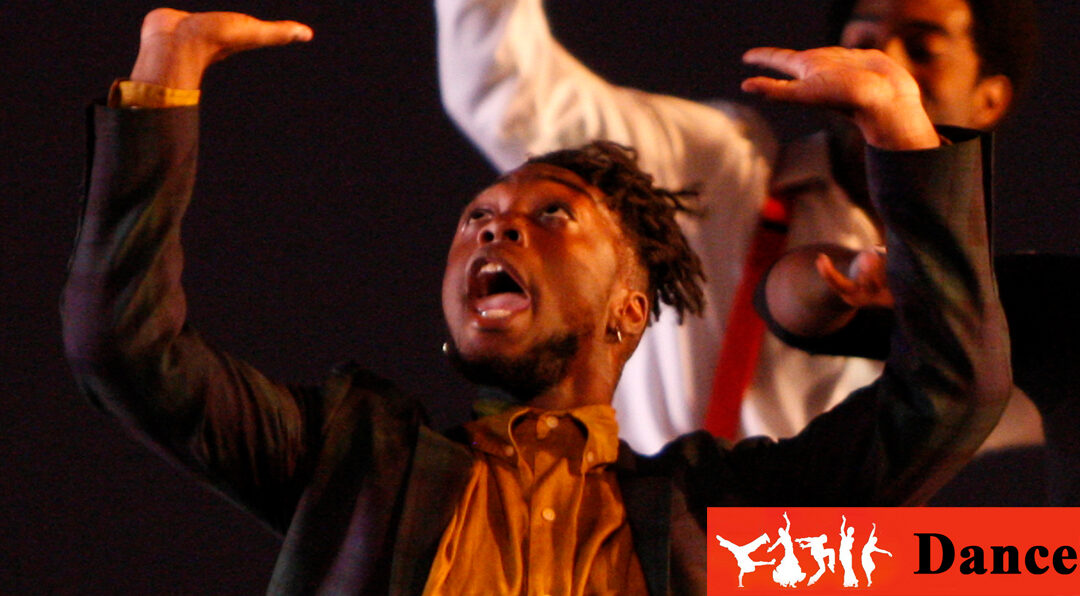
Hindolo Bongay tells how he developed his natural gifts while earning college scholarships, a position in the modern dance company Urban Souls, and a teaching career. Follow him at https://www.facebook.com/hindolo and https://www.instagram.com/hindolobongay/. Visit http://urbansouls.org/ where you can see excerpts from “Blood on the Leaves”.
DanceTalks with Hindolo Bongay: Full Transcript
Hosted by Andrea Cody, Director of Dance Houston. Originally released August 31, 2020. This transcript was generated automatically and may contain small errors.
Episode summary (SEO)
On this episode of DanceTalks from Dance Houston, host Andrea Cody talks with Hindolo Bongay, a Houston dancer, actor, singer and elementary school dance and theater teacher. Hindolo grew up in Alexandria, Louisiana, where a sixth-grade social studies fair project on the history of tap dancing led him into a local dance studio for the first time. He learned an entire recital dance in one session, won dance scholarships, and later competed with a talent agency, where he won the monologue competition he had been too nervous to rehearse in front of his managers. He explains why he chose Texas Southern University’s theater program over a dance scholarship at the University of Houston, how acting taught him to build a character instead of performing just to please the crowd, and how he found Houston’s Urban Souls Dance Company and its artistic director Harrison Guy, performing in Blood on the Leaves. Hindolo also talks about meeting Dwight Baxter, auditioning for Carla Earle’s touring show Baby Hold On To Me, serving as rehearsal director and dance captain for Dance Houston’s Swing, Baby, Swing! with Lindy Hop legend Norma Miller, teaching kindergarten through fifth grade during COVID-19, and his advice for dancers: stay consistent, don’t stop, keep growing. Released August 31, 2020.
Key takeaways
- Say yes to the unexpected. A school project on tap dancing turned into a recital, scholarships and a career Hindolo never knew he had a gift for.
- Acting makes better dancers. Theater taught Hindolo to do his homework and build a character, so even an ensemble role tells a story instead of just showing tricks and turns.
- Make a decision. Harrison Guy’s lesson is that performing is about choices; Hindolo now asks his own students and actors to show him what they come up with.
- Learn from the legends while you can. Working with Norma Miller and Dwight Baxter connected Hindolo to the founding history of the dances he performs.
- Stay consistent. Train at home, take virtual classes and keep moving, because if you stop, it’s hard to bring it right back.
Transcript
This transcript has been lightly edited for readability: filler words and repeats were removed, and several passages that could not be heard clearly in the recording were left out or condensed. The recording for this episode is especially hard to hear in places, so some sections are summarized more briefly than usual.
[0:00] Introduction
Andrea: Hello and welcome to DanceTalks. I’m your host, Andrea Cody, and my guest today is Hindolo Bongay. Hindolo, tell us how you came to Houston.
Hindolo Bongay: I came to Houston for college. Originally I was accepted into the University of Houston for dance, but I decided to take another route and go to Texas Southern University for theater. So that’s pretty much it.
Andrea: What made you change your mind?
[0:53] The monologue he wouldn’t rehearse
Hindolo Bongay: I’ve always had aspirations of enhancing my acting skills. Growing up in Louisiana, I was with a talent agency, LA Entertainment, and they had us do monologues and small scenes and stuff like that, along with the talent we came into the agency with. For myself, of course, I would be competing in dance. But I was really nervous about speaking in front of people. I would never perform my monologue in front of my managers. They would constantly try to make me do it, and I would not. I would always act like I left it at home or forgot it, because my sessions were about an hour away from where I lived.
Andrea: So you’d act like you left it at home?
Hindolo Bongay: Literally. So it went all the way up to the competition. I had been practicing my monologue on my own in my room. I went to the competition and ended up winning the monologue portion, going up against kids who had already been on Broadway and stuff like that. So I thought, “Okay, I’m clearly pretty good at this.” I really wanted to build on that. When I got into the University of Houston, I was offered a pretty nice scholarship, but not enough for me. So my sister said, “TSU has a really good theater department, and I know you’ve always wanted to enhance those acting skills. Let’s go over to the school and see if you can talk to someone there.” I did that and met my professors, and they really loved me. They went over my résumé and portfolio and offered me a really nice scholarship to get into that department. That’s my story of going to TSU, and I really appreciate that whole moment, because it really helped me with acting. It gave me my outlet for it.
Andrea: Awesome. That’s Texas Southern University.
Hindolo Bongay: Yes.
[4:00] The history of tap dancing
Andrea: So let’s go back to how you started dancing. When you were with the agency, you had already started. At what age?
Hindolo Bongay: Honestly, I didn’t know it was a natural talent. I didn’t know I was blessed with that gift. It started with my sixth-grade social studies teacher. We were all required to do the social studies fair, where we were each given a topic for a research project and then had to present it in front of judges, and the top three would go on to the next level. There were different categories, like political science and history, and my teacher gave me the history of tap dancing.
I had no idea about tap dancing, nothing about dance at all. Growing up in a small town, Alexandria, Louisiana, no guys were dancing. It was all girls at the studio, as an after-school activity. But I had the history of tap dancing, and I really wanted to win that competition. So for research purposes, my mom reached out to local studios to see if I could go in and get some video footage to add to my project, to show live tap dancing. The studio I ended up attending was open to me coming in: “Sure, you can record a class at this time on this day.” So I went to the studio, and I saw one of my friends from school there, holding tap shoes. We had never talked about it at school; I didn’t know she danced. I said, “Britney, are you in tap class?” She said, “Yeah, I’ve been doing this since I was like three years old.”
[7:00] Learning the whole dance in one day
Hindolo Bongay: She showed me a few simple steps for my project, so I could demonstrate them. I literally won that round of the competition, and then I had to move on to the next level. So I thought, “Okay, I need to really learn these steps.” I went back to that class, she showed me the simple steps, and in one session I learned the whole dance, literally in a day. The teacher had been observing me, and she kept inviting me to come back, just for fun. She was secretly telling the owner how much I was improving and that she really wanted to add me to the recital. This was probably about three weeks before the recital. She said, “Talk to your mom. You wouldn’t have to pay for anything. I’ll literally pay out of my pocket for your costume and everything. I really want you in this dance, because you learned the whole thing.”
So I told my mom, and she said, “Oh no. Boys don’t dance. I’m not paying for that.” And I said, “You don’t have to pay for it. Literally.” It was something completely new for my small town. So I did the recital, and the crowd went wild. My mom was shocked; everybody was. At the awards ceremony at the end of the year, the studio gives out dance scholarships for the upcoming year, and they gave me scholarships. That’s literally how it started. I had no idea I was blessed with that gift.
[11:41] A natural gift
Andrea: So you had the gift, and you ran with it, joining the competition team.
Hindolo Bongay: Yeah, I just ran with it. I literally had one year of ballet, and I was hitting triple pirouettes and fouetté turns. It was a natural gift; it just came out of me.
Andrea: So coordination, balance, strength for sure. Was flexibility easy for you too?
Hindolo Bongay: Flexibility I still had to stretch for, but honestly, even flexibility was pretty natural. It was weird. I thought, “This has to be a natural gift for me.” I’ve trained so many students over the years, and you can tell. Some people come in just wanting to dance for fun, and some come in naturally, already executing things that should take months and years to learn. I’m not saying the people who are just interested can’t get there, but it doesn’t come up that fast for everyone.
Andrea: Visually and kinesthetically, then. And you have a lot of other gifts too.
[15:16] Building confidence as an actor
Hindolo Bongay: Yeah, because of the acting. I wasn’t comfortable with it, but I won that competition with the monologue, which showed me, “Okay, this is something you should start honing. Start training in it, see what you can do, see if you can build that confidence in acting just as well as in dance.” When I got into the theater department after being accepted with my résumé and portfolio, I was super nervous. I wouldn’t even audition for roles at first; I was questioning even being there. But my professors saw so much potential in me. They said, “I know you can do this. Stop being afraid.” One director wanted me to audition for a singing role, and I said, “No, this is too much. I can naturally do the dancing and the choreography part; can I just be in the musical?” And he said, “No, you need a speaking role, because the character has a solo dance at the end, so you have to take this role.” It really built my confidence.
In dance growing up, it was all about performing to please the crowd, instead of really building some type of character. In theater, you do a lot of homework before you actually perform. Of course, in dance you have to build your technique before you go out and do a full piece of choreography. But in theater, you have your director to help with characterization, and you also have to create your own and really dig deeper into whatever role you have. Even if it’s a small ensemble role, you have to figure out, “What am I going to bring to showcase myself and really execute this character properly?” So it really helped with my choreography and made me a more advanced performer.
Andrea: We always hear in dance that you have to take ballet because it’s the foundation. Do you think learning to act should be a foundation of dance as well?
Hindolo Bongay: Probably, if you’re going to do theater or that style of dance, or a story ballet. It definitely helps. It helped me.
[20:22] Singing
Andrea: You sing, too.
Hindolo Bongay: I do. But we’re not going to get into that.
Andrea: How did you develop your voice?
Hindolo Bongay: Just through church growing up. I was in the church choir. When I was super young, I joined a community choir called United Voices, when I was three. I was the youngest. And then I was in choir in middle school and high school.
Andrea: Harmonies and all of that.
Hindolo Bongay: I can do eight parts.
Andrea: What’s your part?
Hindolo Bongay: I’m a baritone.
[21:47] Finding Urban Souls
Andrea: Cool. So when did you really start your professional career? After school, or during school?
Hindolo Bongay: My first step, I would say, was at TSU. I went there to enhance my acting, of course, but I still wanted that dance. One of my fellow classmates told me about the TSU Dance Company on campus, so I auditioned and made it. He also told me about Urban Souls Dance Company, because he was in the second company at the time. He said, “The TSU company is great; we have fun and we perform for a lot of events. But if you want training with prominent people, you really need to go out and take class with Urban Souls, or you’re going to lose your technique. We have open ballet classes you can come to.” He invited me, and I started attending, and from there I loved it: the environment, everything about it. I auditioned and made the second company first. Then, toward the end of that season, I joined the first company, and we performed the work the first company did. It was called Blood on the Leaves, and that was my first big performance with them.
I was so new to modern dance, because I had never had it at all. Harrison taught me the Horton technique, and I really had to build my foundation on that. I truly appreciate everything Harrison has given me while I’ve been here in Houston. He’s really helped me gain my confidence. As I was saying, growing up it was all about performing to please the crowd, all the leaps and turns. That was great, and it helped get me where I am now, but Harrison really helped me with storytelling, along with the theater department. It’s not always about performing a pretty piece with tricks and turns. You really want to tell that story and make the audience feel something. That’s the more professional style of dance.
[25:02] Blood on the Leaves
Andrea: So what was it like performing Blood on the Leaves with Urban Souls?
Hindolo Bongay: It was great. It happened around the time right after Trayvon Martin, and that’s what the whole performance was about. I met a lot of really good people in that process, and I will say that has been my most favorite performance, honestly. I wish we could do it again; I’d love to bring it back. It was a whole dance concert, with probably about eight different pieces throughout the show.
Andrea: And that was your first time performing with the company?
Hindolo Bongay: We did a small performance with the second company, but that was really my first time performing for a big crowd in a full concert.
Andrea: Is it available? Can we see it?
Hindolo Bongay: There are a few clips, maybe a trailer, so you can see a little bit of it.
Andrea: We’ll put a link to it so people can get a taste.
[27:51] Meeting Dwight Baxter and Carla Earle
Andrea: I know you’ve worked with Dwight Baxter, Carla Earle and Norma Miller.
Hindolo Bongay: Right. I’ve just been auditioning a lot, honestly. I met Mr. Baxter through TSU. They were doing an exhibit about him in the University Museum, and I went and ended up meeting him there and telling him about the dance company. He was super excited about it, and we had him come in a few times to teach classes. I think he taught us a piece one time that we performed at the University Museum. So that was meeting Mr. Baxter.
The situation with Carla was kind of crazy, because I didn’t know Mr. Baxter had such an extensive résumé. He was working with Carla Earle and all these super professional people who had been in the business for years, and they were in Houston with a traveling show called Baby Hold On To Me. They needed three more dancers, because three of their dancers from New York weren’t able to travel for the Houston performance. So Mr. Baxter talked to her and said, “Let’s call Hindolo and see if he wants to come.”
She gave me the number, and I called and talked to Miss Carla. She said, “Can you really dance, or are you just coming in here to have fun?” I said, “Yes, I can twirl.” She invited me to come audition. Her dance captain taught me a piece, I learned it for probably about 30 minutes, and then I came back and she wanted to see it. She said, “Okay, you can dance,” but that she couldn’t make a full decision right then: “Of course you have a yes from me, but I’m going to bring Dwight in so he can see you.” This whole time, I didn’t connect that Dwight was Mr. Baxter. I only knew him as Mr. Baxter. So out of nowhere, Dwight Baxter comes walking in, and I’m like, “Is this the guy you were talking about?” And that’s when I found out about all the other things he’d been part of. She said, “Who did you think I was talking about? Do you not know his résumé?” And I didn’t. I had so much fun with that, because I got to work with people I had only seen on TV.
[32:56] Swing, Baby, Swing! and Norma Miller
Hindolo Bongay: And then the Norma Miller situation was with Swing, Baby, Swing! through Dance Houston. I was so honored to be the rehearsal director for that and assistant choreographer.
Andrea: Oh my gosh. Thank you.
Hindolo Bongay: Miss Carla wanted me, because we already had a connection, to be dance captain for that and really help with the whole process.
[33:35] Teaching elementary dance and theater
Hindolo Bongay: I teach dance and theater at an elementary school, and it’s really great. I love seeing the kids grow in the arts, and even just exposing them, because they may not know if they’re interested. I like to see what I can bring out of them, like what happened to me. A lot of times they’ve never been exposed to dance or theater at all.
Andrea: So what are you doing with your kids?
Hindolo Bongay: We normally do dance training and theater training throughout the first semester, and of course we’re learning the curriculum.
Andrea: What’s your curriculum made up of?
Hindolo Bongay: It’s the Texas curriculum. From there, we have a fall show and a spring show, and if there are events going on, like a fall festival, we’ll do a performance for that. I also have a drama club and a dance ensemble.
Andrea: What grade levels?
Hindolo Bongay: Kindergarten through fifth.
Andrea: Do you have a favorite?
Hindolo Bongay: I think I do. I’ll say third grade. I don’t know, it’s the happy medium. Their behavior is great. Fifth graders are like the seniors of the school.
Andrea: Which songs have you used with them recently?
Hindolo Bongay: Last year we weren’t able to do our second performance, but we had a winter program, and we did a variety of Christmas songs. A few of my singers performed: “Jingle Bells,” “We Wish You a Merry Christmas,” “Santa Claus Is Coming to Town.” I’m in my second year now.
[36:58] Teaching through COVID-19
Andrea: So what’s the plan for next week?
Hindolo Bongay: Next week is going to be virtual, of course. It’s welcome week, and I don’t want to give too much away, but we’ll be doing a dance challenge. It’s a little difficult, because they only have a week, and some of them really want to be there all week, and some need more training than others. I can’t have them all every day; it’s impossible. But we make the best of what we have.
Andrea: When you teach them online, do you get a different sense of who they really are than when they’re all together? Some kids are more insecure. Do they change when they’re at home?
Hindolo Bongay: Not really, because they know they still have to be dedicated. But it’s harder. In person, I can come to you and slowly break it down with you. For the studio recital, the studio opened back up, and the teachers were able to go into the studio one at a time and teach virtually. So we continued the choreography: we have the space, no students are in there, and they’re at home. I just feel sorry for the situation, because we can’t change what’s going on. I just wish it would go away so we can get back to normal everyday life.
Andrea: Are you comfortable with the risk of going back to school if you had to go Monday?
Hindolo Bongay: I’m all for safety, for sure. If it’s not the right time, then no. I can’t control it; I just wish it never happened, because I prefer being more hands-on with my students.
Andrea: The University of Houston developed a filter that goes in AC systems and zaps the virus out of the air. They published it in mid-July, and it looks really good. They want to put it in hospitals and schools.
Hindolo Bongay: That would be great, if we can zap the virus out of there.
[43:11] Lessons from the legends
Andrea: I can imagine that most of your students won’t have the opportunity to learn from the people you’ve learned from. Norma Miller has passed on. Is there something you learned from each of them that really impacted you?
Hindolo Bongay: I was so grateful, because I thought, “Oh my God, I can’t believe I’m here with Norma.” I didn’t know much about Lindy Hop and swing dance before Swing, Baby, Swing! They looked so fun, but I didn’t know the technical aspects at all. It’s definitely not the easiest thing, even though it looks so easy. It’s the technique behind it. I didn’t think I would ever be able to meet someone who was there at the founding stages of a specific style of dance. I knew I wouldn’t have the opportunity to meet Gregory Hines, but people used to compare me to him, so I did my research on who Gregory Hines was, and he’s an amazing tap dancer. But Norma Miller, learning about her, and then actually being in her presence, was just too much for me.
Andrea: What was her presence like?
Hindolo Bongay: Oh my gosh, so strict. If you’re not doing it right, she knows. She was not easy on us at all. She’ll give you a compliment, and then she’ll get on you: “This is not okay. Let me see it again.”
[46:28] “Make a decision”
Hindolo Bongay: I learned a lot from all of those great people, but I would especially say Harrison Guy. One thing he always tells me is that it’s about decisions. It’s about choices and decisions, in performance in general, and in building your confidence and your growth as an artist. A lot of times I want to ask him, “What should I do?” And he’s not that type of choreographer. He says, “Make a decision. What are you going to do? Show me what you’ve got, and I’ll tell you if it’s too much or not enough.” So I really try to instill that in my dancers and the students I teach. Even directing a show, I don’t go in and tell actors how to give the line. I say, “Let me see what you’re going to do.” I’ll tell you if I need to, but this is helping you grow as an artist. That’s one of the biggest things I take from the people I’ve learned from.
[50:00] On hiatus
Andrea: Awesome. Are you training now with Urban Souls, or are you on hiatus?
Hindolo Bongay: Right now, of course, because of COVID, we’re on hiatus, but we’re definitely going to get back into the studio very soon.
Andrea: How have you been dealing with that? School’s been out for months.
Hindolo Bongay: Some of the studios I work at have opened back up, and we really enforce social distancing and masks in the studio. I keep training myself and my students in different ways, some virtual and some in person. Things are slowly starting to get back to normal, I will say, but then not really. It’s okay for a while, and then there’s a spike in numbers and you have to pull back.
Andrea: I would imagine the performing arts are going to be completely different for a while. I think Broadway is still closed.
Hindolo Bongay: I’m not sure, but I know it was closed for a while. I think it’s still closed.
Andrea: I know there’s nothing going on in the theaters here.
Hindolo Bongay: Exactly. It’s not safe enough yet.
[52:17] If theaters don’t reopen
Andrea: So let’s say worst case, we eventually accept that theaters aren’t going to open. How do you see yourself sharing your work, your message and your gifts?
Hindolo Bongay: That’s a really hard question. I hope that is not the case. But if it is, there will still be the arts, for sure. We’ll all just have to become more creative about how to perform, or even teach. It would take a lot of creativity: creating content virtually and uploading videos to different social media sites. But as far as live theater, it won’t be the same. It’s basically like filming a live production, and they’re doing that now. And I love outdoor events, like the drive-in movies they’re doing now. It changes the artistry, because you’re not going to have wings or the special effects you’re used to in a theater, but it’s doable, with everybody spaced out in a big enough space.
Andrea: That may be what we have to go to. All the theaters may have to perform outside. They say it’s safer out there.
Hindolo Bongay: It’s all brand new. But the arts are not going anywhere, because artists can’t live without expressing their artistry. We’ll just have to work within those limits. And I think it’s our responsibility to keep moving the culture forward. That’s all part of it, and we can’t just get stuck.
Andrea: Right. Nobody wants to go back to March 13. I’m watching our school district for my kids like a contestant on Fear Factor. Either you stay home with your children for the next nine weeks and teach them 25 assignments and upload them to various platforms, or they go in with all the other students and cram into those hallways and the cafeteria. Oh goodness. So what’s on your horizon? You’ve got school starting. What else is coming up for you?
[57:00] A virtual choreography series
Hindolo Bongay: Honestly, I’m putting a lot of my focus into school and my teaching right now, but I do have a few things planned. I’m working on a choreography series, a virtual project with about six dancers. I have six pieces I’ve choreographed, and they’ll all be recorded on video in different locations here in Houston, and I’ll upload them to social media.
Andrea: Can you tell us more about it?
Hindolo Bongay: It’s different styles of dance with different dancers. I’ll be doing jazz, tap, musical theater and contemporary. It’ll show my different styles of choreography, because I’m proficient in a lot of different genres of dance. I love performing, but I also really enjoy teaching. It’s one of my biggest passions, honestly.
[59:45] Working with Mr. Baxter
Andrea: Tell us about working with Mr. Baxter on the music video. What was the process like?
Hindolo Bongay: It was fun, of course. Mr. Baxter is just so exciting every time we’re together. I enjoyed it.
Andrea: Did you study his old videos, like “Beat It”?
Hindolo Bongay: Yes, and he showed me a lot of things, like the transitions. I was like, “Oh my God, you guys really did this?” I learned a lot of new old moves. I definitely used it as research for the choreography. That was fun.
Andrea: You all did great. It was awesome; I loved it. And that was a little taste of your choreography.
Hindolo Bongay: It was a fun experience. I loved it.
Andrea: And Swing, Baby, Swing! was a fire-hose approach. There are so many moves in it, and you all could jazz, but swing is a foreign language.
Hindolo Bongay: Definitely. It was a lot, but it was fun.
[63:05] Advice: stay consistent
Andrea: Let’s close with you giving us an assignment, as if we were your students, whether it’s a dance assignment or a little bit of advice on how to keep going as artists and handle all this. What can you send us off with?
Hindolo Bongay: I would say: don’t let this time get you down. Train, even if you have to train at home: follow videos and take virtual classes. There are a lot of really great ones out there. Because if you stop, it’s going to be hard to just bring it right back. You really have to stay consistent with it. So that’s my word of advice for this time specifically: stay consistent, don’t stop, keep growing. You’re great.
Andrea: My guest today has been Hindolo Bongay. Thank you for being a part of DanceTalks. To support DanceTalks, donate to Dance Houston. I’ll see you on Monday.