
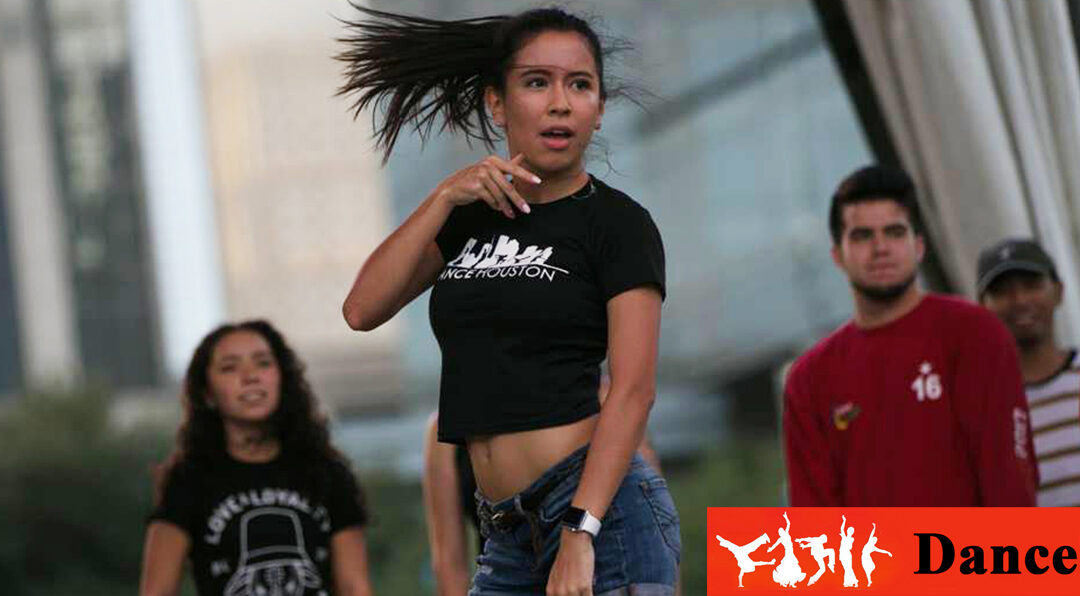
Samantha talks about what contemporary dance is and how she does it. Follow her at https://www.instagram.com/sammy_sossaa and https://www.facebook.com/samantha.taborda.
DanceTalks with Samantha Taborda: Full Transcript
Hosted by Andrea Cody, Director of Dance Houston. Originally released April 21, 2020. This transcript was generated automatically and may contain small errors.
Episode summary (SEO)
On this episode of DanceTalks from Dance Houston, host Andrea Cody talks with Samantha Taborda, a Houston dancer, choreographer and teacher with Dance Houston who loves contemporary dance. Sam traces her path from a daycare ballet program at four and an elementary after-school program called Eagle’s Nest, to the dance company at West Briar Middle School under Lynn Reynolds, where she met her longtime dance partner Shamond Powell, and on to Inertia Dance Company at Westside High School under Sharon Roberts, performing with the Houston Symphony and at a Dallas Mavericks halftime show. She talks about proving that a small girl can break-dance and hip-hop with the boys, returning to dance through Houston Community College’s Houston Central Dance Ensemble and Dance Houston, and meeting her inspirations Les Twins at the 2018 Red Bull BC One Camp in Houston. Sam explains what contemporary dance is, its roots with Isadora Duncan, why she calls it an “all-style,” and how she uses it to spread positivity. She also shares why she and Shamond teach as a male-female duo, how they reach students in after-school programs with cyphers and battles, her motto “Don’t say you can’t; say you will master it,” and how she stays creative and keeps her students and siblings motivated during the COVID-19 quarantine. Recorded April 18, 2020.
Key takeaways
- If you can walk, you can dance. Sam wants every student to feel welcome, never compare themselves to anyone, and know they are the full package.
- Don’t say you can’t. Her motto for students is “You will master this,” because anything, like reading a book, is learned by practicing.
- Contemporary is an “all-style.” It blends ballet, modern and more into naturalistic, expressive movement, and every generation makes it its own.
- Two teachers are better than one. Teaching as a male-female duo gives students both perspectives and an extra set of eyes to catch every detail.
- Life continues. Even in quarantine, Sam keeps creating, posting and offering classes, because one hour of dance can make a difference for someone.
Transcript
This transcript has been lightly edited for readability: filler words and repeats were removed, and several passages that could not be heard clearly in the recording were left out or condensed.
[0:00] Introduction
Andrea: Hello and welcome to DanceTalks. Today is April 18, 2020, and my guest is Samantha Taborda. She is a lover of contemporary dance, and a dancer, choreographer and teacher for Dance Houston. Sam, thank you for being a part of DanceTalks.
Samantha Taborda: Hey, thank you for having me. I’m very excited.
Andrea: Me too. Take us back to the beginning of your journey becoming a dancer. What are your first memories of dancing?
[0:28] Daycare ballet and Eagle’s Nest
Samantha Taborda: We’ll have to go way back. I was actually four years old, now that I think about it. I was in a daycare, and my mom put me in a dance program the daycare offered. I’m not sure if they did it for more than one semester. I know it was for sure in the fall, but I don’t really have a memory of the spring. I did a little ballet, just to stay active, and it was really fun. It was really cute, and we did a performance for our parents. So that was one.
My next chapter was in elementary school, in an after-school program called Eagle’s Nest. They offered a dance program only once, in the fall. It was fun; we learned hip-hop, which I had never learned. That was my first time actually going, “Oh my God, this is fun.” I was nervous, but it was really fun. And then I didn’t dance for a while, because there weren’t any other programs offered.
[1:49] West Briar Middle School and Fusion Dance Company
Samantha Taborda: So I started dancing again in middle school, when I was at West Briar. In sixth grade, I decided, “Well, let me do dance, because I actually like it.” I had fun with it, and there were auditions to be a part of the dance company at our school. I tried out in sixth grade and seventh grade. In seventh grade I didn’t make it to the company, but I made it to an intermediate class, and that’s when I started loving dance more and wanting to do more with it. I saw the members of the dance company doing so well, and seeing how they performed and what their skills were, I thought, “Oh my gosh, I want to do it.” The director was Lynn Reynolds, so I was practicing and everything, and I tried out in eighth grade for Fusion Dance Company. That’s what it was called at the time.
Andrea: So you got the spot on Fusion?
Samantha Taborda: Yeah, Fusion Dance Company. Lynn Reynolds was my director, and we had a male director as well. His name was Slim; that’s what we called him. He was more of a hip-hop guy. Before I started eighth grade, I took a summer dance class to improve my skills, especially in ballet, because I had no skills in that at all. I was very much a beginner, and I did learn ballet, and I’m glad I did, because it’s the basis for anything you learn in modern and contemporary. I had a really fun time, and I met a really great friend; that’s actually when I met Shamond Powell, “Mr. S.” During my year with Fusion Dance Company, we traveled to Corpus Christi to perform, and I started really building a lot more.
Especially because I was very shy, and I didn’t have a strong background in dance. I’ll let you know: how I am now, I was never like this back then, ever. I didn’t know how to perform with facial expressions. All I knew was to smile and dance. And there was a dance I had to do that wasn’t about smiling; I had to stay serious.
[5:07] Seeing Inertia
Samantha Taborda: Then, when we went to perform at Westside High School, that’s when I found out about the Inertia Dance Company. When I saw them perform, I thought, “Oh my gosh, I want to be a part of that.” It was so different, and seeing the types of dances they did motivated me to do so much more. I wanted to keep going, so I did go to Westside High School. I don’t know if you heard that in the background; that’s my cat coughing up a hairball. I’m sorry if you heard a wheezing sound. It’s not me; it’s my cat.
I auditioned for Inertia Dance Company, even though I was still new and didn’t have a lot in me yet to be in that company. I still tried; I wanted to see how far I could take myself. I made it into what was called Dance Three back then, so I wasn’t in the beginner level in high school. There were class levels from beginner all the way up to Inertia: beginner, I believe Dance Two at the time, then Dance Three, the class I made, then Dance Four, which was ahead of us, and then Inertia. So I was happy to be a part of Dance Three. I was still nervous, because I was a freshman and didn’t know what to do, but it was really exciting.
[7:00] “Cry Baby” and making Inertia
Samantha Taborda: My freshman year in Dance Three at Westside was when I learned how to perform. I remember the dance: it was called “Cry Baby,” to CeeLo Green. Sharon Roberts, the director of Inertia Dance Company, saw how well I did it, and I remember she told me, “I can tell that this is your dance.” She could tell right off the bat. And then I decided to go ahead and try out for Inertia Dance Company, because why not? Go for it. Don’t give up. I actually had a sprained ankle at the time.
Andrea: Oh, man.
Samantha Taborda: It didn’t affect it that much, but I was like, “No, I want to do great turns. I want to do well.” The dances we had to learn were modern, and I think one was contemporary, and I said, “I’ve got to get this.” I auditioned, and I made it into Inertia, and that made my day. Inertia changed me as a performer and as a dancer, because I was in the Inertia Dance Company through my sophomore, junior and senior years. All three years I was there, it was nothing but amazing. While I was there, I was able to perform for private events. I also performed with the Houston Symphony, and we performed in a Dallas Mavericks halftime show. We had to compete for that slot, and thank goodness we did, because Inertia got it. I’m smiling too big just thinking about it. Inertia really gave me a lot of great opportunities and experiences I never thought I’d have, especially with the Houston Symphony. Oh my gosh, I never would have thought. And Mr. S and I were in Inertia together as well, so he was also my dance partner there.
[10:00] Both lines
Samantha Taborda: During my senior year in Inertia, I was trying to break a barrier for myself as a female. It’s really hard for females to show that they can do more than what other people think they can do. So I proved that I could do some breakdancing and some hip-hop, because who cares? And I’m short; I’m 5’2″, and I’m small, so people thought, because I’m small and I don’t know much about dance, I can’t go any higher. And I proved people wrong.
I’m sorry, I have to say this; I will always remember it. My senior year, at an Inertia practice the summer before school started, we were in formation, a girl-boy-girl-boy line. I was supposed to be in the girls’ line, obviously, but I was standing in between the girls’ line and the boys’ line. And Ms. Roberts said, “Sam, what line are you going to be in? The girls’ or the boys’?” And I was like, “Both,” because that’s where I was. The members of Inertia started laughing a little, because they thought it was funny. And she said, “You can laugh all you want, but Sam is the only girl who can be in both the girls’ and the guys’ lines.” I was happy with that. I will always remember that.
[12:24] Coming back to dance and Dance Houston
Samantha Taborda: After I graduated from high school, I actually stopped dancing.
Andrea: When did you graduate?
Samantha Taborda: In May of 2014. After that, I didn’t dance again until I was in the Houston Central Dance Ensemble at HCC, in spring 2015. I did that for one semester, partly for the class credit, and I thought, “I want to dance again.” I missed it a little. But then I stopped again. And then Shamond Powell introduced me to you, in spring 2016. Ever since he introduced me to you and Dance Houston, I knew I couldn’t keep dance out of my life. I knew it was a part of me. Dance Houston was really different, because it’s not your regular school company where you come in, practice and perform. It’s actually much more. It made me learn more about what I can really do to represent myself, not just a company I auditioned for. I’d like to thank you for that. Being a part of the Norma Miller show was so fun, and teaching the dance camp for the past two years was really fun. I still remember it when I hear the music. And to this day I’m still teaching, and I really have to thank Dance Houston for it, because if it weren’t for Dance Houston, I don’t think I’d be doing what I’m doing right now: teaching other students what I have learned and gone through, and making sure they don’t feel the way I did.
Andrea: I’m glad it’s been so good for you.
Samantha Taborda: It has been, and I have to thank you, and I have to thank Shamond, because if he hadn’t introduced me to you, I don’t think it would have happened. I thought dancing was awesome, but I didn’t know how to become a part of it. I was very shy back then.
[15:21] Meeting Les Twins
Samantha Taborda: A highlight I had: I met Les Twins in 2018. I have to check my notes here: the weekend of April 27 and 28, 2018, there was a Red Bull BC One Camp here, and they were the ones who actually inspired me to start dancing, because they were twins and they didn’t care what anyone else thought. They just did their own thing, their style, and they were true to that. I never thought I would meet my inspiration in person. And I actually battled, which was so cool. It was the best thing ever. I even cried: “Oh my God, I met them!” And then also meeting Phillip, who was in a crew from America’s Best Dance Crew, in Houston for the H-Town Get Down in 2018. That was cool too. When I saw him compete, I thought, “I hope I meet him,” because he’s really good. His style is very different, and his work is impeccable, in my opinion, especially what he posts. I never thought I would meet him. So meeting him and Les Twins, oh my God, my inspirations. It was just really great.
[17:05] What is contemporary dance?
Andrea: So tell us about contemporary dance. What does it mean? What is it?
Samantha Taborda: I learned about contemporary dance in high school, when I did a contemporary dance that Ms. Roberts created. I didn’t know much about contemporary, because I hadn’t really danced it. But when I did, it felt so different. It wasn’t ballet and it wasn’t modern; it was a mixture of everything. I thought, “What is this?” What it is, is an expressive type of dance that emphasizes more naturalistic movement. In ballet, you have first position, second position, third position. Modern is more flowy. Contemporary is not either-or; it’s actually a mixture of them. When I danced that piece, it was so great and so different. You do a type of movement you’d never learn in either one; you’re basically doing a lot of styles in one. That’s what I love about contemporary: you can express whatever mood you’re feeling. If it’s happy, you show it; if it’s dark, you show it. That one was a very dark dance, and I loved it. It was different from anything I would ever do.
I did some research, and it was founded by Isadora Duncan. I’m not sure if you’ve heard of her?
Andrea: Yeah, yeah.
Samantha Taborda: She was one of the people who founded or created contemporary. From what I know, she knew ballet and modern, and she decided to get away from that and do something different. I didn’t know that. And she’s a female too, so females rule here. When I found out she created it, I have to say thank you to her, because if it weren’t for her, or any of the other creators, I don’t think we in this generation would learn about contemporary. I think we would stick to ballet.
Andrea: Have you seen her work?
Samantha Taborda: You know what? No, I have not. I wish I had. I’ve read about her history, but I haven’t seen her work.
[20:21] An “all-style”
Andrea: From the first contemporary dance you saw, whether that was the piece you learned with Ms. Roberts or another performance, how have you seen contemporary dance change from then to today?
Samantha Taborda: If you look back at Isadora’s time, around the late 1800s to the early 1900s (she was born in 1878, I think), people were more into classical styles. When she created contemporary, she made it more about expression. She did use the movements and skills she had learned at that time, and then whoever saw her work next built on it, and that’s how people started to create their own styles of contemporary. Like for me, I learned contemporary from Ms. Roberts, and from what I learned from her, I made it my own style. Everyone is using their own expression and their own style now, because contemporary can go anywhere. To me, I call it an “all-style,” because it’s a combination, and whatever we’re learning in movement at this time, that’s our contemporary. It’s just 2020 contemporary.
Andrea: Cool. How do you think contemporary dance reflects our identity?
[23:03] Spreading positivity
Samantha Taborda: It goes back to telling our story. If I were to create contemporary in my own version, it would be positive. I like to show things very happily, and I want to spread positivity to other people, especially to my students. What I want to spread around the world is all about fun, and I want to show people that no matter who you are, anyone can do this. Anyone is welcome. And I want the audience to feel that positivity too, because we’re expressing it. I love positivity; that’s just me. When I hear a song that I can feel, I create, and it’s all fun and upbeat, and it just blows up. When I teach it to my students, I want them to feel it as well, and they feel what I’m feeling, all the happiness and fun I created. Then when they perform it, they show it to the audience, and the audience can feel it. That’s why I like to show expression and happiness, to show how much fun this can be, and that dance is a great expression for anyone.
Andrea: You’re really trying to change the world.
Samantha Taborda: Yeah, in a way. In my own way.
Andrea: And do you see that positive feedback loop in your life?
Samantha Taborda: Yeah, I do. The reason I’m going that route is because I was bullied for so many years in school. Kids can be mean, and even after high school, people still bully each other. I don’t want my students, or anyone who wants to learn dance with me, whether it’s a friend or family or anyone, to feel like they can’t do it. That’s how I felt. I felt like I couldn’t dance because I wasn’t up there like everyone else. I want everyone to feel welcome. Don’t think about the negative, and don’t compare yourself to anyone, because at the end of the day you are the full package, and you are able to bring anything. If you can walk, you can dance. I saw that somewhere: “If you can walk, you can dance.” And I took that and said, “You know what? That’s true.” If you can walk, you can dance. If you can move your hip a little bit, you can dance. If you can clap, you can dance. That’s it. I don’t ever want anyone to feel left out, because at the end of the day, to me, positivity will always win, because it’s all love and happiness. And I also like to bring hope to others.
[27:19] “You will master this”
Andrea: How do you do it? How do you get these kids out of their shells, off the walls and up off the floor?
Samantha Taborda: It’s based on my experience. I think about what I would want someone to tell me if I were in their shoes, which I was. I always wished someone could tell me something. So what can I tell them to motivate them? What can I do to get them out of their shells? Because no one got me out of my shell; I had to learn it myself, and I don’t want them to feel that way. I want to be that motivation for them. I don’t want them to feel limited. I want them to feel like they can do anything and not let anything stop them. To be honest, no one gave me advice on how to do it. I learned from experience, the pros and the cons, and I wanted to give that to this next generation, because the next generation will always be the future, and that’s what we need at this point.
Andrea: Awesome. How do you do it, in terms of the words you use, or how you walk into the room? What’s the secret?
Samantha Taborda: The secret is, I always tell all my students, and I started this in 2018: “In my class, or when you are with me, or anything you are doing, don’t say you can’t do it. Just say you will master it.” Because you can. If you can’t read a book, you learn to read a book; it’s all about learning, and you just keep practicing and practicing. So I always tell them: don’t say you can’t; say you will master this. That’s my motto. “You will master this.”
[29:55] How dance has changed
Andrea: Cool. How have you seen dance change during your lifetime?
Samantha Taborda: Dance has changed big time. In my time, it looked like dance was more of a hobby, and I didn’t feel like there were a lot of opportunities other than becoming a background dancer in concerts or music videos. That’s how people saw it: “Oh, dance is just a hobby, just something to do to be active,” and that’s it. I’m not sure exactly when it changed, but I think around 2014 or 2015 we got more dance studios, and people started taking dance classes not only to improve their skills. And then social media came in, and it took a big part in dance, because people started showing off what they can do: “Hey, I learned this choreography; let me show it off. Boom.” And now people are doing dance challenges: “I can do it; let me nominate someone else to do it.” It was a great way to connect with other dancers too, because on social media people use hashtags, like #hiphop, or they tag the person they learned the choreography from. The person who sees it comments, “Oh my God, that’s awesome,” and that’s when people start to become friends and connect, take dance classes together and make videos together. Then other people want to follow them and see more, and people start to build their own careers and become more creative.
[32:07] Teaching as a duo with Shamond
Andrea: You’ve mentioned Shamond Powell, who I will be speaking with on the program. You guys teach together; you’re a duo. What do you think makes that special? Why do you do it?
Samantha Taborda: I like two teachers teaching together, because he and I experienced that in our middle school and high school dance companies, being taught by two individuals, male and female. The benefit was that not only could the girls learn from a female perspective on a dance or choreography, but the guys could too, and we also had a male figure who taught us his style and his version. He taught the boys, but he could also teach the girls, and that was something we both learned and enjoyed, because it expanded our horizons and made our dancing a lot better. When we teach together, one of us teaches while the other watches and sees what the students need to work on, and vice versa. We’re helping each other, and we’re both building our creativity. If we want to do a partner dance or tricks, we can do it together and show our students.
Andrea: Right. And I’ve even seen in your online classes that while one of you is demonstrating, the other is correcting them. If you’re turned around, you can still see, without a mirror. That’s pretty great. It’s like eyes in the back of your head.
Samantha Taborda: Yeah. And it’s good for the students, because I know how I felt with two teachers: “Okay, we have one watching; let me show off and do what I’ve got to do.” While he’s teaching and I’m watching, I’ll call out, “Oh, I see you doing this,” or “I see you doing that,” because whoever is teaching can’t see everybody. He’s trying to present, and the only time he can see them is when they show him how they’re doing. So that’s another benefit.
Andrea: It doubles the energy, and it just gets higher and higher.
Samantha Taborda: It does, and we like to hype them up too, so it’s double the hype, double the teaching, double the attention, all in one.
[35:45] Teaching after-school kids
Andrea: And you guys taught together at Change Happens, the after-school program. What’s the difference with those kids? They’re after-school kids, not dance students. How is it different with that kind of group?
Samantha Taborda: From my perspective, I feel like I was them, because I learned dance in an after-school program. I want them to feel like they can do anything, even if they aren’t as skilled, or even if some know and some don’t. We still give everyone a fair chance and keep teaching them, no matter what, so they can show their skills on a fair level. So we don’t want to change anything, honestly. We still want to teach and make the kids feel like they can show off anything.
Andrea: Was the format of the classes or the performance different? Stretch, warm-up, exercises, freestyle, across the floor: do you adapt it for an after-school program, or do you adapt your style to them? And for the performance, are they still doing a choreographed routine, or is it a little easier? How do you make it so they can all hang?
Samantha Taborda: We do a warm-up and we do stretch, so we still treat it like a dance class, because we want them to get that experience, as if they were at a dance studio. And then we actually do a cypher, where everyone shows their skills and moves. In the beginning they’re shy, and then they keep at it. We actually challenge them: “Okay, hey, show it right there.” We have them battle each other, so we’re bringing them the experiences we’ve had, so they’re not missing out on anything. And they love to perform. They do show off, which actually makes my heart warm and fuzzy inside. When Shamond and I came back to teach at Change Happens, the students who had taken our class the previous semester still remembered the dance moves, and we had them show and tell, because they wanted to show off their skills. So we like to give them everything we can bring to the table.
[39:05] Dancing in quarantine
Andrea: We’re in the middle of this, and we don’t know how long it’s going to last. So give us a snapshot: what is it like to dance right now?
Samantha Taborda: It’s different, because we’re staying in our houses. Obviously I can’t go to a dance studio and dance, but at home I still listen to music and I still dance, because I don’t want to lose what I have learned. I also want to build my creativity and show it off, because what I’m doing is helping me create more dances for the future. And if I post something, maybe people can stop thinking about quarantine for a second or two, and maybe it can motivate them to dance at home instead of just being sad. I know it’s such a tough time, but it’s motivating me as a dancer and as a role model to others. Whatever I post about dance could help someone else stay active, or maybe post a video, or want to learn something from me while we’re quarantined.
Andrea: And what is that doing for you personally?
Samantha Taborda: It’s motivating me, actually. It keeps me from thinking about the negative, because at the end of the day, if I want to help others and do something, I have to do it myself. It’s a tough time, so let’s do this. Let’s not let this quarantine take hold of us. Let’s just go for it. Also, I have three little siblings, and they look up to me and what I’m doing, and that’s a big motivation for me too. They love watching me dance.
Andrea: Keeping everybody positive. You’re still developing, and you’re using this as an opportunity to be creative, to prepare and to inspire. It sounds like in some really important ways, nothing has changed for you.
Samantha Taborda: No, I just miss going outside, or going to the studio. But what I’ve learned is that even though this quarantine has stopped us, life continues. Life will keep going, and I don’t want us to stop what we’re doing, especially my students. I don’t want them to stop dancing. I want them to keep going, keep being creative, keep doing what they’re doing. I really hope things go back, because I don’t think any of us want to stay home. But if it does go on, I would still encourage everyone to go outside. I’m not saying go to a park or a parking lot and all hang out. No, no, no. Go outside your house, and take your laptop or your iPod, your iPhone, whatever access you have to music. If you have a speaker, great. If you have earphones, that’s fine too. Listen, and be inspired.
And I’m teaching during this time as well. If I can help someone, if I can offer a free class, I would do it in a heartbeat. When you’re dancing, you feel like you’re in a different world, and I want them to feel that. I want them to feel like they’re not in quarantine, even if it’s just for an hour, because I know that one hour is going to make a difference for them and motivate them to want to do more. So if I can help for one hour to inspire or motivate them in some way, I would. And I’d also encourage them to grab their camera, or whatever they have access to, and just record themselves doing something. If they need someone to motivate them, that’s not a bad thing; you probably do need someone to help you start. So I say go for it. We all need that motivation from somebody.
Andrea: My guest today is Samantha Taborda. Sam, thank you for being a part of DanceTalks.
Samantha Taborda: Yay, thank you for having me. I enjoyed it.