
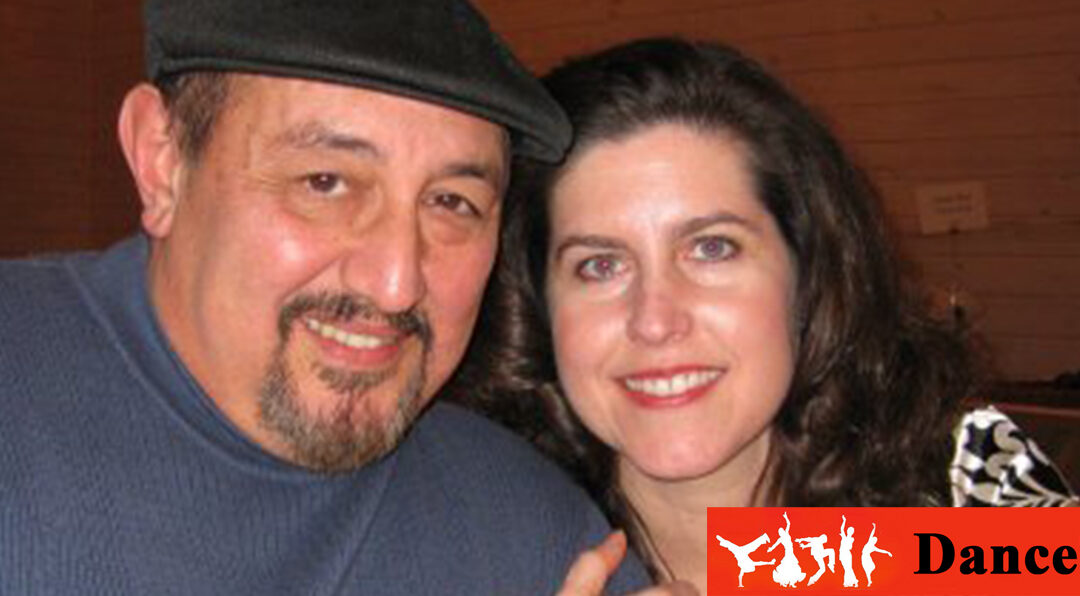
Alex and Victoria Arizpe talk about how Alex, a street dancer with no formal training, became a choreographer and inspirational instructor. They share about their experiences working on a swing ballet commissioned by Ben Stevenson, performing in commercials, and teaching youth at Houston Ballet Academy, St. John’s School, The Shriner’s Hospital for Children, and Gateway Academy for adolescents with social and learning differences. Connect with them at https://www.facebook.com/alex.arizpe1 and https://www.facebook.com/victoria.arizpe.1.
DanceTalks with Alex and Victoria Arizpe: Full Transcript
Hosted by Andrea Cody, Director of Dance Houston. Originally released September 28, 2020. This transcript was generated automatically and may contain small errors.
Episode summary (SEO)
On this episode of DanceTalks from Dance Houston, host Andrea Cody talks with Houston swing dancers, choreographers and teachers Alex and Victoria Arizpe. Alex, a retired Houston firefighter and former St. John’s School middle school theater teacher who teaches social dance at Houston Ballet Academy, grew up with no formal training: winning a twist contest as a boy, top rocking and break dancing in Houston’s neighborhoods, and founding the Love Train Dancers of Houston before joining Delia Stewart’s company in 1983. There he met Victoria, a trained jazz and ballet dancer who now teaches high school dance at St. John’s, and the two built the Uptown Street Dance Company and later the Swingtown Jitterhoppers. They share stories about winning a three-day dance marathon at the Astroarena, Alex’s work in commercials and as a stand-in on the TV movie Challenger, the Houston Swing Dance Society’s first Frankie Manning workshop, choreographing the Houston Oilers dancers for a game in Japan, and The Best Little Whorehouse in Texas at the Country Playhouse. They also describe the 20-plus-minute swing ballet Ben Stevenson commissioned for Texas Ballet Theater in Fort Worth, and Alex’s outreach work at Shriners Hospital for Children and Gateway Academy, where students who wouldn’t touch each other ended up slow dancing at their prom. Recorded September 27, 2020.
Key takeaways
- You don’t need permission to create. Alex had no formal training, yet he walked into a professional company and said, “I’ll choreograph that,” and Victoria calls that fearless, unjudging creativity his genius.
- Formal training gives you a language. Taking class at Delia Stewart’s studio gave Alex the words for steps he was already doing, and his street creativity gave trained dancers like Victoria a new kind of freedom.
- Go to every audition. A dance call that turned out to be a commercial paid Alex residuals for months, a lesson he passes on to his ballet students.
- Music is the way in. Whether with ballet students, children at Shriners Hospital or teens at Gateway Academy, Alex starts with music that makes people want to move, and the connection follows.
- Step up to the front. Alex tells his students, “You can’t become who you need to be by remaining who you are,” and that there are no strangers, only friends you haven’t met yet.
Transcript
This transcript has been lightly edited for readability: filler words and repeats were removed, and several passages that could not be heard clearly in the recording were left out or condensed.
[0:00] Introduction
Andrea: Hello and welcome to DanceTalks. I’m your host, Andrea Cody. Today is September 27, 2020, and my guests are Alex and Victoria Arizpe. Alex is a retired firefighter and middle school theater teacher from St. John’s School, and he is currently an instructor for Houston Ballet Academy. His wife, Victoria Arizpe, is a high school dance teacher for St. John’s School. Alex and Victoria, welcome to DanceTalks.
Alex Arizpe: Thank you.
Victoria Arizpe: Thank you so much.
Andrea: Thank you for being here. I’m so excited to talk with you guys and hear more about your careers and how it all began. I met you guys, I think, around 1996, but your professional competitive career started in 1969. So catch me up and tell me how it all began for you as a little boy.
[0:52] Television, Lawrence Welk and the twist
Alex Arizpe: Well, I’ve always liked dance, but I really didn’t hear a lot of music back then, because I was born in ’53. My dad started with the very first televisions in the ’50s, so we had a television repair shop, and that’s when I first started seeing shows. It started with The Wizard of Oz, and later on The Wizard of Oz came out in color, and I was like, “Oh my God.” I saw them dancing and bouncing around, and I was still real young. So that was the one that got me started, and the second big one was Lawrence Welk, with my grandma. I was like, “Grandma, they’re really great!” I didn’t even know why. They were dancing, and it was all fancy stuff.
Andrea: What did Lawrence Welk do?
Victoria Arizpe: He had a show. It was on Channel 8, on PBS.
Alex Arizpe: Channel 8, yes. It was all real cool stuff, a variety show, and they had a bunch of good dancing. I was into that. And then lots of musicals, and I started seeing the western shows too. They did some country western dancing.
Victoria Arizpe: You won the twist when you were eight years old.
Alex Arizpe: I won the twist when I was eight years old.
Andrea: Was it a big competition?
Alex Arizpe: It was kind of a school competition, but the rest of them were older than I was. My cousin Hank, who is five years older, kind of did a simple twist, and I picked it up quick. All of a sudden they’re doing the twist and all kinds of stuff, and I’m being silly. Back then I was a little chubby kid, like Spanky from the Little Rascals, so that’s what they called me. I just started dancing and going crazy, and my cousins were laughing at me. At the very end they lined up people to dance and said, “We’re going to vote and see who wins this thing.” Long story short, I won the competition, not because I was good, but because I was doing the twist so silly at my age. A crowd pleaser. That was my first competition. After that I started to see more about dancing and listening to songs.
Victoria Arizpe: And you were going clubbing before you were really of age.
Alex Arizpe: Yeah, that was with my cousin Hank.
Victoria Arizpe: So he was really a pure street dancer, with no formal training at all.
[4:15] Clubs, church dances and the X on your hand
Andrea: What kind of places were you going when you first started as a teenager?
Alex Arizpe: There were a lot of dances at churches that had big old halls, and we would just do a lot of fun stuff. I was just learning and dancing with people who were taller than me.
Andrea: What kind of music?
Alex Arizpe: The ’60s and ’70s. Hank would take me more, because he wasn’t a dancer, but he liked to see me dance. I’d dance with anybody, just asking them, and Hank wouldn’t ask anybody, but I did. They thought I was just a cute little chubby guy. So I started doing that a lot more, and after a while I got to go to other places. My cousin said, “You can go to these clubs, but they’re going to put an X on your hand, and you’re not going to drink anything.” I said, “That’s fine.”
Andrea: That was a great era, when you could get the X on your hand and still go in and have a good time.
Alex Arizpe: He looked after me. And I just kept dancing, following these girls who were taller than me. Like I said, I guess I was a cute little boy dancing, because I was asking. It went on and on, and then into breakdancing.
[5:38] Soul Train, top rocking and the Freakazoids
Alex Arizpe: I grew up with Soul Train, and that sold me, really and truly. I started to try to imitate them, doing the breakdancing and this and that. Some people were doing really good hip-hop stuff and teaching us, so that helped me a lot. But I was a biter. You know what they call it in street dancing? I’d take phrases from what they did, change them and do something different for me. That’s what I kept doing for a long time, until I joined the Freakazoids here, and we started doing a lot more with them. That was really my first breakdancing, when I was helping them direct.
Andrea: Who were the Freakazoids?
Alex Arizpe: It was just a bunch of people who got groups together, and I started working with them because I was helping them.
Victoria Arizpe: Break dancers.
Alex Arizpe: Break dancers, pop lockers. But I wasn’t a break dancer, because I wasn’t going to spin on my head. Even though I tell the kids I lost my hair by spinning on concrete, so don’t do that. I’m a comedian.
Victoria Arizpe: You weren’t a break dancer; you were a top rocker.
Alex Arizpe: Yeah, I was a top rocker. Top rockers are the ones who dance standing up and do all the fancy stuff, and that’s where I was really doing my best dancing, because I’m very creative. I’d let the boys who were smaller spin on their heads, and they’d put a little cardboard on the floor.
Andrea: Where did y’all go?
Alex Arizpe: It was in the neighborhood. It wasn’t a studio, nothing like that. We were just constantly doing it in the grass and making up different stuff. I mostly started directing them, because they knew I was a top rocker and they weren’t; that’s more dancing on your feet, footwork. Then we’d do some battles against other crews flying in from New York and Chicago. We met them in old studios that whoever brought them down was renting, and we got to compete against them just for fun. Win some, lose some.
[8:15] The Love Train Dancers and Delia Stewart
Alex Arizpe: Eventually I started putting dance companies together myself, and the very first one was called the Love Train Dancers of Houston.
Victoria Arizpe: “Get all aboard and join hands.”
Alex Arizpe: Yeah, that was my first company. Long story short, I was trying to find more people to dance, and one of the dancers I was dancing with, Donnie, went to the Delia Stewart Jazz Dance Company. He said, “You ought to come over here, man.” This is about 1983, so now I’m moving up into the ’80s. So I saw the Delia Stewart company performing, and later I choreographed for them too.
Victoria Arizpe: I think we were at the Houston Festival, dancing for Delia, and she hired you to come and perform because we needed time for a quick change. His company performed “Thriller” there at the Houston Festival, and then he started coming and taking classes at Delia’s, because up until then it was all learning in the streets and being creative.
Alex Arizpe: And I was like, “Oh my gosh, look at all these dancers doing pirouettes.” I didn’t even know the terminology, because I didn’t speak French. I said, “Oh my gosh, what I could do with this talent, compared to the street dancers I have.” That’s when it started. I never took ballet or anything like that, but at Delia’s we started taking more formal training. I wanted to have a language. I didn’t know what a pirouette or a chassé was. I said, “I don’t speak French; I speak Spanish. Can we do that?”
[10:40] Meeting Victoria
Alex Arizpe: That’s when I met her. I had a dance partner who was supposed to perform a routine with me, and she was unable to perform, so I needed a new partner, and the show was coming up pretty soon. Victoria was really just a teenager. She was sitting at the edge of the stage in the corner, and I said, “I’ve seen you dance back there.” So we stood up, and I did a little jerk to see if she could follow, and she could. That’s how it all started. We ended up doing a big dance, and there’s a video of it.
Victoria Arizpe: It was a jitterbug, to Bette Midler’s “Boogie Woogie Bugle Boy.” Lots of lifts and tosses.
Alex Arizpe: I’d have her here, and I’d flip her, and she’d go around, and I’d catch her. She was only 17 at the time, just a kid. I was flipping her up and down and backwards, and that’s when we connected. I said, “Oh my God, I’ve got to keep dancing with you.” So we went on and on after that, doing all these dances everywhere, and eventually we started building the company more and more. Then we became the Uptown Street Dance Company.
[12:52] “That was his genius”
Victoria Arizpe: Let me say this first. What I think is interesting is that, as a trained dancer, the idea of dancing freestyle, just stream-of-consciousness dancing, was frightening to me growing up. To get out and dance and not have someone tell you what to do, just to be on the spot: that was his genius. Even now that I’ve become more of a choreographer, back then it petrified me. And to see someone with no training walk into a place and say, “Oh, I’ll choreograph that for you,” and to have that drive, that will, that creative inspiration and vision, and not care what anybody else says or thinks about it, but just be his unique individual self and put it out there. That’s what he’s done his whole life.
Alex Arizpe: I’m a natural creator to this day.
Victoria Arizpe: So he walked into Delia’s and said, “I want to create a piece.” It was during the Flashdance era, the early 1980s, and Stacey Northcutt wanted to do something more hip-hop. It was called “Break vs. Jazz,” jazz dancers and street dancers competing against each other. She choreographed the jazz part, and he choreographed the street part. That was his first venture. But to walk into a professional dance company as a street dancer and just go, “Yeah, I’ll do that”: to me, that was wow. He didn’t have a lifetime of somebody correcting him and telling him he didn’t have it, all the things we get when we train in dance, where you become self-conscious and judge yourself. He didn’t have that. He was able to just go in there and be him, and put it all out there the way he sees it and wants it done. And that’s how our collaboration started as well. What was the theater where we danced?
Alex Arizpe: The Tower Theater.
Victoria Arizpe: The building’s still there on Westheimer near Montrose, but it’s not a theater anymore. It’s a Mexican restaurant.
Alex Arizpe: And all the dancers who were working for Delia kind of didn’t care for me, because I wasn’t trained.
Victoria Arizpe: You walked right in and took their spot, kind of. They worked so hard to do triple pirouettes, all this training to get out there and show off, and then he walks out there and does a head roll and the crowd goes crazy. So it’s kind of like, “Wait a minute, you’re stealing my thunder.”
[16:10] The commercial and the residuals
Alex Arizpe: There’s a story I tell about moving your head. We were at the ballet with a younger group, level five, I think, and I told them, “We’re going to move your head this way, and you’ve got to go the other way.” They said, “Why do we have to do that?” I said, “I’ll tell you the story.” I went to an audition, and I didn’t know it was a commercial. They put five of us in there and just played some songs and said, “Dance, and look like you’re excited and happy.” So I started pop locking, boom, boom, I did my head like this, and he says, “You stay.” I didn’t know what the commercial was going to be about. Lewis Houston, one of our dancers, was a good gymnast, and he started doing back handsprings, so they picked him too. Then we filmed it at a gas station. Back then, when you bought gas, they gave you a scratch-off ticket. So I scratch the ticket, look in and go, “Wow.” No words. I just moved my head, over and over again, ten times. Months and months went by, and then all of a sudden I started getting checks. I didn’t know my agent had signed me for royalties.
Andrea: Residuals.
Alex Arizpe: Residuals, yeah. I didn’t know, and I started getting $500, $1,000, $2,000. They just kept coming. So I told the kids at the ballet, “This is why you’ve got to learn it.” They all started moving their heads at the same time. I told them, “Guys, you’ve got to go to every audition, because you never know what’s going to happen.” I did one other commercial, with a very young girl. I was supposed to be someone who can’t read, and she helps me read. That one didn’t pay that much; it was just a simple commercial. All of a sudden I was like, “I can do this even more,” but I really didn’t try for that any more after that.
Andrea: Dancing was always your passion.
[19:33] “Thriller” at the Houston Festival
Alex Arizpe: It was. And then we did “Thriller.” That’s when I first met Delia’s company.
Andrea: You didn’t choreograph the music video, obviously; you were inspired by the video. What was the arrangement? Were you doing a lip-sync sort of thing?
Alex Arizpe: It was my company, and we performed outside at the Houston Festival. It was a lip-sync kind of thing.
Andrea: Did y’all get dressed up?
Alex Arizpe: Oh yeah, makeup and everything. I went and bought the stuff for them to wear, and there’s video of that too. We found one of the boys who looked the part, and that’s when it sold. It was a hit downtown, with cars everywhere. We brought them there, and we danced in that one too.
Andrea: Did you dance in most of them?
Alex Arizpe: I was more of a director at that time. I wanted to make sure they did it all right. It started going from there and went on and on.
[21:16] The firefighter, the stand-in and Rush
Andrea: When did it get serious? Was dancing ever your full-time job?
Alex Arizpe: No, I was still a firefighter during that time.
Victoria Arizpe: In 2003 is when you left the fire department and started doing just dancing.
Alex Arizpe: Yeah, in 2003. But during that time, my agent sent me to another job, and this one had to do with the movie about the Challenger that blew up in space. She hired me because I had the right figure for one of the actors in the movie. And you can rent the movie Rush, a serious movie about something that happened in Texas in 1975.
Andrea: Wait, wait, you just went from the Challenger to Rush. Which one did you want to talk about?
Alex Arizpe: Let’s do the Challenger first. They called me in to be the stand-in and stuntman for an actor. They’d stage me: “You’re going to walk over here when he comes out.” I’d show him where he’s supposed to be and which way he’s supposed to face. The actor was Keone Young, who played the Hawaiian astronaut who died in space. I wasn’t being filmed; I was just his stand-in. When they got in the F-15 planes, I wouldn’t really fly, but I’d go out on the runway. They could film me going in there, and then he comes in, opens his mask and starts talking. The fire department always allowed me to go do those things.
Victoria Arizpe: With the fire department, you had two days on, so 48 hours of work, and then five days off, and it would rotate, so it gave them freedom to do other things.
Alex Arizpe: And if the men were sitting at home, I didn’t mind giving them $500. “Hey guys, work for me this week,” because we can trade time. My partners didn’t mind, so every chance I got, I’d give them some money and they’d work for me for a week. So we got to do that show, and I got to meet everybody and work at NASA. That was a lot of fun.
Victoria Arizpe: Let’s tell her more about your dancing.
Alex Arizpe: Okay, sure. It’s DanceTalks.
[24:17] “Remember the Alamo?”
Alex Arizpe: At the fire department, they made up names for me, like Dancing Bear or something.
Andrea: They had nicknames for you.
Alex Arizpe: Oh God, the fire department likes to put everybody down. My favorite one, when people ask me about the fire department: a new guy came in, kind of cocky, and he saw me in there. The first thing he said was, “Hey, are you Hispanic?” I said, “Yes, sir.” “Really? Where are you from?” “Houston.” “Are you really Hispanic?” “Yes, sir.” He says, “Well, if you are, do you remember the Alamo?” I said, “Yes, sir. We won.” He said, “Shut up.” After that he never bothered me again. And I was always dancing at the station, every time they played a certain song, entertaining everybody. I couldn’t help it. I had to get up.
[25:29] Amsterdam
Alex Arizpe: So we were doing a lot more dancing with Delia Stewart’s company, and then a friend who came from Amsterdam invited us to go perform in Amsterdam, the whole company. Victoria came late, and I was already there. Our company was really good guys, good dancers, and we got up there. She and I started dancing, with a lot of people watching, and I was flipping her and doing all these stunts, and they gave us a standing ovation. And the first thing all the dancers said, Mark, our best friend, said, “We’ve been training for years, and you guys can pick up Victoria and throw her,” and they all went crazy.
Andrea: Awesome flips, though, really. Where did you pick them up, or did y’all make them up?
Alex Arizpe: I saw certain things and then started changing them my way. There was one where I’m flipping her from between the legs, throwing her up and flipping her this way.
Victoria Arizpe: And some of it we learned from going to the Lindy festivals here.
[27:04] The dance marathon at the Astroarena
Alex Arizpe: And I was winning all these contests back in the ’60s and ’70s. I think three years in a row in country western, and three years in the disco era.
Andrea: What were those contests like?
Victoria Arizpe: You should tell about the marathon.
Alex Arizpe: There was a dance marathon at the Astroarena. You only had about 10 minutes every hour to go to the bathroom and maybe eat something, and then you had to get back on the floor. This is three days, watching the glass windows turn dark and light again, and you’d just kind of sleep on your partner. We didn’t even want to sleep; we just kept dancing.
Victoria Arizpe: He says everybody just moved for three days until everyone else was eliminated. And I didn’t dance with him in that one, thank God, because I wouldn’t have wanted to do that.
Alex Arizpe: I had another friend I danced with for a while, Kim. There were two Toyota trucks parked in the middle, and we were dancing around them the whole time. If you win, you get the trucks. Some people wore their cowboy boots, because it was the western era, and they had to cut the boots off them, because their feet swelled from being in them so long. I wore just some tennis shoes. You’d go eat for maybe 10 minutes and then hurry up and get back out there and dance again. When we got down to nine couples left, they said, “Now you have to dress up in your costumes and dance. Now it’s a performance.”
At some point I started seeing things. I asked Kim, “Is there a fire truck here in the middle?” She said, “No.” “Are you sure?” They were taking people out because they thought they were doing drugs to stay up. Well, at the fire department we had these little ammonia capsules that you pop, like smelling salts, and you wake up. It wasn’t a drug, and it woke me up every time. The fire truck disappeared, so I figured I was fine.
So now we’re dancing in competition in costume, with the two trucks up there, and it’s the last day, and I’m like, “Oh my God, this is too much.” I told Kim, “They’re going to play a slow song now.” That was kind of easy, because she was thinner and lighter, and she was pretty tough to hang in there. We finally finished, and we won.
Andrea: My goodness.
Alex Arizpe: Two Toyota trucks, and she kept one and I kept one. And $12,000 cash, so we got to share that.
Andrea: Wow. Not bad for three days’ work.
Alex Arizpe: I had just bought a Bronco at the time, so I gave the truck to my sister, because I helped raise all her kids, the four of them.
Victoria Arizpe: His mother really raised them, but he was a big part of their life.
Alex Arizpe: My mom was going blind, and then she did. That’s why I got my first car at age 12, and my license at 13, a hardship license. So I started driving everywhere, and my grandpa let me drive his truck when we went to his ranch hunting. And then that’s when I started working at AstroWorld.
Andrea: Oh, cool.
Alex Arizpe: Yes, for nine years.
[31:55] AstroWorld and the lifts that took a toll
Alex Arizpe: They had a big contest at AstroWorld, a huge one, to see who was going to win the big prize, and it was just about $100. But at that time AstroWorld had a lot of performances.
Andrea: I think they did right up until the end.
Alex Arizpe: They had stages. I would go watch all of those and get inspired. I didn’t have a partner, so I just saw a girl dancing and said, “I don’t know your name, but would you be my partner?” She said sure, so we started dancing, and we won the whole thing. They sent a picture of me winning, and that got me started even more. It was just happening without me even trying. And it went crazy when Victoria and I finally started dancing. I was flipping her and all this kind of stuff, and eventually I did get hurt. I overdid it too many times, and my back froze.
Victoria Arizpe: He was doing a lift where he picks me up over his head with one arm, and I would run into it. And finally he said, “Okay, we don’t need quite so big a preparation. Just take a step right here, and I’ll take you up.” After he lifted me about 10 times, it was like, “Oh, my back froze.” I had to load him into the back of my station wagon.
Alex Arizpe: And I called my other friend to come pick me up in his truck. I couldn’t even sit. I was holding myself up so my feet weren’t touching the ground, as long as I could.
Victoria Arizpe: And in general wear and tear, he’s had…
Alex Arizpe: This is a titanium shoulder, and that one was from the fire department. I was trying to break my record of 350 pounds on the bench press, and I had a fireman who was supposed to spot me. “If you see me get stuck right here, just help lift it up. Once I get past that point, I can finish it.” Instead, when I got stuck, he lifted it up and then let it go, and my arm just went pop, pop. It took about a year or more before I could get it fixed, and now it’s all titanium. And this one had three screws in it from throwing one of the dancer girls. She was supposed to go into me and flip over, and instead she took my arm with her, and I blew a rotator cuff. I finally got that one fixed. I can’t ever throw again, but I can still dance.
Victoria Arizpe: No more lifts.
Alex Arizpe: After I got hurt, I said, “Well, no more of that.” But I could still partner dance.
[35:16] Frankie Manning comes to Houston
Alex Arizpe: I had videos of all the dancers back during the swing era.
Victoria Arizpe: The second swing era.
Alex Arizpe: Yes. Do you remember the very first time Frankie Manning came to Houston? It was at some big place, a lodge, I think, over in the Heights.
Victoria Arizpe: Rowena set it all up.
Alex Arizpe: And they were kind of mad at us, because we were just doing what we knew, jitterbug. Somebody came and started filming and taking pictures of us. Everybody else was still learning, but we just kept going and doing what we knew, so they filmed us instead.
Andrea: Y’all were coming out of nowhere. I think that was in March, and things had been going on with the formation of the Houston Swing Dance Society for about a year prior to that. Was that ’95?
Victoria Arizpe: Well, they officially formed in ’97, with that event.
Andrea: But they were coming together, coming out of SSQQ, figuring out what they were and where they were going to go. That Frankie workshop was so big, and I want to say that night, at one of the evening dances, at a pavilion on Gessner, they had a circle and you guys just got out there, and it was like a Hollywood movie. You were flipping all over the place.
Victoria Arizpe: I vaguely remember that.
Andrea: And I remember there was a lot of discussion after that about doing aerials on the dance floor.
Alex Arizpe: We weren’t in the cats’ corner that much.
Andrea: It was like, “What do we do with these people?”
Alex Arizpe: I call it the lion corner. That’s when we were throwing people behind us.
Victoria Arizpe: Sometimes we would have arguments: “I don’t want to flip right now!”
Alex Arizpe: I was leading!
[37:59] The call from Ben Stevenson
Alex Arizpe: The best story that we have is when one day I get a call from Fort Worth. Ben Stevenson had moved to Fort Worth, to Texas Ballet Theater.
Andrea: For our listeners who don’t know, Ben Stevenson was the artistic director of Houston Ballet who really brought it into world-class recognition.
Alex Arizpe: So I get a call from his right-hand man, Tim, and he says, “Ben Stevenson wants to talk to y’all, both of you.” I said, “Victoria, why does he want to talk to us? Who’s Ben Stevenson?”
Victoria Arizpe: See, this is the dichotomy of the two worlds. I have formal training in ballet and jazz, and he’s complete street. It just wasn’t familiar to him.
Alex Arizpe: So he said Ben wanted us to come and put a show together.
Victoria Arizpe: He wanted us to set a swing ballet on the professional company, Texas Ballet Theater, about 20 minutes long.
Alex Arizpe: 25. It was eight different numbers we had to choreograph for the whole company. He had seen us perform with Houston Met and seen our choreography there, so he’d been looking at us for a long time. We went to his office, and Victoria says, “What are we going to ask him? What does he want us to do?” I was like, “I don’t know who he is.” So he sits over there, and we’re sitting over here, and I said, “Victoria, I think he’s just going to want us to do what we want to do.”
Victoria Arizpe: He said, “No, you’ve got to ask him.” Of course, in my mind I’m thinking, “Does he want more with these ballet dancers? More technical? More swing, more ballet? What do you want us to choreograph for you?” So we asked him, and he goes, “I don’t know. You guys do it.”
Alex Arizpe: That’s what I heard. I was like, “I guess we can do whatever we can do.” He just wanted swing. It was a lot of fun. And he told us the reason he hired us: he said, “I’ve seen y’all in Houston many times, performing this and that, and I want this to open the show in Fort Worth for the first time.” That was 2003, I think.
Victoria Arizpe: 2003. They flew us in, and we started choreographing and put it together. I taught all those dancers how to Lindy hop, which is so different from the regular partnering they do in many ways. They do waltz and a lot of the social styles as well, but the lifts and tricks in swing, as you know, can feel blind, with the acrobatics of it.
Alex Arizpe: So he gave us the whole company. He’s got people who are in charge over him and people who pay, so he introduced us to all those men, and they were pretty cocky. One guy kept bugging him: “Why would you give the whole company to these people we don’t know much about?” I was standing next to him. Finally, Ben answered him, and that was his way of telling him, “Shut up, I’m in charge here.”
Andrea: I love this.
Alex Arizpe: He was asking Ben, “Who are these people? We don’t know them.” This was the guy with the money. I guess Ben didn’t feel he had to explain himself. “What are his credentials? He’s a firefighter.”
Andrea: It certainly speaks to your character.
[43:18] Opening night in Fort Worth
Victoria Arizpe: Can I tell about my emotional moment? It’s kind of a sad one, but it was great.
Andrea: In Fort Worth?
Victoria Arizpe: Yes. They have a Playbill, with notes from the artistic director written in the front. We had been shopping at the mall before the opening night, and when we got there I opened the program and was reading Ben’s words.
Alex Arizpe: I came back and looked at her, and she was teary. I said, “What’s going on?”
Victoria Arizpe: As soon as I read it, I was like, “Oh my gosh.” It said that Ben had always wanted to work with us, since he had seen some of our work back at the Met way back when. That touched me, because I don’t think of myself in that way. It was just an emotional moment for me when I read it.
Alex Arizpe: He said it had been his dream to work with us.
Andrea: And you made it come true. That’s awesome.
Alex Arizpe: We did it for him. He brought us back a second time too. He was going to send us to China to perform it, because he did a lot of work with China, but the SARS thing happened that same year and we couldn’t go. So he called us back a second time, because he had new dancers coming in, and we taught it a second time.
[45:25] Miller, the Met and Southwest Jazz Ballet
Alex Arizpe: We were also trying to perform on stage in the park, at Miller Outdoor Theatre. They hired dance companies to perform, but they wouldn’t let my company on stage. When they found out Ben Stevenson had hired us, different companies started asking me, “How did y’all get hired by Ben Stevenson?”
Andrea: So your company never performed at Miller Outdoor Theatre?
Victoria Arizpe: No, we did, with the Met. And we danced at Miller several times, because we did educational outreach there, our company by itself; that was their program. And then with Delia Stewart’s company, and also with Southwest Jazz Ballet, way back when. We danced with her and did shows with her, and traveled around to California and Corpus Christi doing performances with her, which was great. And Galveston too.
[46:53] The Urban Cowboy call he missed
Andrea: Tell us a story about Urban Cowboy.
Alex Arizpe: Urban Cowboy, the movie. Well, I didn’t get to do it, because my girlfriend at the time was very jealous, because she wasn’t a dancer. People were calling from the place where the movie was happening, Gilley’s. I was using the nickname Spanky then, because I was younger. She said, “They were trying to look for you here, calling you.” I said, “Well, why didn’t you let me know?” She goes, “That has nothing to do with me anymore. Go find them; they’re still there.” So I ran over there as quick as I could, and they had already packed up and left. She got what she wanted. And I was engaged two other times, but both of them left me, because they weren’t dancers and I had dancers.
Victoria Arizpe: Well, you were busy and driven with your business.
[48:51] The Houston Oilers dancers in Japan
Alex Arizpe: True. Because we were the last choreographers for the Houston Oilers before they took the team to Tennessee. They called us in. They didn’t have cheerleaders then; the Derrick Dolls had all been fired for fraternizing with the players, and all the wives said, “Get out of here.” So they called us in. This was 1992. They said, “We’re bringing in some new dancers, and they’re called the Houston Oilers Dancers; they’re not the Derrick Dolls anymore. We need y’all to choreograph.” And we said, “Well, we’re not cheerleaders, so we’re going to do dance,” which we did. Then they sent us to Japan. Victoria couldn’t go at the time, so I took the dancers and we flew over there, and we played the Dallas Cowboys.
But the sad part was that when we got there, some of our dancers weren’t allowed to go eat in the restaurant with everybody else, only the white ones. They came out and told me, “Alex, no one will let us in there.” I said, “Are you serious?” It had to do with Rodney King. That had just happened, when he was beaten by the cops, and they were afraid. So I would walk in with the other dancers so they could eat, but they wouldn’t let them into the hotel restaurant where we were staying. I didn’t speak the language, but the guy we had with us did.
Then we were getting back on the plane, and here comes a band from a university next to the University of Houston.
Andrea: TSU?
Alex Arizpe: TSU, yeah. We were all saying hi, and as soon as we got home, here’s the news: they were all in trouble, because they had taken stuff from the stores in Japan, put it in their pockets and walked out, and got caught at the airport. So that was a shock for me. I was like, “Oh my God, I can’t believe that.”
[52:29] Where the ideas come from
Andrea: How did you approach a project like that, or the Texas Ballet Theater swing ballet? When you’re given license to create a show, where do you begin? Is it just a vision?
Victoria Arizpe: He’s always had the big, large vision.
Alex Arizpe: Music. It really takes me where I need to go and what to do with it. I don’t say I’m a great dancer or anything. I can lead and do all this stuff, but I get these ideas to put things together.
Andrea: How many Houston Oilers dancers did you have? Was it all girls?
Victoria Arizpe: They were all girls. It was a big group, with varying styles of dance, and they were all really talented. It was a lot of fun, and very different from the other kinds of choreography we did.
Alex Arizpe: And then they told us we had to perform a big number at halftime, so we did “Thriller.” We did 1940s swing and some different styles, and we bought the costumes, because they couldn’t afford to order something in time. Then they got mad at us and said, “We’re not going to do this anymore.” Normally all these people go buy beer during halftime, and when you guys start dancing, they stop buying. I guess we were too entertaining. I had a three-year contract with them, but I had to give it up and say, “I can’t do this.” So we just did the one season, and that was it.
Victoria Arizpe: Well, we got married that year too.
[55:06] Uptown, the Swingtown Jitterhoppers and Houston Ballet
Alex Arizpe: True. And then we started putting the other companies together. The Love Train Dancers was the first, before I knew Victoria. Then we did Uptown.
Victoria Arizpe: The Uptown Street Dance Company, and then the Swingtown Jitterhoppers.
Alex Arizpe: Jitterhoppers, that’s the mix, jitterbug and swing hoppers all together. You get it?
Andrea: Yes, I get it. I love it.
Alex Arizpe: And it went on and on. I wish we could come back and start swinging again, both of us, really. I’m just so glad I could dance all that time, especially when the ballet gave us a new thing to do that they call “social.” That means we teach partner dances at the ballet, not to the company, but to all the kids, so they can learn to lead and follow.
Andrea: Do you teach at Houston Ballet Academy year-round or just for their summer program?
Victoria Arizpe: He was for a long time, up until coronavirus.
Andrea: You’re furloughed now, but normally they have social throughout the year?
Victoria Arizpe: They did, up until a year before, and we taught every summer. He was teaching social to the level fours, and for many years we’ve taught social dance for the summer intensive. Sometimes we do swing, sometimes western, sometimes Bollywood, different styles, just teaching them how to lead and follow, and waltz, all of that.
Alex Arizpe: “Hadippa” is a real popular one. They’ve asked us to do it three or four times.
Andrea: The Bollywood piece?
Alex Arizpe: The Bollywood one. And the western ones as well.
[57:04] The Best Little Whorehouse in Texas
Alex Arizpe: We’ve done some stuff with the one you can’t pronounce, about the…
Victoria Arizpe: Are you talking about The Best Little Whorehouse in Texas? There’s nothing wrong with saying that. It’s a real show.
Alex Arizpe: We choreographed that too. It was for the anniversary of the Country Playhouse. They were going to close it down.
Andrea: I remember that.
Alex Arizpe: We did the show for them, and we didn’t know until they told us that so many people came to see it that it helped them save the place, so they wouldn’t close up. And now it’s the Queensbury Theatre.
Andrea: That’s so nice. Good job.
Alex Arizpe: It was great, because I was in my western element, and it was just fun.
Victoria Arizpe: I don’t know if our daughter was in middle school then, but I have this memory of her sitting in the house while we were teaching the dancers the poses, and she had on a hoodie and scrunched it up and covered her head, like, “My parents…”
Alex Arizpe: Those are the fun things about dancing. We don’t think about it that way; we’re just teaching choreography. But she’s like, “Mom and Dad!”
[58:57] The Lion King at St. John’s
Alex Arizpe: So anyway, that’s exactly how I started dancing and trying everything out. Then I heard swing dance was coming up, while I was still doing my dancing from the ’60s and ’70s. It just went on and on. I didn’t want to stop, and something new would come up.
Victoria Arizpe: All the different eras you got to dance in.
Alex Arizpe: From the ’50s and ’60s and ’70s on. And those televisions helped me a lot, because I even choreographed some of the shows I saw. I did The Lion King, and all the other ones.
Andrea: You mean at St. John’s?
Alex Arizpe: St. John’s, where they let me do some of these. The Lion King was the biggest one, and thank God it turned out to be okay. It actually turned out to be good, because it was so packed that they could have closed us down. The place holds 650 people, and there were over 900. They brought in a fire marshal for capacity, and I just happened to see him. He was a fireman I knew, and I asked him, “Are you going to close us down?” He said, “No, I can’t kick all these people out.” So I was lucky.
Andrea: That’s hilarious.
Victoria Arizpe: And our headmaster at the time was Mark Desjardins.
Alex Arizpe: He lost his seats. Then he came into the black box and stuck his head in the door, and I went, “Oh, shoot.” I walked right outside, and he said, “Wow, did you see how many people were in there? I lost my seats, and I don’t care. It was just great.” His family came late, and people were sitting on laps, anywhere they could. He was real happy, and he said it turned out flawlessly. I thought I was going to get fired.
[62:07] Still dreaming
Andrea: When you think about wanting to do a show again, what do you still dream about? You said you wanted to get back into swing. It doesn’t seem like you’ve ever stopped, but it sounds like you’re itching to do something else.
Alex Arizpe: I’ve mentioned this for a long time: I almost wish I could open up a place and start teaching dance again, in my own studio. I know it’s kind of hard to do with everything going on, but it’s just a wish.
Victoria Arizpe: He just loves working with kids, and it’s magic watching what he does with them. Especially at the ballet; that was my favorite, because the kids there are so structured in what they do, and when Alex works with them, it’s like they have permission to just dance from their hearts and have a blast. They feel it. When you’re doing ballet a lot, it’s so structured and rigid that it’s not in their heart as much, and I think he helps them connect to that joy.
Alex Arizpe: Because I grew up with songs of all styles. I’d do The Lion King, and they’d pretend to be the animals, because I’m trying to mix in acting. And they love doing Hairspray; that’s another one. These are the songs that I want to hear too, that make me want to dance, and they follow.
Victoria Arizpe: Dancing in a different way, just a little more free and expressive.
[64:09] Passing it on to their children
Andrea: How have you passed on your dancing, your own style, to your own children?
Victoria Arizpe: Well, Alyssa and Austin both took from us.
Alex Arizpe: They kind of know how to partner dance and lead, and they’re both pretty good at it, especially Austin, because he’s around music more than she is. He’s in Atlanta, Georgia; he’s a stuntman, so he’s doing it all. And my daughter’s in Chicago, and she’s also doing a play.
Victoria Arizpe: She’s an actor.
Alex Arizpe: They didn’t follow us into dancing as much as she and I did. I wish I’d had more time when they were growing up, but they were involved in school.
Victoria Arizpe: I think it’s that love of the creative process. That’s what they’ve gained most: enjoying being creative and finding their own unique voice and what they have to say.
[65:29] Shriners Hospital and Gateway Academy
Alex Arizpe: This is my last story, and it always gets to my heart. I was doing the outreach program for a long time for the ballet, and TUTS was also sending me to Shriners Hospital, when it was here. It’s not here anymore; they moved. So I started working with those kids with disabilities. I did that for a few years, and the ballet has me signed up if things open up again. I’m just part time now. Then someone called me about another one, Gateway Academy. I don’t know if you’ve heard of that place.
Andrea: No.
Alex Arizpe: They had kids with Asperger’s and autism. They said, “We don’t know if you’ll be able to do this, but we really need someone to help. All these kids are high schoolers, ready to graduate, and we don’t know how to get them to dance.”
Victoria Arizpe: They were going to have a prom.
Alex Arizpe: And they won’t touch each other. That’s one of the things with those kids; they don’t touch. I said, “Well, how can I teach them this?” I went there for quite a few weeks to work with them, and luckily there were five or ten teachers there just in case. They all had different things going on. Slowly they started kind of grabbing hands. There was a boy who didn’t want to dance. He sat in the bleachers behind us, and he would tap my shoulder and ask, “Do you know anything about the Allman Brothers?” I said, “No, I don’t know much about them.” He said, “I didn’t think you would,” and walked away. I felt stupid.
So I worked with them for weeks and weeks, and I saw them slowly getting better, but I wasn’t really sure. Then, after a while, they called me back and said, “You’ve got to come back and see this.” So I drove over there, and they were having their prom. I walked in, and they were all slow dancing, cheek to cheek. The teacher said, “Really, they’re slow dancing, cheek to cheek.” I started crying. I said, “What did I do?” And she said, “You gave them permission.” I loved working with them.
Victoria Arizpe: And the Shriners kids were amazing too. He’d go there and make up dances for a little musical. They put on a very short musical within about an hour, so they’d each have lines and a song they had to learn how to sing, and they’d dance. He was great at coming up with different ways for them to move with their disabilities, so they could all be involved and be part of it. The main thing was the music. They could really connect with the music, and they always wanted to hear things from the ’60s, ’70s and ’80s. The parents were there too, and he’d get them involved, and the kids loved watching their parents dancing and having fun, seeing a side of their parents they hadn’t seen before. I think it brought a lot of joy to a lot of people.
Alex Arizpe: I would go back there again. I really would.
Victoria Arizpe: Shriners is in Galveston now, but Gateway Academy is still over here.
[72:12] “There are no strangers, just friends you haven’t met”
Andrea: Let’s close with this. If we’re feeling a little insecure or hung up on our technique and what we’re supposed to do, can you send us off with some advice on how to tap into that freedom and joy that you bring?
Alex Arizpe: One thing I tell the kids is that you can’t become who you need to be by remaining who you are. I say, “If you want to be in front, go get in front and stand there, because this is your future. You can do this. You can’t just stay in the back. Walk up to the front; there’s space.” And sometimes when they’re arguing, or new kids are coming in and they’re cocky, I tell them, “Guys, there are no strangers, just friends you haven’t met.” So whenever you feel it, step up. Just get out there. Do a pirouette.
Andrea: My guests today are Alex Arizpe and Victoria Arizpe. Guys, thank you for being a part of DanceTalks.
Alex Arizpe: Thank you.
Victoria Arizpe: Thank you.
Andrea: Thanks for listening. Please subscribe and share our podcast, and reach out to us on social media if you’d like to talk. To support DanceTalks, donate to Dance Houston. Talk to you on Monday.